EasyManua.ls Logo

Cray CRAY-1 - Page 180

Default Icon
216 pages
Print Icon
To Next Page IconTo Next Page
To Previous Page IconTo Previous Page
Loading...
I
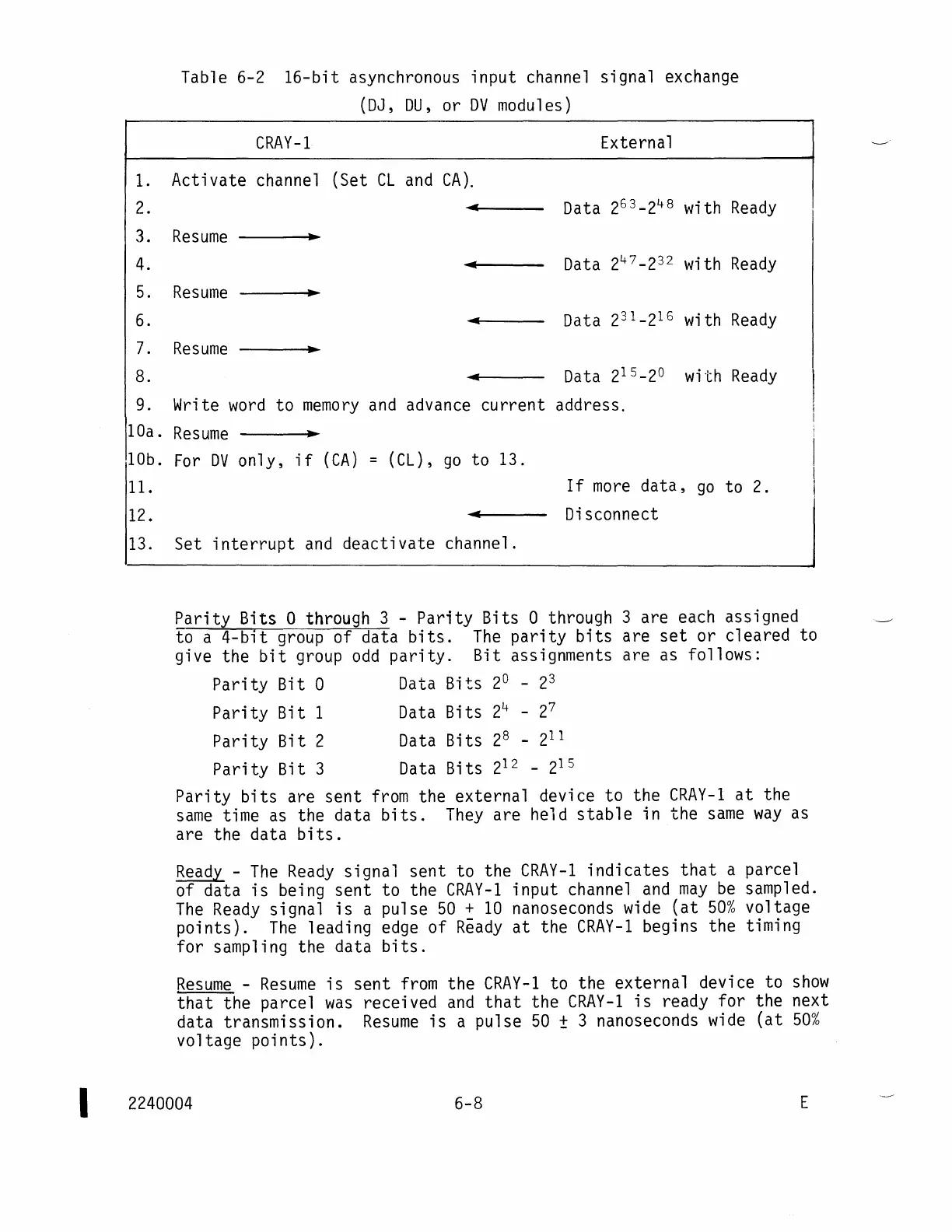
Table 6-2
16-bit
asynchronous input channel signal exchange
(OJ,
DU,
or
DV
modules)
CRAY-l
External
1.
Activate channel (Set
CL
and
CA).
2.
Data
2
63
_2
48
with
Ready
3.
Resume
4.
Data
2
47
_2
32
with
Ready
5.
Resume
6.
Data
2
31
_2
16
with
Ready
7.
Resume
8. with
Ready
9.
Write
word
to
memory
and
advance current address.
lOa.
Resume
lOb.
For
DV
only,
if
(CA)
= (CL),
go
to 13.
11.
If
more
data,
go
to 2.
Disconnect
12.
13.
Set
interrupt
and
deactivate channel.
Parity
Bits a through 3 -
Parity
Bits 0 through 3 are each assigned
to a
4-bit
group of data
bits.
The
parity
bits
are
set
or cleared to
give the
bit
group
odd
parity.
Bit assignments are as follows:
Parity
Bit 0
Data
Bits
20
- 2
3
Parity
Bit
1
Parity
Bit
2
Parity
Bit 3
Data
Bits
24
-
27
Data
Bits 2
8
-
211
Data
Bits
212
- 2
15
Parity
bits
are
sent
from
the external device to the
CRAY-l
at
the
same
time
as
the data
bits.
They
are held
stable
in the
same
way
as
are the data
bits.
Ready
-
The
Ready
signal sent to the
CRAY-l
indicates
that
a parcel
of data
is
being
sent
to the
CRAY-l
input channel
and
may
be
sampled.
The
Ready
signal
is
a pulse
50
+
10
nanoseconds
wide
(at
50%
voltage
points).
The
leading
edge
of
Ready
at
the
CRAY-l
begins the timing
for sampling the data
bits.
Resume
-
Resume
is
sent
from
the
CRAY-l
to the external device to
show
that
the parcel
was
received
and
that
the
CRAY-l
is
ready for the next
data transmission.
Resume
is
a pulse
50
± 3 nanoseconds
wide
(at
50%
voltage
points).
2240004
6-8
E

Table of Contents