Driver assistance systems
Blind spot detector (BSD)
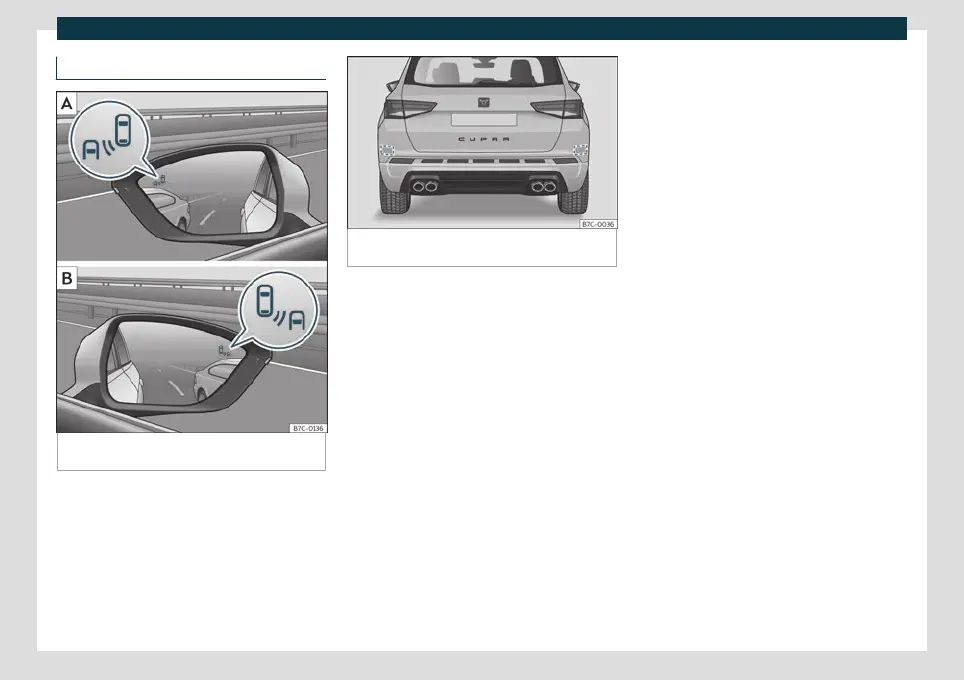
Fig. 225
In the exterior mirrors: blind spot detec-
tor indication.
Fig. 226 Rear view of the vehicle: radar sensor
zones.
The blind spot detector uses radar sensors to
monit
or the ar
eas behind the vehicle
›››
Fig. 226. The system does this by measur-
ing the vehicle's distance from other vehicles
and its speed differential. The blind spot de-
tector will not work at speeds of less than ap-
prox. 15 km/h (9 mph). The system uses op-
tical signals in the external rear view mirrors
to notify the driver.
Indication on the exterior mirror
The control lamp (expanded view) provides
an indication in the corresponding external
mirror
›››
Fig. 225 regarding the traffic situa-
tion behind the vehicle, if it is deemed to be
critical. The control lamp of the left-hand
external mirror indicates the traffic situation
to the left of the vehicle, and the control
lamp of the right-hand external mirror indi-
cates the traffic situation to the right of the
vehicle.
In the case of retrofitted tinted windows or
windows with tinted film, the indications of
the external mirrors may not be seen clearly
or correctly.
Keep the external mirrors clean and free of
snow and ice, and do not cover them with
adhesives or other similar materials.
Radar sensors
The radar sensors are located on the left and
right of the bumper and are not visible from
the outside
›››
Fig. 226. The sensors monitor
both the blind spot and traffic behind the ve-
hicle
›››
Fig. 227,
›››
Fig. 228. The range to
the sides of the vehicle is a bit larger than the
width of a lane.
The lane width is not detected individually,
but is rather pre-configured in the system.
Thus if you are driving in wide lanes or in be-
tween two lanes, the indications may be in-
correct. Furthermore, the system can detect
vehicles driving in the lane next to you (if
there are any), and can also detect stationary
objects such as dividers, and thus give an in-
correct indication.
271



 To Next Page