Self-help
Check after 10 minutes of driving
Screw the inflator tube
››
›
Fig. 29
5
again
and check the pressur
e on the gauge
6
.
1.3 bar (19 psi / 130 kP
a) and lower:
●
Stop the vehicle! The tyre cannot be
sealed sufficiently with the tyre mobility set.
●
You should obtain professional assistance
›››
.
1.4 bar (20 psi / 140 kP
a) and higher:
●
Set the tyre pressure to the correct value
again.
●
Car
efully resume your journey until you
reach the nearest specialised workshop
without exceeding 80 km/h (50 mph).
●
Have the damaged tyre replaced.
WARNING
Driving with an unsealed tyre is dangerous
and can cause accidents and serious injury.
●
Do not continue driving if the tyre pres-
sure is 1.3 bar (19 psi / 130 kPa) and lower.
●
Seek specialist assistance.
Changing a wheel
What to do first
●
Park the vehicle on a horizontal surface
and in a safe place as f
ar away from traffic as
possible.
●
Apply the electronic parking brake.
●
Switch on the hazard warning lights.
●
Move the selector lever to the P position.
●
If you are towing a trailer, unhitch it from
your v
ehicle.
●
Have the vehicle tool kit
›››
page 38 and
the spare wheel* ready
›››
page 338.
●
Observe the applicable legislation for each
country (reflective vest, warning triangles,
etc.).
●
All occupants should leave the vehicle and
wait in a safe place (for instance behind the
roadside crash barrier).
WARNING
●
Always observe the above steps and pro-
tect yourself and other road users.
●
If you change the wheel on a slope, block
the wheel on the opposite side of the car
with a stone or similar to prevent the vehi-
cle from moving.
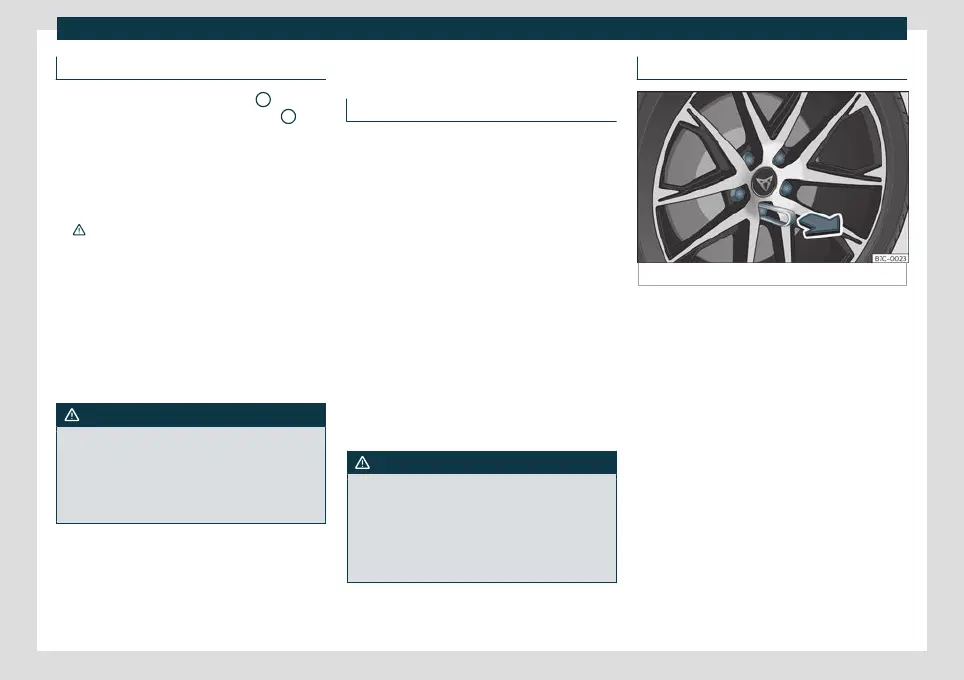
Wheel bolt caps
Fig. 30
Wheel: wheel nuts with caps.
Removal
●
Fit the plastic clip (vehicle tools
›
›
›
Fig. 28)
over the cap until it clicks into place
›››
Fig. 30.
●
Remove the cap with the plastic clip.
The caps protect the wheel nuts and should
be remounted after changing the tyre.
The anti-theft wheel locking bolt has a
special cap. This only fits on anti-theft lock-
ing bolts and is not for use with standard
wheel nuts.
41



 To Next Page