ENGLISH
76
this is practically a straight tip screwdriver of the correct size for manoeuvring the caps of the main connections of the system (1” and
1”1/4). To be used at the first installation to remove the caps from the mouths on which you want to connect the system; for the filling
operation in the case of horizontal installation; to access the non-return valve, … If the key is lost or damaged, the same operations can
be performed using a straight tip screwdriver of a suitable size.
Use of end “D”: (Fig. 16)
hexagonal socket head suitable for removing the cap to perform filling in the case of vertical installation. If the key is lost or damaged,
the same.
Use of end “E”: (Fig. 16)
this is practically a straight tip screwdriver of the correct size for manoeuvring the motor shaft access cap and, if the interface for quick
connection of the system has been installed (par. 14.3), for access to the key for disengaging the connection. If the key is lost or
damaged, the same operations can be performed using a straight tip screwdriver of a suitable size.
Use of end “F”: (Fig. 16)
the function of this tool is dedicated to maintenance of the non-return valve and it is better described in the respective paragraph 20.
18. EXPANSION VESSEL
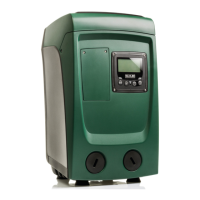
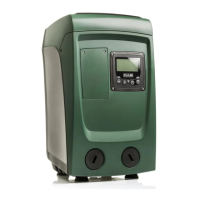
The system is complete with an integrated expansion vessel with a total capacity of 2 litres.
The main functions of the expansion vessel are:
• to make the system elastic so as to protect it against water hammer;
• to ensure a water reserve which, in the case of small leaks, maintains the pressure in the system for a longer time and spreads
out needless
• restarts of the system which otherwise would be continuous; when the utility is turned on, ensure the water pressure for the
seconds that the system takes to switch on and reach the correct rotation speed.
It is not a function of the integrated expansion vessel to ensure a water reserve such as to reduce interventions of the system (requests
from the utility, not from a leak in the system). It is possible to add an expansion vessel with the capacity you prefer to the system,
connecting it to a point on the delivery system (not a suction point). In the case of horizontal installation it is possible to connect to the
unused delivery outlet. When choosing the tank, consider that the quantity of water released will also depend on the parameters SP and
RP that can be set on the system (par. 13.2). The expansion vessel is preloaded with pressurised air through the valve accessible from
the technical compartmen (Fig. 3).
The preload value with which the expansion vessel is supplied by the manufacturer is in agreement with the parameters SP and RP set
as default, and anyway it satisfies the following equation:
P_AIR = SP – RP – 0.7 Bar
Where::
• P
_AIR
: air pressure value in bar;
• SP = Set Point (Par. 3.0) in bar
• RP = Reduction of pressure to restart (Par. 0.3) in bar
So, by the manufacturer:
P_AIR = P_AIR = 3.0 - 0.3 - 0.7 = 2.7 Bar
If different values are set for the parameters SP and/or RP, regulate the valve of the expansion vessel releasing or letting in air until the
above equation is satisfied again (e.g.: SP=2.0bar; RP=0.3bar; release air from the expansion vessel until a pressure of 1.0 bar is
reached on the valve).
Failure to respect the above equation may lead to malfunctions of the system or to premature breakage of the diaphragm inside the
expansion vessel. Considering the expansion vessel capacity of only 2 litres, any operation to check the air pressure must be performed
by connecting the pressure gauge very rapidly: on small volumes the loss of even a limited quantity of air can cause an appreciable
drop in pressure.
The quality of the expansion vessel ensures the maintenance of the set air pressure value, proceed to check it only at calibration or if
you are sure of a malfunction. Any operation to check and/or reset the air pressure must be performed with the delivery system not
under pressure: disconnect the pump from the power supply and open the utility nearest to the pump, keeping it open until it no longer
gives any water. The special structure of the expansion vessel ensures its quantity and duration over time, especially of the diaphragm
which is typically the component subject to wear for items of this type. However, in the case of breakage, the entire expansion vessel
must be replaced and exclusively by authorised personnel.
18.1. Expansion vessel maintenance



 To Next Page