EASYSENSE Q3+ and Q5+ DO185 (2)
•
Outdoor 100 k lx (100,000 lx)
This larger range is suitable for recording light level outdoors in sunlight, which
makes it ideal for environmental monitoring.
• In/Fast 1,000 lx
This range has a fast linear response and can therefore monitor rapid variations in
light intensity that cannot be observed with the eye e.g. fluctuations in the light
intensity of a bulb due to voltage fluctuations. This variation can be a source of
interference to the sensor in general use. Fast logging times are required for data to be
collected in these type of investigations so this range is not available to Q3+ users.
5) Temperature Sensor
This sensor has four ranges to choose from. The selected range will also be
applied to the plug-in temperature sensors supplied in the Q3+ or Q5+ pack.
• Celsius, 0 to 110ºC
• Celsius, -30 to 110ºC
• Fahrenheit, 0 to 232˚F
• Fahrenheit, -22 to 230˚F
Notes:
• For convenience the built-in temperature sensor is displayed on the same scale as the plug-in
temperature sensors. In fact EASYSENSE Q can only be used in an environment of 0 to 40°C, 0 to
95%RH (non-condensing).
• The speed of reaction of the built-in temperature sensor to any change in external temperature will be
delayed by EASYSENSE Q’s plastic case.
6) Barometric Pressure Sensor (Q5+ only)
This sensor has three ranges to choose between for weather and
pressure investigations.
• Range 1: 85 to 110 kPa
• Range 2: 850 to 1100 mbar
• Range 3: 25 to 33 inHg
7) Humidity Sensor (Q5+ only)
This sensor has one range, 0 to 100% Relative Humidity for weather and
environmental investigations.
Plug-in sensors
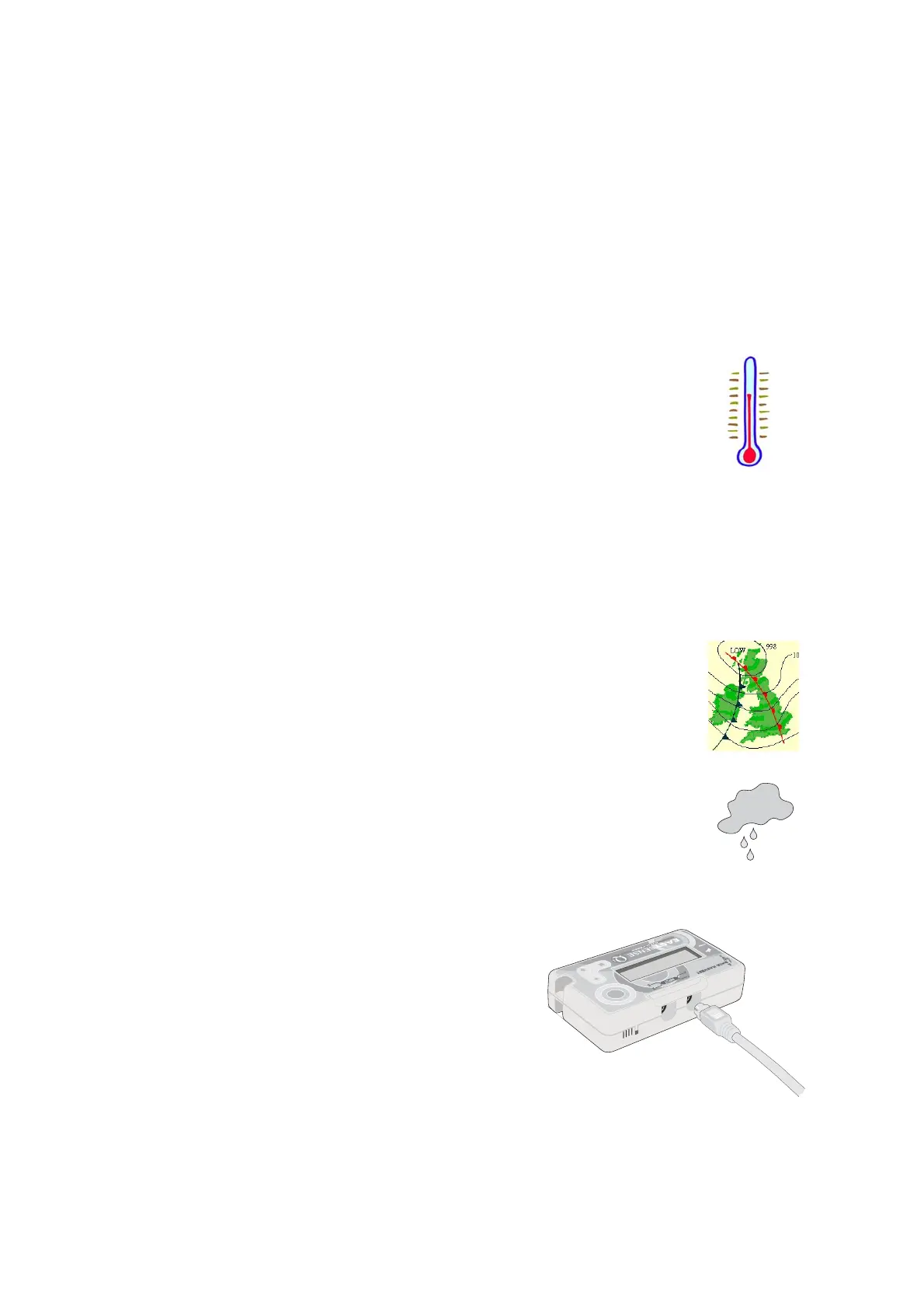
Connect plug-in sensors to the two inputs on
EASYSENSE Q labelled as 1:A and 2:B.
When a sensor is connected it will automatically
be detected and displayed on the LCD display i.e.
in Meters as number 1) and/or 2) (depending on
which input the sensor is connected to).
To maintain consistency with existing software, sensor inputs 1 and 2 are
dual labelled as A and B. This labelling is utilised during Timing
investigation when digital sensors (e.g. Light gates) are connected to either
Input A (1:A) or Input A and B (1:A and 2:B).
© Data Harvest Group Ltd.
6


 To Next Page