Need help?
Do you have a question about the Days Strider MD 4 and is the answer not in the manual?
Explains symbols used in the manual for clarity and hazard highlighting.
Details the purpose and classification of the scooter for indoor and outdoor use.
Provides essential guidelines for safe operation, including risks and precautions.
Outlines critical safety rules and hazards to avoid during scooter operation.
Covers safety precautions for handling the scooter during transport and maintenance tasks.
Details safety measures and hazards associated with battery use and charging.
Warns about electromagnetic interference and its effects on scooter and external electronic devices.
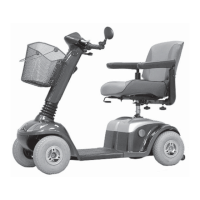
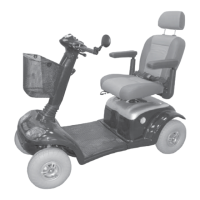
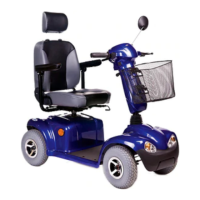
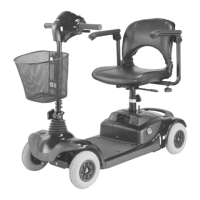
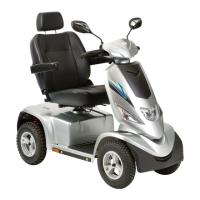
Provides a visual overview and labeling of the Strider scooter's external parts.
Details the functions and layout of the dashboard, including controls and indicators.
Provides step-by-step instructions for safely getting on and starting to drive the Strider.
Explains the process of dismantling the Strider for transport in stages.
Details the procedure for adjusting the seat to the desired height for user comfort.
Explains how to adjust the seat's distance and armrest width for a standard seat configuration.
Guides on adjusting seat distance, armrest width, and height for a captain's seat.
Details how to adjust the backrest to different positions for comfort and safety.
Explains how to adjust the height of the headrest for optimal support.
Describes how to adjust the tiller's angle for easy access to controls and displays.
Explains how to safely navigate inclines and slopes, including climb angle limits.
Details how to safely maneuver the Strider over obstacles like kerbstones.
Provides specific instructions and tips for safely climbing kerbs.
Explains the overload protection feature and how it affects motor operation.
Describes how to read the battery charge display and its relation to driving range.
Discusses factors affecting the Strider's driving range and how to maximize it.
Explains the system that protects batteries from over-discharging and its implications.
Details the correct and safe procedure for mounting and dismounting the Strider.
Explains how to adjust and fasten the seat belt for secure usage.
Describes how to turn the seat to different positions for optimal user positioning.
Outlines the steps to power on the Strider using the keyswitch.
Guides on how to adjust the scooter's maximum driving speed using the speed controller.
Lists essential checks to perform before starting a journey to ensure safety and functionality.
Explains the correct method for operating the drive lever for forward and reverse motion.
Details the operation of the Strider's braking system, including motor brake.
Explains the use of the additional handbrake for specific versions of the Strider.
Describes how to use the toggle switch for operating turn indicators.
Explains how to operate the pressure switch for the headlights.
Details how to use the horn button for signaling.
Provides instructions on how to safely switch off and park the Strider.
Explains how to activate and use the hazard warning lights.
Details important charging parameters like temperature, charger use, and charging time.
Lists the conditions under which the batteries should be charged.
Guides on connecting the battery charger to the mains power.
Outlines the sequential steps for connecting and charging the scooter batteries.
Explains the meaning of the LED indicators on the battery charger during the charging process.
Details the procedure for safely disconnecting the battery charger after charging is complete.
Explains how the battery charger regulates voltage and current for charging.
Provides information on the type of batteries used and their characteristics.
Explains the automatic shut-off feature that protects the batteries from discharge.
Describes the lighting system components for the 4-wheel version.
Details the function of anti-tipping wheels and their importance for stability.
Specifies the size and type of wheels and tyres fitted to the Strider.
Identifies the main components of the Strider's drive unit.
Explains the working principle of the drive system, including motor, gearbox, and axle.
Describes the programmable electronic control unit and its function in regulating drive characteristics.
Details the operation of the Strider's braking mechanisms, including motor and handbrake.
States that a driver's license is not required for operating the Strider.
Recommends third-party insurance for scooter users and advises on obtaining it.
Clarifies the classification of the Strider for road traffic use and permissible areas of operation.
Offers general advice on transporting the Strider, including dismantling for smaller vehicles.
Explains how to safely load and secure the Strider when transporting it fully assembled.
Details the steps involved in dismantling the Strider into components for easier transport.
Provides a summary of the steps required to dismantle the Strider for transport.
Illustrates and describes the process of removing the seat unit from the Strider.
Guides on how to remove the rear panelling from the Strider.
Explains how to safely disconnect and remove the Strider's batteries.
Describes how to fold the tiller down for transport or storage.
Details how to separate the drive unit from the main chassis.
Explains how to unlock the drive unit before separating it from the chassis.
Describes how to tilt the drive unit away from the chassis after unlocking.
Details the final step of separating the chassis from the drive unit.
Provides step-by-step instructions for reassembling the Strider after transport.
Summarizes the key steps involved in reassembling the Strider.
Guides on how to reconnect the drive unit to the chassis securely.
Explains how to lock the drive unit in place after reassembly.
Details how to reconnect the motor's electrical plug.
Describes how to fold the tiller back into its upright position.
Guides on placing batteries back and securing them with straps.
Explains how to reconnect the battery cable plugs.
Details how to reattach the rear panelling after reassembly.
Guides on how to correctly fit the seat back onto the Strider.
Lists essential checks to perform daily before operating the Strider.
Details weekly checks, focusing on tyre pressure and potential hazards.
Presents a timetable for annual inspections, covering various scooter components.
Provides preliminary steps to take before attempting to diagnose or fix a problem.
Lists common faults, their causes, and recommended remedies for the Strider.
Explains the meaning of blink codes displayed by the operation indicator for fault diagnosis.
Covers crucial safety precautions to follow when performing repair work on the scooter.
Lists the specific tools required for carrying out the described repairs.
Details mechanical adjustments and procedures for maintaining the Strider.
Explains how to adjust the clamping bolt for the drive lock mechanism.
Guides on removing and refitting the wheels for the 3-wheel version of the Strider.
Guides on removing and refitting the wheels for the 4-wheel version of the Strider.
Details the process of replacing the inner tube and tyre on the Strider's wheels.
Explains how to replace bulbs in the headlight for the 3-wheel Strider.
Details the procedure for replacing the headlight bulb.
Guides on replacing bulbs in the front indicator lights.
Refers to another section for replacing rear light and indicator bulbs.
Explains how to replace bulbs in headlights and rear lights for the 4-wheel Strider.
Details the procedure for replacing headlight and rear light bulbs.
Guides on replacing bulbs in front and rear indicator lights.
Explains the fuse system and their locations within the Strider.
Identifies the types and locations of fuses used in the Strider.
Specifies the fuse used in the battery charger unit.
Provides information on the types of batteries suitable for replacement and their specifications.
Details the safe and proper disposal procedures for used or damaged batteries.
Guides on correctly reconnecting battery cables, emphasizing safety precautions.
Describes the location and information found on the scooter's nameplate.
Lists detailed technical specifications for the Strider scooter, including dimensions and performance.
Provides general technical data and performance characteristics of the Strider.
Provides detailed dimensional drawings and measurements for the 3-wheel Strider.
Provides detailed dimensional drawings and measurements for the 4-wheel Strider.
Lists the specified torques for various screws and bolts used in the Strider.
Outlines the environmentally responsible procedures for disposing of the Strider and its components.


 To Next Page
 General