The DEGER MLD Control is an energy converter 6 with a central control box, designed for solar tracking systems to maximize energy yield. It utilizes MLD (Maximum Light Detection) technology, which allows for precise and power-saving operation by continuously adjusting the position of solar modules to face the sun directly. This dual-axis mechanism ensures that the modules are always in the optimal position to capture the maximum amount of sunlight throughout the year, accounting for both direct and diffuse irradiation.
Function Description
The MLD Control system integrates several components to achieve optimal solar tracking:
- Energy Converter 6 (EC-6): This is the core control unit for the solar tracker motors. It manages the movement of the modules along the elevation (EL) and azimuth (AZ) axes. The EC-6 can operate one motor for EL and AZ, or two motors (one for EL and one for AZ), depending on the system configuration. It features reverse polarity protection and a SAFE POS (broken wire detection) function to ensure safe operation and prevent damage in case of wiring issues. The EC-6 also includes jumpers for configuring reverse direction, reverse polarity, and SAFE POS functions, allowing for customization based on the installation hemisphere (southern or northern) and specific requirements. LED indicators on the EC-6 provide visual feedback on motor activity and status.
- Central Control Box (CCB): The CCB serves as the central interface for controlling up to 100 DEGER systems. It includes a joystick for manual control of the inclined and table positions, allowing for maintenance work (e.g., mowing grass) or manual snow removal. The system can switch back to automatic mode once the joystick is returned to the neutral position. The CCB also integrates inputs for the wind monitor and snow sensor.
- Wind Monitor: This component measures wind speed and triggers an alarm if the speed exceeds a predefined threshold (e.g., 10 m/s for 10 minutes or 12 m/s for 3 minutes). When the wind alarm is activated, the solar modules are moved to a safe position to prevent damage. The wind monitor includes a 4.3-inch wind speed display, showing current wind speed, alarm status, time interval, and historical data. It also features a power switch and relay output.
- Snow Sensor (Optional): The snow sensor detects snow and ice accumulation on the solar modules. When a certain amount of snow or ice accumulates, a signal is sent to the CCB, which then moves the solar modules into the greatest possible inclined position to facilitate snow to slide off.
The system's overall connection diagram illustrates how these components interact. The EC-6 receives power from the CCB and controls the EL and AZ motors. MLD sensors for EL and AZ provide feedback to the EC-6 for precise positioning. The wind monitor and snow sensor are connected to the CCB, which in turn communicates with the EC-6. Additional EC-6 units can be connected for larger installations.
Important Technical Specifications
EC-6:
- Input voltage: AC 100 to 240 V
- Line frequency: 50 to 60 Hz
- Max. nominal current (at AC 100 V): 2 A
- Output voltage (EL/AZ motor): DC 24 V
- Max. nominal output current: 2.5 A
- Peak output current (for max. 200 ms): 14 A
- IP protection class: IP 54, CAT 2, UL50 type 3R
- Dimensions: 245 mm x 162 mm x 66 mm
- Total weight including 2 MLD sensors: Approx. 2 kg
CCB:
- Input voltage: AC 100 to 240 V
- Line frequency: 50 to 60 Hz
- Nominal current: 1 A
- Output voltage: DC 21 V
- Output current: DC 1.4 A
- IP protection class: IP 54, CAT 2, UL50 type 3R
- Dimensions: 250 mm x 180 mm x 160 mm
- Total weight including wind monitor: Approx. 4 kg
Wind Monitor:
- Input voltage L-N: AC 100 to 240 V
- Line frequency: 50 to 60 Hz
- Nominal current: 1.1 A
- IP protection class: NEMA 4X, IP 54
- Dimensions: 250 mm x 180 mm x 110 mm
- Weight: Approx. 3,000 g
Climatic conditions:
- According to DIN EN 50178:1998-04
- Installation AMSL (above mean sea level): Max. 2,000 m
- Permissible ambient temperature: -20 °C to +50 °C
- Barometric pressure range: 70 kPa to 106 kPa
- Air humidity range: 5% to 95%
- Expanded air humidity range (for wind monitor Advanced): 0% to 100%
Usage Features
- Optimal Energy Yield: The MLD technology ensures that solar modules are always precisely aligned with the sun, maximizing energy capture throughout the day and year.
- Dual-Axis Tracking: The system supports both elevation and azimuth movement, allowing for comprehensive sun tracking.
- Scalability: A single CCB can control up to 100 DEGER systems, making it suitable for both small and large-scale solar installations.
- Safety Features:
- Wind Alarm: Automatically moves modules to a safe position during high winds.
- Broken Wire Detection (SAFE POS): Prevents damage in case of wiring faults.
- Emergency Stop: The external voltage supply must be able to be disconnected by a 10 A-B or 6 A-C circuit breaker.
- Mechanical Limits: The system includes limit switches to prevent over-rotation and ensure safe operation.
- Manual Control: A joystick on the CCB allows for manual positioning of modules for maintenance or snow removal.
- Configuration Flexibility: Jumpers on the EC-6 allow for customization of motor direction, polarity, and safety functions to adapt to different installation requirements and hemispheres.
- Data Logging: The wind monitor displays historical wind speed data, aiding in system monitoring and analysis.
- Snow Removal Assistance: The optional snow sensor and automatic module positioning help to clear snow and ice, maintaining optimal performance in winter conditions.
Maintenance Features
- Easy Cleaning: The manual specifies using soft towels and non-corrosive/aggressive liquids for cleaning.
- Troubleshooting Guide: A detailed troubleshooting diagram helps identify and resolve common issues, such as motor malfunctions, sensor errors, and wiring problems.
- Component Exchange: The guide provides instructions for exchanging components like the MLD sensor, EC-6, and energy converter if necessary.
- Clearance Check: Regular checks are required to ensure that the elevation and azimuth drives can move freely without obstruction and that all cables are long enough. This includes verifying that limit switches switch off the motors and that the full rotation and pivoting spectrum are achieved.
- Disassembly: Instructions are provided for safely disconnecting the DEGER system from the power supply and disassembling components.
- Disposal: Parts can be recycled after disassembly, and only trained personnel should dispose of them according to national and regional regulations.
- No Specific Maintenance Required: The manual states that no specific maintenance or repair work is required for the CCB or EC-6 beyond general cleaning and checks.

 Need help?
 General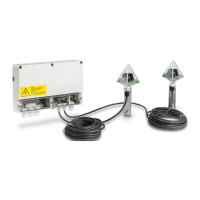

 To Next Page
