LT-2320
4
GENERAL INFORMATION
recommended for use with this device. Other humidier systems
may prevent the device from detecting respiratory events and
may cause inappropriate pressure levels in the mask.
• The height of the device must be lower than the mask when
using a humidier to prevent water from getting into the mask
• Never rinse or place the device in water. Never allow liquids to
get into or around any of the ports, switches or air lter. Doing so
will result in product damage. If this occurs, do not use the
device. Disconnect the power cord and contact your equipment
provider for service.
• Condensation may damage the device. If this device has been
exposed to either very hot or very cold temperatures, allow it to
adjust to room temperature (operating temperature) before
starting therapy. Do not operate the device outside of the
operating temperature range shown in the Specications.
• Do not place the device directly onto carpet, fabric or other
ammable materials.
• Tobacco smoke may cause tar build-up within the device, which
may result in the device malfunctioning.
• Dirty inlet lters may cause high operating temperatures that may
affect device performance. Regularly examine the inlet lters as
needed for integrity and cleanliness.
• Never install a wet lter into the device. You must ensure
sufcient drying time for the cleaned lter.
• Only use a DeVilbiss DC Power Cord and Battery Adapter Cable.
Use of any other system may cause damage to the device.
• Oxygen is a prescribed gas and should only be administered
under the supervision of a physician.
• The ow setting of the oxygen source must be specied by a
physician.
• Maximum oxygen pressure is 50 psi.
• Maximum oxygen ow rate is 10 lpm.
• Always turn on CPAP before turning on oxygen ow.
• Always turn off oxygen ow before turning off CPAP.
• Proper lter function is important for the operation of the device
and to protect the device from damage.
B. INITIAL INSPECTION AND SET UP
DeVilbiss recommends equipment inspection upon delivery:
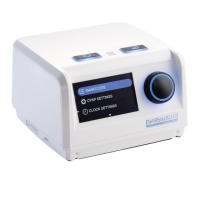
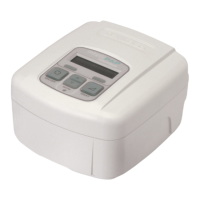
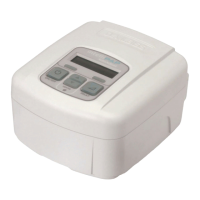
• Apply power to the IntelliPAP 2 / DeVilbiss BLUE DV6X CPAP
device.
• Test pressure accuracy using an outlet cap (mask/leak simulator),
a calibrated CPAP pressure gauge and the procedures listed
under Pressure Accuracy Test in this manual.
• Set therapy pressures as prescribed and comfort features per
patient preference using Setting Pressures and Features Section
or the Provider Quick Setup Guide DV64D-125-XX.
C. TRAVEL
Air Travel
The IntelliPAP 2 and DeVilbiss BLUE DV6X CPAP devices are
approved for use on commercial aircraft when using battery power as
mentioned below.
NOTE: Use in Commercial Aircraft Approval requires that Bluetooth
®
must be deactivated in the aircraft. Refer to Instruction Guide for
Bluetooth details. Also see DC Power below.
International Travel
DV6x CPAP devices automatically accept AC voltages of 100-240V, 50
and 60 Hz. The device will need a power cord appropriate for the
region/country. NOTE: Using a power cord or adapter (AC or DC) that
is not intended for the DV6x CPAP may result in the CPAP showing
error code E0D.
Altitude
DV6x CPAP devices automatically compensate for altitudes between
700 hPa and 1060hPa (~ 1,400 ft below sea level to 9,800 ft). At
higher altitudes, breathing patterns change which may cause the loss
of some benets of CPAP therapy.
D. BATTERY AND DC POWER
DV6x CPAP devices automatically accept 12V DC power. Always use
DeVilbiss power cords and adapters. NOTE: Using a power cord or
adapter (AC or DC) that is not designed for the DV6 CPAP may result
in the CPAP showing error code E0D.
Custom Battery (Optional)
DV6x CPAP devices have an optional 98 wHr external battery
(DV6EB) that is designed as a backup power source when AC power
is not available, when traveling by air or any time portability is needed.
Pressure and DV6EB Battery Limitation Chart
Pressure
Setting
CPAP only
Hours
CPAP &
Heated
Humidier @ 1
CPAP & Heated
Humidier @ 3
CPAP & Heated
Humidier @ 5
5 23.33 7.46 7.01 4.54
10 14.41 6.13 5.76 3.92
15 10.32 5.30 4.26 3.27
20 7.21 4.56 3.51 2.95
One battery needed
for 8 hour night
Two batteries needed for
8 hour night
Three batteries needed
for 8 hour night
12 Volt DC Power
DV6x CPAP devices with heated humidication will operate using 12V
DC power from a motor vehicle equipped with DC (cigarette lighter
type) plug-in connector. The device must be connected to the plug-in
using the optional DeVilbiss vehicle DC connector (DV6X-619). NOTE:
If the vehicle’s battery is used, for multiple nights, without powering the
vehicle’s motor during use, the vehicle should be powered during the
day to replenish the battery.
DV6x CPAP devices with heated humidication will operate using a
12V deep-cycle marine battery using the optional DC battery clamp-on
adapter (DV51D-696) with the optional DC power cord (DV6X-619).
NOTE: See DC Power Chart below for the correct battery amperage
needed.



 To Next Page