LT-2320
9
TESTING
TESTING
The following test procedures verify correct operation of the DV6x
CPAP and should be performed on all devices prior to returning to
patient.
A. PRESSURE AND FLOW ACCURACY TEST
No routine calibration or service is required provided the device is
used in accordance with the manufacturer’s directions. NOTE: Some
countries require periodic servicing and calibration for this type of
medical device. Contact your equipment provider for further
information.
Additional equipment required: outlet cap (DV51D-620), a calibrated
pressure gauge (0-30 cmH
2
O, accuracy ±0.25 cmH
2
O) with tubing,
ow control valve and a mass ow meter.
1. Apply AC power to the unit with blower stopped.
2. Enter Clinical menu, select CPAP Settings and ensure the
following settings are selected
a. Mode to CPAP
b. Pressure to 12 cmH
2
O
c. SmartFlex to OFF
3. Go to Mask Fit Check screen.
4. Attach calibrated pressure gauge to the device using the outlet
cap.
NOTE: Occlude (block) hole on side of outlet cap to ensure proper
pressure reading. Any leak in test set-up will affect pressure accuracy.
5. Start the blower and wait 30 seconds for pressure to stabilize.
6. Verify that the displayed pressure matches the pressure measured
on the gauge (±0.5 cmH
2
O). Accuracy at other pressure settings
can be checked if needed.
7. If the Pressure is out of calibration, remove tubing and stop the
blower for approximately 1 minute to auto-calibrate. Allow no
breathing on the unit while auto-calibration is taking place. Start
the blower and allow 30 seconds for the pressure and ow to
stabilize.
NOTE: If the pressure is still out of calibration, perform a full
calibration using the Manual Calibration Procedure. If manual
calibration does not improve pressure or ow accuracy, there may be a
problem with the ow path or control board. Refer to Troubleshooting.
8. Connect the mass ow meter and ow control valve to the unit
outlet port and close the valve.
9. In the Mask Fit Check screen, adjust the ow control valve to
achieve 60 L/m on the ow meter. Wait at least 30 seconds for
the ow to stabilize.
10. Verify that the leak ow on the Mask Fit Check screen matches
the 60 L/m on the ow meter (set value ±10 L/m). Accuracy at
other ow settings can be checked if needed.
11. Correct all settings to the original, preferred or prescribed
settings.
12. If the ow is out of calibration, remove tubing and stop the blower
for approximately 1 minute to auto-calibrate. Allow no breathing
on the unit while auto-calibration is taking place. Start the blower
and allow 30 seconds for the pressure and ow to stabilize.
NOTE: If the ow is still out of calibration, perform a full calibration
using the Manual Calibration Procedure. If manual calibration does not
improve pressure or ow accuracy, there may be a problem with the
ow path or control board. Refer to Troubleshooting.
B. TRIGGERING and SMARTFLEX PRESSURE
TEST
Additional equipment required: ow control valve, USB to Micro B USB
CPAP to PC cable (DV63D-615) and a PC computer running DeVilbiss
SmartLink
®
software v 3.0 or higher.
1. Connect the ow control valve to the unit outlet port and close the
valve.
2. Apply AC power to the unit and connect the unit to the remote
control application via the CPAP to PC cable.
3. Use the remote control application to ensure the following device
settings are selected:
• Operating mode is CPAP
• CPAP Pressure is 12 cmH
2
O
• SmartFlex is 3
• SmartFlex Mode is Full-Time.
Start the blower and wait at least 30 seconds for the pressure to
stabilize.
4. Display the Status screen on the remote control to observe the
Triggering eld.
5. Open the ow valve slightly to allow a small amount of air to
escape. Allow the valve to remain open for several seconds and
then quickly close the valve. Continue cycling the valve opening
slightly then closing quickly and verify that the Status screen
triggering value changes from’ inhale’ to ‘exhale’. It may take
several cycles before the unit starts triggering.
6. If the unit did not trigger correctly during this test, stop the blower
for approximately 1 minute to allow auto-calibration to occur. Start
the blower and allow 30 seconds for the pressure to stabilize.
Repeat above steps to check unit triggering.
NOTE: If the unit still does not trigger correctly, perform a full
calibration using the Manual Calibration Procedure. If manual-
calibration does not improve triggering, there may be a problem with
the ow path, control board or blower. Refer to Troubleshooting.
7. Observe the SmartFlex pressure increase and decrease during
‘inhalation’ and ‘exhalation’. The pressure should change between
12 to 9 cmH
2
O.
8. Correct all settings to the original, preferred or prescribed
settings.
NOTE: If there is an issue with triggering ‘inhalation’ or ‘exhalation’ or
with the SmartFlex pressure change, replace PC board.
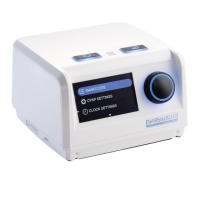
C. KEYPAD, ROTARY KNOB and DISPLAY
TEST
Requires DV6HH humidier to be attached to DV6x CPAP. No
additional equipment required.
1. Apply AC power to the unit and start the blower.
2. Enter Clinical menu. Rotate the knob to nd the CPAP Settings
menu; then press the knob to select.
3. Continue to the Ramp setting, press the knob and go to the Time
setting. Set a 5 minute delay.
4. Go to the Pressure setting, select it and set the pressure to 3.0.
5. Rotate the knob to the left to highlight the arrow by the Ramp
menu. Press to select.
6. Go to the Humidity setting, select it and rotate the knob to ensure
that at least one heat icon is displayed.



 To Next Page