Need help?
Do you have a question about the DLab DM0506 and is the answer not in the manual?
Specifies the environmental conditions necessary for the proper operation of the centrifuge.
Outlines the recommended temperature and humidity ranges for transporting and storing the centrifuge.
Details the requirements for placing the centrifuge on a stable surface, considering ambient temperature and ventilation.
Provides instructions for safely connecting the power cable and ensuring proper grounding of the centrifuge.
Details the layout of the control panel, including keys and their functions for operating the centrifuge.
Explains the main display indicators for speed, lid lock status, and timer during operation.
Guides on preparing samples and filling centrifuge tubes, emphasizing not exceeding working volume.
Explains the importance of balancing tubes visually or by weight to ensure stable operation and prolong centrifuge life.
Instructs users to check the rotor for any corrosion or scratches before use to prevent damage.
Details the correct method for placing centrifuge tubes symmetrically onto the rotor to prevent imbalance.
Step-by-step guide for standard centrifuge operation, including starting, stopping, and handling settings.
Instructions for correctly installing and removing the centrifuge rotor, including safety precautions.
Details on adjusting speed, run time, RCF, and deceleration levels using the control panel.
Procedures for initiating centrifugation and stopping the process, including error message handling.
Provides guidelines for cleaning the centrifuge housing, chamber, drive shaft, and rotor to maintain performance and prevent damage.
Identifies common operational issues, their causes, and recommended solutions, including error codes.
Guides on how to open the centrifuge outer lid when the centrifuge is powered on or off, including emergency procedures.
Details the rotor structure, available adaptors, and specifications for compatibility with centrifuge tubes.
Highlights important precautions for rotor usage, including sample density limits and cleaning recommendations.
Informs that the high-strength plastic rotor cannot be autoclaved.
Provides a table detailing conditions for cleaning and sterilizing different types of centrifuge tubes.
Advises on suitable cleaning agents for PC tubes, recommending pH 7-9 to avoid chemical instability.
Specifies autoclaving temperatures and times for PA, PC, and PP centrifuge tubes to prevent deformation.
Estimates the service life of centrifuge tubes based on usage frequency, sample type, and sterilization conditions.
States the one-year warranty period for the entire centrifuge unit under normal maintenance conditions.
Details the five-year warranty period for the rotor and lists exclusions from the warranty coverage.
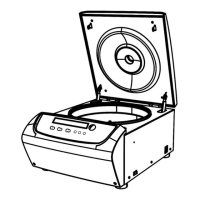
The DM0506 Clinical Centrifuge is a laboratory instrument designed for the separation of samples through centrifugation. It is intended for use in various clinical and research settings where sample separation is required. The centrifuge operates by rotating samples at high speeds, generating relative centrifugal force (RCF) that causes components of different densities to separate.
The primary function of the DM0506 Clinical Centrifuge is to separate liquid mixtures into their components based on density. This is achieved by placing samples in centrifuge tubes, which are then loaded into a rotor. The rotor spins at a user-defined speed, creating a centrifugal force that drives denser particles to the bottom of the tube, while lighter components remain at the top. The centrifuge supports both rotation speed (RPM) and relative centrifugal force (RCF) settings, allowing users to select the most appropriate parameters for their specific applications. It features a brushless motor, ensuring quiet and efficient operation. Safety is a key aspect of its design, incorporating a door lock, overspeed protection, and an onboard diagnosis system to prevent accidents and ensure reliable performance. The device also includes a timer function for precise control over centrifugation duration, with options for continuous running (HOLD) or timed operations.
The DM0506 Clinical Centrifuge is designed for user-friendly operation with a clear LCD display and an intuitive control panel. The main display shows the current speed and timer settings, and an animated icon indicates when the machine is in run mode, with its rotation speed reflecting the centrifuge's operating speed.
Before operation, users must prepare samples to be separated, ensuring that the amount of sample does not exceed the centrifuge tube's working volume to prevent leakage. It is crucial to balance centrifuge tubes, ideally by weighing them, to prolong the centrifuge's service life and prevent excessive vibration. While some imbalance is tolerated, running the centrifuge under poor balance conditions should be avoided. Users must also check the rotor for any corrosion or scratches before use and avoid using damaged rotors. Centrifuge tubes must be inserted symmetrically onto the rotor to maintain balance. The rotor itself needs to be firmly tightened to the main shaft, and its lid (if applicable) must be securely fastened to prevent it from detaching during operation.
To begin, the power switch is turned on, and the most recent settings are loaded onto the LCD display. The parameter knob is central to adjusting settings. A gentle press on the knob selects a parameter (speed, RCF, timer, or deceleration), making it blink on the display, indicating it's ready for adjustment. Rotating the knob clockwise increases the value, while counter-clockwise rotation decreases it. Quicker rotation allows for more dramatic adjustments. The minimum rotation speed increment is 10 rpm, RCF increment is 10g, and timer increment is 1 second. The timer can be set for specific durations (30 seconds to 99 minutes) or to "HD" for continuous running without a time limit.
The centrifuge also supports predefined programs. Users can load program settings by pressing the designated program keys (P1 or P2). To edit a predefined program, the key is pressed and held for 5 seconds. Users can cycle through speed, RCF, and timer settings by repeatedly pressing the program key and adjust them with the parameter knob. Settings are updated after 7 seconds of inactivity.
To start a run, the "START/STOP" key is pressed. The rotor will only begin rotating once the lid is securely locked. The timer starts counting down once the set speed is reached. During operation, settings can be modified. Pressing the parameter knob returns to the settings screen, allowing adjustments. After 7 seconds, the new settings are applied, and the centrifuge continues running with the updated parameters. If any failure occurs during operation, the centrifuge automatically stops, and an error code is displayed in the timer section, guiding users to troubleshoot using the provided list of common failures. To stop the centrifuge, the "START/STOP" key is pressed, or the timer concludes. The centrifuge beeps when the rotor fully stops, and the lid lock is released. If the lid remains locked, the "Door" key can be pressed to release it.
The centrifuge also offers an RCF operation mode. After turning on the power, users can switch to RCF mode. It's important that the set RCF does not exceed the maximum allowed by the centrifuge tube and adaptor. The RCF value is calculated based on the maximum centrifugal radius and operating speed of the rotor. The parameter knob is used to select the rotation speed unit as "xg," and the RCF value can then be adjusted in increments of 10xg.
A deceleration level can be set by pressing and holding the knob for 5 seconds. After a beep, users can rotate the knob to choose between two deceleration levels. Level 1 is the default and suitable for most applications, while Level 2 provides slower deceleration.
Proper maintenance is crucial for the longevity and safe operation of the DM0506 Clinical Centrifuge. Users are advised to disconnect the power supply before any cleaning or maintenance procedures.
For the centrifuge housing, it's recommended to cover the unit with a cloth to avoid prolonged exposure to ultraviolet light, which can cause color changes or label degradation. The centrifuge should be cleaned with a cloth or sponge soaked in a neutral cleansing agent. For sterilization, a cloth soaked with 70% alcohol solvent can be used.
The centrifugal chamber requires careful cleaning. Water or other solvents should never be poured directly into the chamber, as this can lead to corrosion or damage to the drive unit and bearings.
The drive shaft benefits from periodical maintenance, which involves wiping it with a soft cloth and applying a thin layer of silicone grease.
The outer lid can be cleaned and sterilized in the same manner as the centrifuge housing.
Rotor maintenance is particularly important. If the rotor is not used for an extended period, it should be removed from the centrifugal chamber, and its lid (if present) should be taken off. The rotor should then be placed upside down to dry the rotor hole and prevent corrosion. In case of sample leakage into the rotor holes, they should be flushed with clean water, thoroughly dried, and then a thin layer of silicone grease applied to the rotor surface. Regular cleaning of the rotor (every 3 months is recommended) ensures that the cavities and drive shaft hole are clean, followed by the application of silicone grease.
For centrifuge tubes, specific cleaning and sterilization conditions are provided, varying by material (PA, PC, PP). For instance, PC material has low chemical stability to alkaline solvents, so cleaning agents with a pH value over 9 should be avoided. Neutral cleaning agents with a pH of 7-9 are recommended for PC tubes. Autoclaving conditions also vary by material; PA softens at 120°C, while PC and PP soften at 130°C. When autoclaving, tubes should be placed upright with the opening facing upward, and threaded covers/inner covers should be removed to prevent deformation. Tubes should only be handled once the autoclave cools to room temperature. The service life of plastic centrifuge tubes depends on the sample, rotor speed, and temperature, with high-quality tubes lasting 30-50 times and conventional tubes around 10 times. It is critical never to use centrifuge tubes with cracks.
The centrifuge features onboard diagnosis, displaying error codes on the LCD if a failure occurs, aiding in immediate identification of possible causes. For issues beyond simple troubleshooting, users are advised to contact the service center and not attempt repairs themselves.
 General
| Max. Speed | 5000rpm |
|---|---|
| Weight | 1.5 kg |
| Display | LED |
| Run Time | 1 min to 99 min |
| Motor | DC motor |
| Safety Devices | Over-speed detection |
| Voltage | 200-240V, 50Hz/60Hz |
| Power Supply | AC 220V ±10%, 50/60Hz |


 To Next Page