28
FEEDFORCEADJUSTMENTS(Continued…)
Generally, top performance from a sharp saw band
resultsfromrelativelylowFeedForcevalvesettings.
Itwillbenecessarytoincreasethesettingasthesaw
bandbecomesduller.Thiswillkeepthecuttingrate
constantthroughoutthelifeofthesawband.
Feedforceadjustmentsarenotnecessaryfor
changing stock cross‐sections. A balancing valve
enablesthesawbandtomaintainauniformcutting
rate.
Reducingcuttingrateandbandspeedforpipe,tubing
andstructural.
1. Increasing loading per tooth occurs when sawing
thin stock sections. Although the blade can bear
someoverloading,acuttingratereductionmustbe
made.
2. Whenitbecomesnecessarytomodifysolidsection
sawingrecommendations:(a)measurethethinnest
sectiontobecut;(b)applyapercentagefactorof
40%forthinmaterialto70%formaterialswitha
wallover25mm;(c)useahighbandspeed,but
never exceed the maximum speed recommended
onthechartfoundatthebeginningofthe
OPERATIONchapterforstockofthesamesize.
FEEDRATE
1. Correct feed rate is important for helping: (a)
determineoverallcuttingaccuracyandfinishofcut;
(b)improvebladelifebyeliminatingbreakageand
tooth stripping at the cut’s start and break‐out
points.
HEADELEVATIONANDSENSINGARM
Headelevation
1. Sawheadelevationduringautomaticsawingcycle
is initiated when the head down limit switch is
actuated. The saw head then rises to a height
determinedbyasensingarm.
2. Afteracuthasbeenmadeinthemanualoperating
mode,the actuatedhead downlimit switchstops
machine operation. To lift the head off the limit
switchandresumeoperation,theoperatormust:(a)
pushandholdthesawheadupbutton.
Sensingarm
1. Thesensingarmworksinconjunctionwiththehead
clearlimitswitchtoassurethesawheadisraised
sufficientlyaboveexistingstocksothatautomatic
indexing or manual stock positioning can be
accomplishedsafely.
Sensingarmoperationwhenthesawheadrises
1. Thesawheadliftsthesensingarmabovethestock
atarapidrate(thereisnoslowheadraisingrate)
until it actuates the head clear limit switch. This
causes saw head upward movement to stop the
bladeapproximately25mm above thestock.This
clearanceanticipatespotentiallycrookedoroutof
roundstockbeingused.
2. Ifoperatinginautomaticmode,thefixedvisethen
unclamps, the index vise clamps, and stock is
indexed forward. Following the advance of stock,
thefixedviseclampsandtheindexviseunclamps.
3. Whenthefixedviseunclampspriortoindexing,its
jawopensjustenoughtoallowstockadvancement.
Thevisejawscanbeopenedwideronlywhenthe
sawheadhasbeenmanuallyraisedabovethejaws.
Thispreventsdamagetojawsorsawguidearm
whenfullyopeninginalowerposition.
Leftsawguidearmadjustmentforstockwidth
mustbemademanuallybytheoperator.
Sensingarmoperationwhenthesawheadlowers
1. Thesawheadlowersattherapidapproachrate
untilstockiscontactedbythesensingarm.Afeed
rateisthenestablishedandcuttingbegins.
2. Sensing armcontact with thestock inmaintained
throughoutthecut.Afteracuthasbeenfinished:
(a)theheaddownlimitswitchisactuated;(b)the
sawheadrises.
MINIMUMBAREND
1. Whentheindexingviseiscompletelyforward,both
ofitsvisejawsextendtowardsthefrontvisejaws.
Thisextension,togetherwiththenestingdesignof
thevises,permitsautomaticindexingofstockuntil
asmallbut‐endremains.
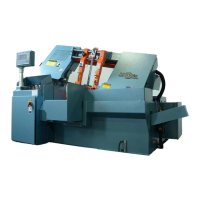
C‐3028NC C‐4033NC C‐420NC
Min.barend 95mm 110mm 110mm
C‐5650NC C‐560NC
Min.barend 115mm 155mm
2. If the stock is shorter, it will not be stable in the
indexvise.


 To Next Page