9. Intake/Exhaust System
132
Inspecting the Turbocharger
1. Daily inspection and service
Turbocharger performance depends largely on the state
of engine maintenance.
Hence, it is important to maintain the engine as instructed.
1) Intake system
In the intake system, pay attention to the maintenance of
the air filter. For a wet-type air filter, if the oil level is below
the specified level, the filtering performance is degraded.
On the other hand, if the oil level is too high, the filter
sucks in oil, contaminating its case. In particular, if the
rotor is contaminated, the finely tuned balance is lost,
causing vibrations. In addition, a massive load is applied
to the bearing, causing seizure and abnormal wear.
Thus, use of the air filter is essential for full use and
service of the machine. For a dry-type air filter, intake air
resistance should be as low as possible.
2) Exhaust system
In the exhaust system, if exhaust gas leaks from the
exhaust manifold or turbocharger connection,
the turbocharger performance is degraded. Hence, partic-
ular care should be taken to prevent gas leaks and seizure.
Since heat-resistant steel nuts are used for components
that become hot during operation, such as the turbine
chamber, these nuts should not be confused with other
general nuts. In addition, mounting nuts should be coated
with an anti-sticking agent if specified.
3) Lubrication system
In the lubrication system, pay attention to the oil quality
and oil filter cartridge replacement intervals. Degraded
engine oil can affect the turbocharger as well as the
engine itself adversely.
2. Periodic inspection and service
The condition and contamination of the turbocharger
should be checked regularly.
1) Inspecting the rotation of the rotor
To check the rotating state of the rotor, listen for any
abnormal noise during rotation.
If a sound rod is used, touch the tip of the rod to the turbo-
charger housing and rev up the engine slowly.
If a high-pitched noise persists, there is a problem with
the part.
In this case, the bearing or rotor may be operating abnor-
mally, so the turbocharger must either be replaced or
repaired.
2) Checking the free play of the rotor
Remove the turbocharger from the engine and check
both the axial and radial play of the rotor.
When removing the turbocharger, make sure to seal the
oil inlet and outlet with tape, etc.
During rotation, the wheel must rotate smoothly without
any interference.
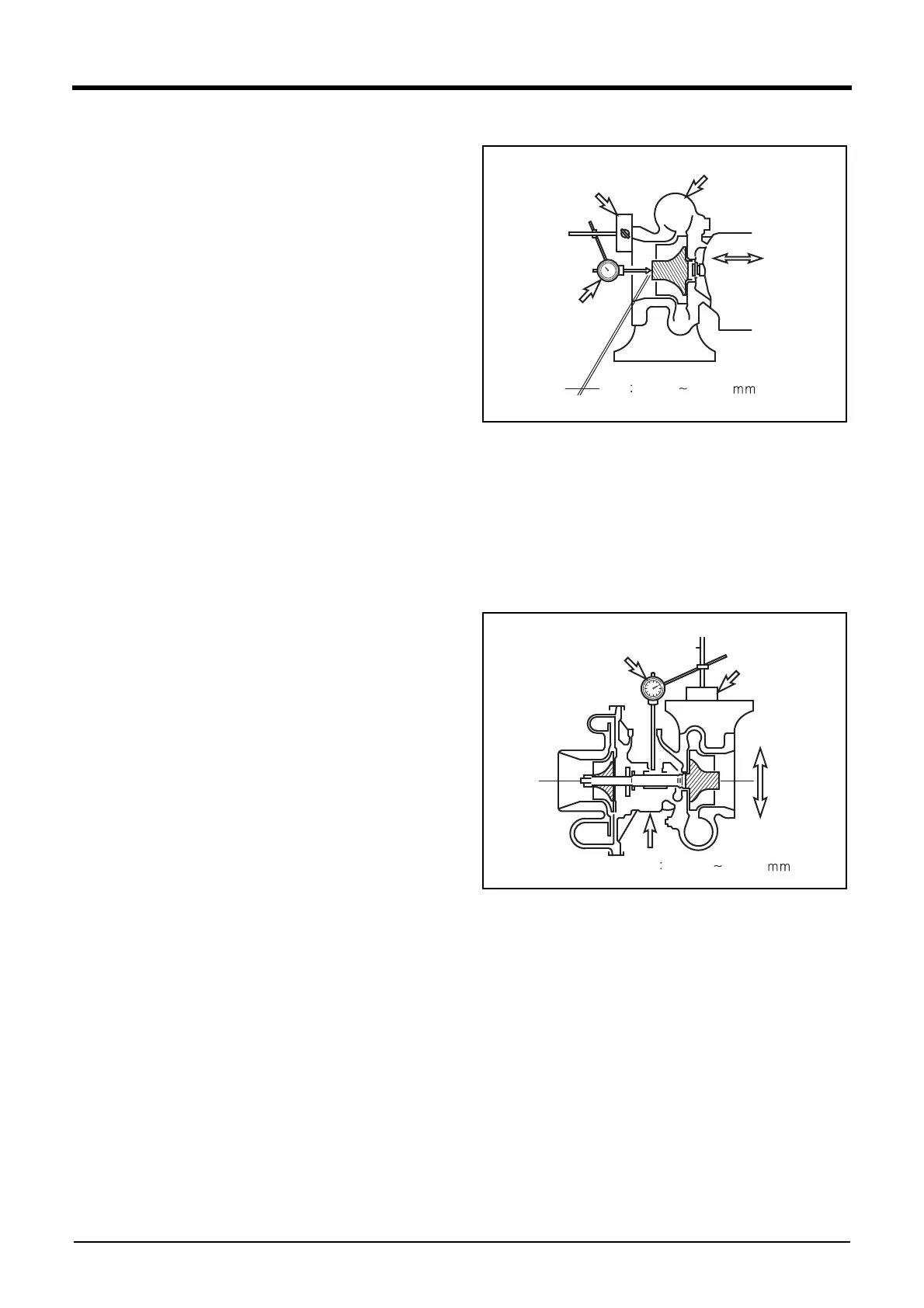
• Rotor axial play
EDL08190025
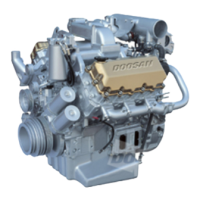
• Rotor radial play
EDL08190026
• If the axial or radial play exceeds the wear limit, either
replace the turbocharger or remove and repair it.
3) Removing and inspecting the turbocharger
Remove the turbocharger from the engine and clean or
inspect it.
When doing so, make sure to seal the oil inlet and outlet
with tape, etc.
A. Dial gauge D. Move the turbine shaft in the
axial direction.
B. Magnetic vice E. Maintenance standard
(0.025 ~ 0.127 mm / 0.00098
~ 0.005 in.)
C. Turbine chamber
A. Oil outlet D. Move the turbine shaft side to
side in the radial direction
simultaneously.
B. Dial gauge E. Maintenance standard for
radial play
(0.254 ~ 0.356 mm / 0.01 ~
0.014 in.)
C. Magnetic vice


 To Next Page