6. Cooling System
91
Thermostat
General Information
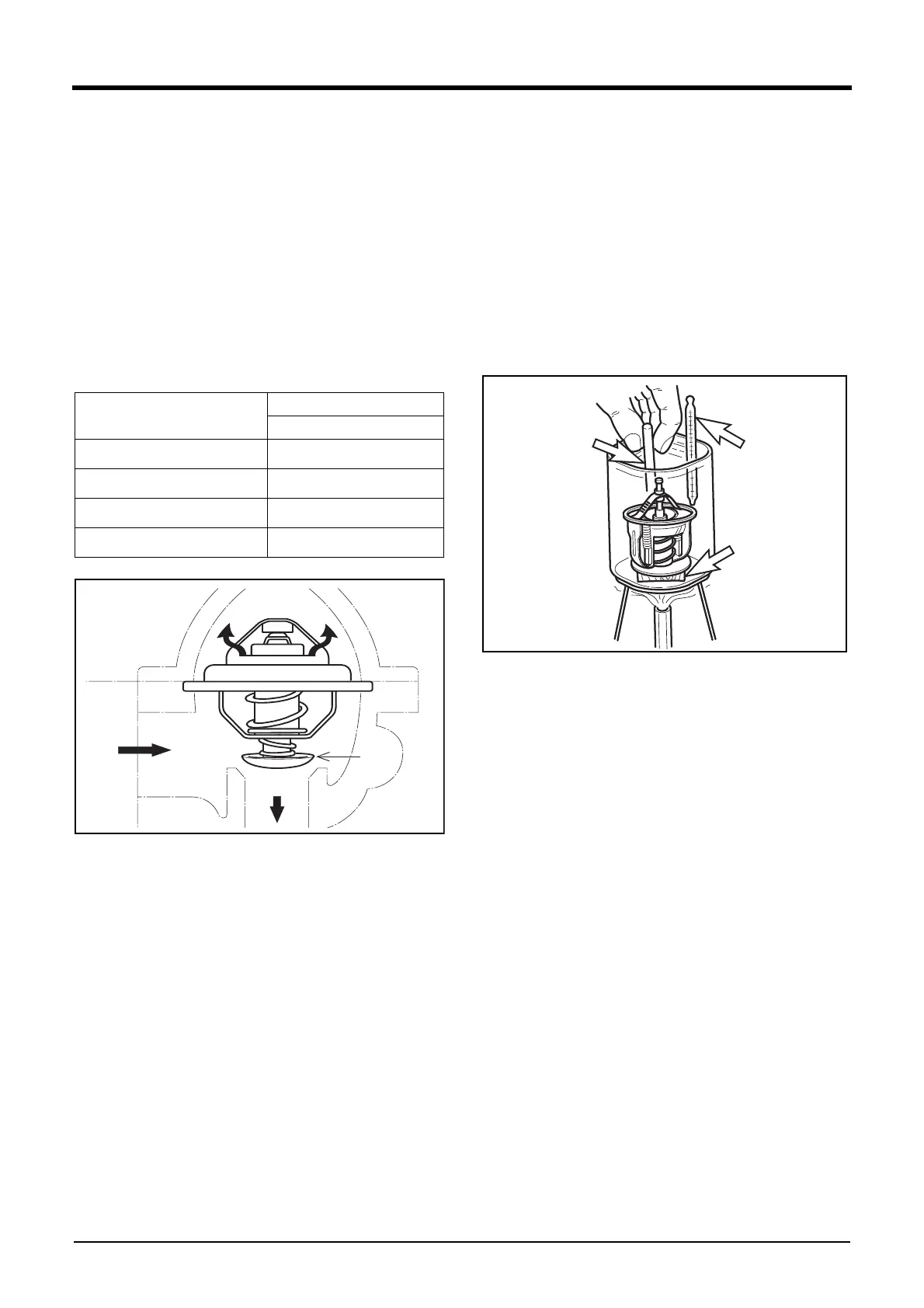
The thermostat is used to maintain a constant coolant
temperature and prevent heat loss in order to enhance the
engine's thermal efficiency.
When the coolant temperature is low, the thermostat valve
closes and coolant is bypassed directly to the pump. When
the coolant temperature rises and the thermostat valve
opens completely, the bypass circuit closes and the coolant
passage to the radiator opens to allow coolant to flow to the
radiator.
EDL022060A
Inspection
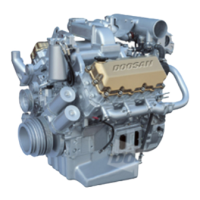
1. Check the wax pellet and spring for damage.
2. Submerge the thermostat in water and heat the water
slowly to check whether the thermostat operates prop-
erly.
If the lift is 0.1 mm (0.039 in.) (start of opening) at a water
temperature of 71 °C (160 °F) and 8 mm (0.315 in.) (fully
open) or more at a water temperature 85 °C (185 °F), the
thermostat is normal.
EFM2055I
Cautions for Replacing and Handling the
Thermostat
1. Cautions for handling
The reaction rate of the wax pellet type against changes
in the coolant temperature is slower than that of the
bellows type.
This is because the wax pellet type has a higher thermal
capacity. Therefore, the engine must first be idled suffi-
ciently to prevent a rapid rise in the engine coolant
temperature. In cold weather, avoid overloading or over-
speeding immediately after starting the engine.
When draining coolant from or adding coolant to the
engine cooling system, drain or pour it slowly to allow
enough air to escape from the system.
2. Replace the thermostat
If the thermostat is defective, replace it with a new one.
Item
Specifications
Temperature regions
Type Wax pellet
Opening temp. 71 °C (160 °F)
Fully open temp. 85 °C (185 °F)
Valve lift 8 mm (0.31 in.) or more
1. Heat exchanger 3. Coolant pump
2. Bypass valve 4. Coolant pipe
Measuring ruler
Thermometer
Wooden panel


 To Next Page