1-1
1.0: OVERVIEW
The 3200-XS Sub-Bottom Profiling System is a high resolution wideband frequency modulated (FM) sub-
bottom profiler that uses EdgeTech’s proprietary Full Spectrum CHIRP technology to generate cross-
sectional images of the seabed and collect digital normal incidence reflection data over many frequency
ranges. The 3200-XS transmits an FM pulse (also called "CHIRP pulse") that is linearly swept over a full
spectrum frequency range.
The reflections measured by the system are displayed as shades of gray or color on a computer monitor
and may be printed on a continuous feed thermal printer. Data are stored in real time onto a large capacity
hard drive and can be archived to DVD.
1.1 Advantages of Full Spectrum CHIRP Technology
EdgeTech's Full Spectrum CHIRP technology has several distinct advantages over conventional sub-
bottom profiling systems: The use of separate acoustic projectors and receivers enable:
• Simultaneous transmission and reception of acoustic signals
• High repeatability of the transmitted signals to enable sediment classification
• High signal-to-noise ratio (SNR) for improved acoustic imagery
• High resolution for measurement of fine sediment layering
• Additional processing gain for energy efficiency
• Gaussian shaped amplitude spectrum of the outgoing pulse to preserve resolution with sediment
penetration
• Reduction of side lobes for minimal destructive signal scattering caused by the sediment when
profiling near the bottom
1.1.1 Separate Acoustic Projectors and Receivers
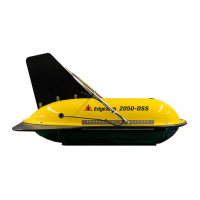
The 3200-XS Sub-Bottom Profiling System uses acoustic projectors and receivers mounted in a towed
vehicle to transmit and receive acoustic FM pulse signals. The projectors are wide band piston type
transducers, and the receivers are hydrophone arrays composed of lead zirconate titanate (PZT) crystals.
The transducers are mounted in the forward section of the tow vehicle, and the hydrophone arrays, which
are designed for profiling at ship speeds up to seven knots, are mounted aft.
The use of separate transmitting transducers and receiving hydrophone arrays preserves linearity, and
allows the simultaneous transmission and reception of the acoustic signals. The transducers and
hydrophone arrays are mounted beneath acoustic baffles, which minimize direct path, tow vehicle, and
surface reflections. A preamplifier in the tow vehicle amplifies and drives the received signals through a
tow cable to the surface.


 To Next Page