3-13
3.9 Tow Vehicle Deployment
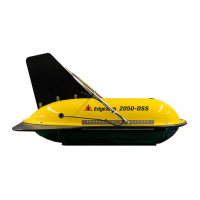
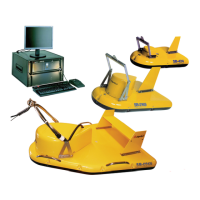
The SB-424, SB-216S, and SB-512i Tow Vehicles can be towed using a Kevlar Reinforced Tow Cable that is
available separately with the 3200-XS Sub-Bottom Profiling System. However, for the larger SB-0512i tow
cable, a steel cable with a minimum 500 Kg (1100 lb.) working strength is recommended instead.
The steel cable can be secured to the tow cable using electrical tape, making sure there is enough built-in
slack in the tow cable so that the entire load is supported by the steel cable. A steel cable could also be
used in the same manner with the two smaller SB-424 and SB-216S Tow Vehicles to increase the life of
the tow cable. For towing in deep water, a single, armored tow cable is required.
CAUTION!
Do not tow the tow vehicle too close to the survey vessel. Towing in this
manner can cause the tow vehicle to be pulled in against the hull of the
ship due to the low pressure of the propeller wash and the effect of the
water flowing by the hull. In addition, sonar reflections from the hull
may be evident in the records.
The tow vehicle may be towed at speeds of up to 10 knots. However, to optimize performance and
minimize flow noise, it is recommended that the tow vehicle be towed at speeds of less than 5 knots. Lead
ballast in the nose of the tow vehicle provides towing stability by allowing the tow point to be placed as
far forward as possible and by making the tow point well above the center of gravity of the tow vehicle.
The tow point is factory adjusted so the tow vehicle is level when it is towed in the water at 3 to 5 knots.
CAUTION!
Do not tow the tow vehicle with the nose angled up or down, as this can
degrade sonar imagery. Before starting the survey, verify the Tow
vehicle is as level as possible when towing at 3 to 5 knots.
3.9.1 Obtaining the Best Sonar Imagery When Towing
To generate good sonar imagery, the pitch of the vehicle, which is how much in degrees the nose is angled
up or down, must be less than one half of the -6dB beam width of the acoustic pulse at its highest
frequency—and less at lower frequencies. As a rule of thumb, for a 0.5-meter long hydrophone array, the
-6dB beam width at 10 kHz is 20 degrees. For example, if you are transmitting a 2 to 15 kHz FM pulse using
a tow vehicle with a 0.5-meter long receiving array, such as in the SB-216S or SB-216D Tow Vehicle, you
must keep the tow vehicle from pitching more than about 7 degrees in either direction, or:


 To Next Page