APPENDIX A: THE DIGITONE FM SYNTHESIS
74
In some instances, an operator can be both carrier and modulator. This means that it outputs its result as a
tone while also using it to modulate another operator. We have divided the operators into three groups: C, A,
and B (B1 and B2) to lessen the complexity and make the Digitone easier to use. Since group B consist of
two operators, the parameter controls for B are macro mapped to both operators.
A.3 ALGORITHMS
An algorithm is a set routing, or combination, of the operators. Routing the modulation in dierent ways
gives you several dierent methods of applying modulation and naturally dierent results.
CarrierEnvelopeModulator
Feedback
Feedback
Modulator
Envelope output
Carrier
Direct output
Output
Algorithm
Modulation
Level
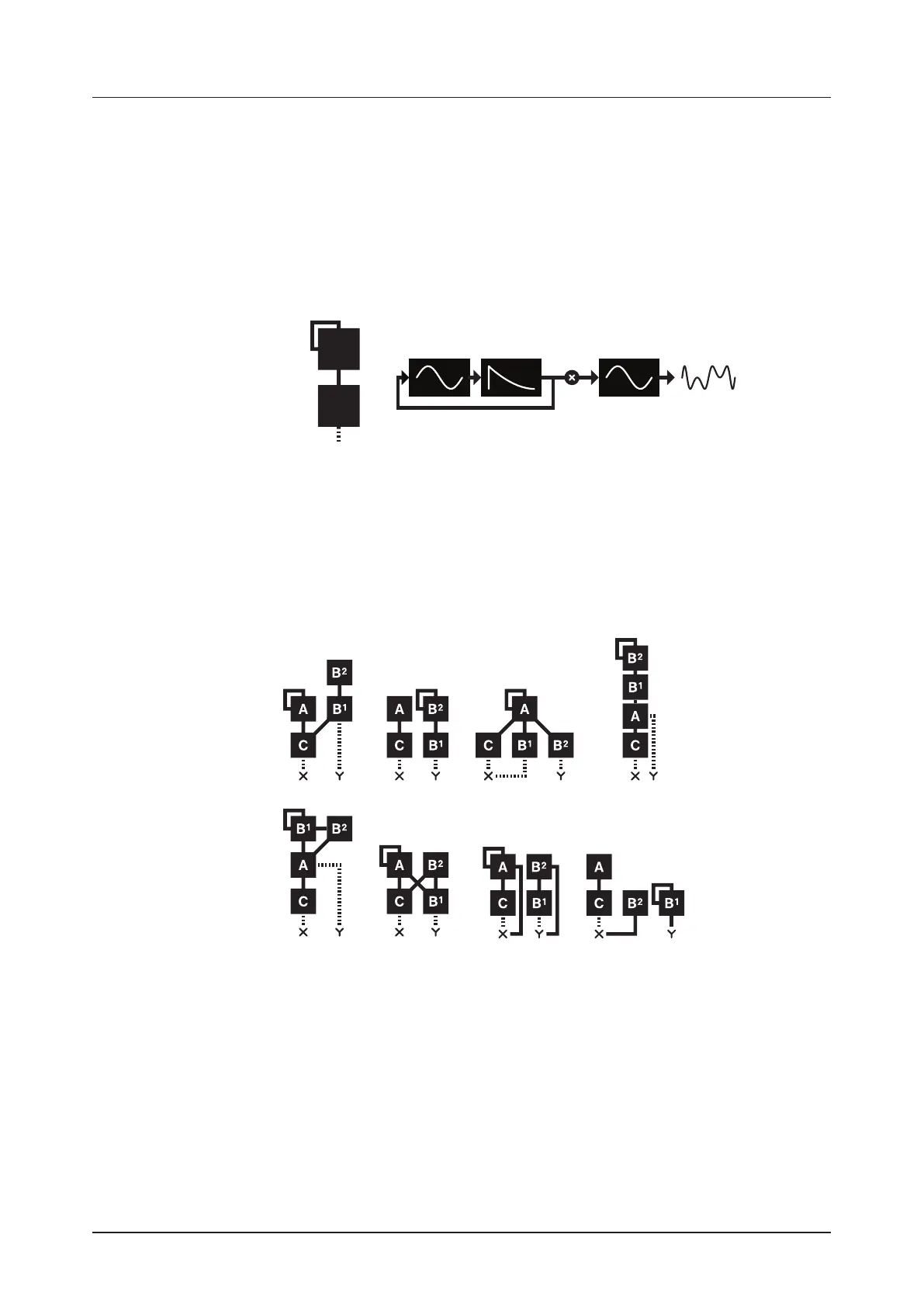
Pictured above is a 2 operator algorithm, which is FM synthesis in its most basic form. The Digitone has four
operators available which can be routed in many dierent ways. Dierent algorithms dramatically changes
the characteristics of the output - for example stacking four operators can lead to very complex timbres.
The Digitone has eight dierent algorithms where the four operators are routed in dierent ways. For more
information, please see “11.3.1 ALGO” on page 40. Each algorithm has two carrier outputs (X and Y) that
come from two dierent operators depending on what algorithm you chose. It is possible to use the MIX
parameter to mix between these outputs so that you can cross-fade between two separate timbres. For
more information, please see “11.3.8 MIX” on page 40.
1 2 3 4
5 6 7 8
The lines going to X and Y indicate the output from a carrier. There are two dierent ways a carrier output
is sent to the X/Y outputs: 1. Its amplitude is unaected by the operator envelope (dotted line). 2. Its ampli-
tude is aected by the operator envelope (filled line). The sound from the X/Y outputs is then routed via the
overdrive to the filters.
A.4 FM RATIOS
Frequency modulation is applied in multipliers of the principal frequency to retain the sounds tonality. These
multipliers are known as ratios. Each operator group’s ratio is a multiplier of the input pitch (note value). The
higher the ratio, the higher the pitch frequency. For example, when applying modulation with a ratio of 1:2
(carrier:modulator), the carrier output resembles a square wave. A ratio of 1:1 sounds like a sawtooth, and
odd numbers can be used for various metallic or other “natural” sounds. In Digitone, the FM ratios for the
dierent operator groups works like this:


 To Next Page