3
Reference Manual
00809-0100-4021, Rev GC
Section 1: Introduction
April 2014
Introduction
Optimize measurement reliability with diagnostics designed for any protocol on any host
system.
Thermocouple Degradation Diagnostic monitors the health of a thermocouple loop,
enabling preventative maintenance
Minimum and Maximum Temperature Tracking tracks and records temperature
extremes of the process sensors and the ambient environment
Sensor Drift Alert detects sensor drift and alerts the user
the Hot Backup
™
feature provides temperature measurement redundancy
Refer to the following literature for a full range of compatible connection heads, sensors, and
thermowells provided by Emerson
®
Process Management:
Temperature Sensors and Assemblies Product Data Sheet, Volume 1 (document
number 00813-0100-2654)
Temperature Sensors and Assemblies Product Data Sheet, Metric (document number
00813-0200-2654)
1.2 Considerations
1.2.1 General
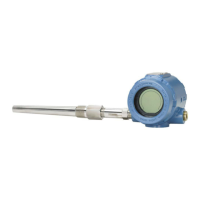
Electrical temperature sensors, such as resistance temperature detectors (RTDs) and
thermocouples (T/Cs), produce low-level signals proportional to temperature. The 3144P
transmitter converts low-level signals to HART or F
OUNDATION fieldbus and then transmits the
signals to the control system via two power/signal wires.
1.2.2 Electrical
Proper electrical installation is essential to prevent errors due to sensor lead resistance and
electrical noise. For HART communications, the current loop must have between 250 and 1100
ohms resistance. Refer to Figure 2-11 on page 22 for sensor and current loop connections.
F
OUNDATION fieldbus devices must have proper termination and power conditioning for reliable
operation. Shielded cables must be used for F
OUNDATION fieldbus and may only be grounded in
one place.
1.2.3 Environmental
Temperature effects
The transmitter will operate within specifications for ambient temperatures between –40 and
185 °F (–40 and 85 °C). Since heat from the process is transferred from the thermowell to the
transmitter housing, if the expected process temperature is near or beyond specification limits,
consider using additional thermowell lagging, an extension nipple, or a remote mounting
configuration to isolate the transmitter from the process. Figure 1-1 details the relationship
between housing temperature rise and extension length.







 To Next Page

