Need help?
Do you have a question about the EROAD ELD and is the answer not in the manual?
Explains the EROAD ELD system, including the in-vehicle device and Depot application.
Provides instructions on finding the ELD's serial number and details PIT Group verification.
Guides on logging into the ELD and navigating the Home screen, including duty status counters.
Explains how to change duty statuses like Off Duty, Personal Conveyance, and Yard Moves.
Details checking HoS, viewing summaries, rolling views, rulesets, and exemptions.
Guides on managing trailers and entering shipping documents.
Covers WMT configuration, entering fuel gallons, and viewing vehicle information.
Describes the ELD's driving mode and how co-drivers can switch views and be added.
Details switching active drivers and vehicles on the ELD.
Covers viewing/sending messages and reviewing logs for accuracy.
Explains how to correct logs, add remarks, delete, or insert missing records.
Guides on certifying daily logs and properly logging out of the ELD.
Explains how drivers can review and accept/reject edits suggested by their supervisor.
Explains how drivers or co-drivers can swap driving time entries.
Guides on claiming driving time that was not automatically logged to a driver.
Explains how to email logs for backup purposes.
Details how to transfer driver records to an inspector via email or web services.
Guides on how to display driver records, including header info, logs, and events, to an inspector.
Explains how to view and manage ELD malfunctions and associated alerts.
Guides on how to resolve data diagnostic issues affecting the ELD's functionality.
Provides contact information for EROAD support and the company's address.
Lists terms and their definitions used throughout the EROAD ELD User Manual.
Lists typical error messages and malfunctions with their descriptions and remedies.
The EROAD ELD is an Electronic Logging Device designed to simplify a driver's job by providing control over duty status changes and log management. It's part of a system that includes an in-vehicle device and a Depot application, accessible via a web browser, where records are stored through a cellular data network.
The ELD automatically records driving time, location (via GPS), route, and operational data from the truck. It helps drivers comply with federal and state driving and duty-hour requirements by tracking Hours of Service (HoS) and ensuring safe and efficient operation. The device is self-certified and registered with the FMCSA, and its compliance has been independently verified by PIT Group.
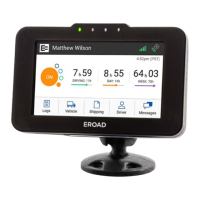
The device features a user-friendly interface with a Home screen displaying key information like current time, cellular strength, GPS status, duty status, and an HoS counter. Three indicator lights on the front provide quick status updates: green for power ON, yellow for a new message, and red for degraded mode or temporary loss of distance calculation.
Drivers log in by selecting their name from a list on the Login screen and entering a personal identification number (PIN). For new users or those not listed, a search function is available. The Welcome screen may prompt drivers to review unidentified trips, accept edits, or certify logs.
Drivers can easily change their duty status (Off Duty, Sleeper Berth, Driving, On Duty) by tapping the Duty Status circle on the Home screen. Optional statuses like Personal Conveyance (Off Duty) and Yard Move (On Duty) are available if allowed by the carrier. When using Personal Conveyance, the Home screen changes to a dark background, and the ELD prompts the driver to continue or end this status if the vehicle is shut off and then reactivated. Yard Move status also results in a dark background while driving. Quick remarks can be added during login or duty status changes.
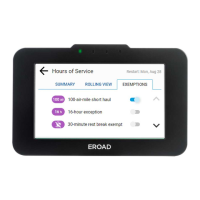
The HoS screen offers four views: Summary, Rolling View, Ruleset, and Exemptions.
The ELD allows drivers to add or drop up to three trailers by entering their IDs. It also supports adding shipping documents, such as bills of lading, which can be persistent (automatically carried over) or modified/dropped as needed.
For drivers operating in Oregon, the ELD facilitates changing vehicle weight configurations for Weight-Mile Tax (WMT) reporting.
Drivers can enter fuel gallons directly into the device.
The ELD displays CMV Power Unit Number, Plate number, Truck Tractor VIN, and mileage.
When the vehicle reaches 5 mph, the ELD automatically enters Driving mode, displaying minimal information for safety. Co-drivers can view logs in motion by switching views.
The ELD supports co-driver login, allowing both active and co-drivers to be logged in simultaneously. Drivers can switch between active and co-driver views by entering their PIN.
Drivers can view and send messages to dispatchers. Unread messages are highlighted in orange, read messages in gray, and replies in blue.
The ELD allows drivers to review their logs, which are graphically represented for a 24-hour period. Drivers can cycle through previous days, view HoS, certify logs, and inspect data.
The ELD has a dedicated Roadside Inspection mode. Drivers change their duty status to ON and activate this mode before handing the device to an inspector. In this mode, only required information is displayed, and the inspector cannot modify logs but can transfer or display records. The device can be removed from its mounting arm for inspection. Records can be transferred via email or web services, requiring a safety official's code.
The ELD is compliant with FMCSA requirements and generates data diagnostic events and malfunctions. A red banner and LED indicate malfunctions, prompting drivers to view details and follow recommended actions on the malfunction visor card or contact their supervisor. Data diagnostic issues also appear as a red banner, requiring drivers to examine logs and enter information to resolve them.
The ELD system automatically resolves GPS signal loss. It also provides error messages and malfunctions with descriptions and remedies, guiding drivers to fix issues or contact support.
 General
| Device Type | Electronic Logging Device (ELD) |
|---|---|
| GPS Tracking | Yes |
| Connectivity | Cellular, Bluetooth |
| Dimensions | Varies by model |
| Weight | Varies depending on the specific EROAD ELD model |
| Input Voltage | 12/24V DC |
| Data Transfer | Cellular, Bluetooth, USB |
| Power Source | Vehicle power and internal battery |
| Software Updates | Over-the-air (OTA) |
| Display | Touchscreen (varies by model) |

 To Next Page