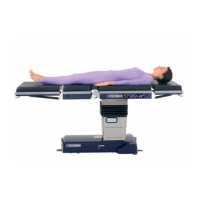
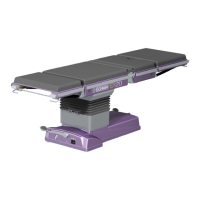
MR & MRS OPERATION TABLES
Page 12 of 29 T-SM5f
Part 4
Trendelenburg screw assembly friction
collars
NOTE: Sections 4.16 and 4.17 should only be
referred to for tables with serial numbers
preceding those detailed below, for later tables or
tables that have had the latest Trendelenburg
screws fitted refer to section 4.18.
Tables with serial numbers as detailed below have
the latest Trendelenburg screw fitted and section
4.18 applies :-
MR - 2060 (or above)
MRS - 1177 (or above)
4.16 Adjustment of the friction collars on the
Trendelenburg screw MUST be checked regularly.
If the table does not easily stay in Trendelenburg
or reverse Trendelenburg position, but tends to
slip down under patient’s weight, this indicates
that the Tufnol friction collars (9, Fig. 10) need
tightening. Proceed as follows:
i Remove the leg section as described in the
Instruction Manual and then pump the table
top to maximum height with the height
adjustment pedal.
ii Elevate the head section to the maximum
raised angle and place the table in maximum
reverse Trendelenburg position.
iii Remove the gearbox cover (3, Fig. 9).
iv Bolster the table top in position as shown in
Fig. 9 and then free the lower end of the
Trendelenburg screw assembly (1, Fig. 9)
by removing the pivot screws (2, Fig. 9).
v Pivot the Trendelenburg screw assembly
about its bevel gear housing (4, Fig. 9) to
gain access, in turn, to the four screws
(5, Fig. 9) holding the two halves of the
housing together. Remove the four screws
to separate the two half housings and remove
the Trendelenburg screw assembly, with the
bevel gear lower half housing from the
table.
vi Refer to Fig. 10a. Mark the bevel gear lower
half housing (3) and screwed bush (12) to
aid reassembly, then remove socket head
grub screws (4) from the half housing and
unscrew the screwed bush (12) until heads
4. MAINTENANCE
of friction collar grub screws (11) are
exposed.
vii Tighten grub screws (11), securing friction
collars (9), to a torque of 16 to 17 lbf in.
viii Screw screwed bush (12) into the half
housing and secure with socket head grub
screws (4).
ix Using a suitable torque wrench (e.g. Torque
driver-Part No. 759581 and 4mm Bit-Part
No. 759582), attached to nut (17) using
adaptor (Part No. 759566), check final
friction of screw shaft (15); the torque
required to turn screw shaft (15) should be
between 30 and 35 lbf in. If final friction
torque cannot be achieved, further tighten
each friction collar grub screw (11), by 1 to
2 lbf in. per occasion until 30 to 35 lbf in.
torque is achieved. If torque figure is not
achieved by a maximum setting of 20 lbf in.
then refer to section 4.17.
4.17 If further friction cannot be obtained by
carrying out the above procedure, the friction
collars are worn and a new Trendelenburg screw
assembly should be fitted. Refer to section 4.34
under REMOVAL AND INSTALLATION OF
COMPONENTS.
4.18 For tables having the latest design of
Trendelenburg screw assembly (see note
preceding 4.16) the adjustment of the friction
collar on the Trendelenburg screw MUST be
checked regularly. If the table does not easily stay
in Trendelenburg or reverse Trendelenburg
position, but tends to slip down under patient’s
weight, this indicates that the friction collar needs
adjusting. Refer to Fig. 10b and proceed as
follows:
i Remove the leg flap and place gear lever in
Lateral Tilt position.
ii Unscrew sleeve cap (1) and remove the end
cap tubes (2) from the Trendelenburg screw
assembly.
iii Using torque screwdriver (Part No. 759581
set to 20-25 lbf.in. and fitted with adaptor
T2095 Part No. 759653 and 20mm socket),
check the setting by locating socket over the



 To Next Page