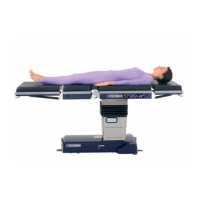
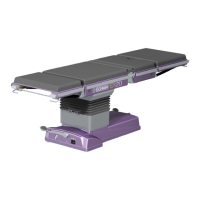
MR & MRS OPERATION TABLES
Page 20 of 29 T-SM5f
Part 4
Failure of cable operated control arm gear
selection, MRS table only (pre Serial No.1024)
4.31. The control arm gear lever operates the table
top movement selection mechanism in the gearbox
by means of a flexible cable assembly (3, Fig. 11).
If movement selection fails to function correctly
while the table is in use, immediate action must
be taken to engage the standby controls. The fault
symptoms can be any of the following:
i The gear selector lever may have been struck
and bent, causing gear selection to be upset.
ii Trendelenburg movement is permanently
engaged but the gear lever does not spring to
this position when placed in the vertical
gate. This indicates that the ferrule at either
end of the inner cable has been sheared-off,
in which case the cable assembly should be
renewed or the ferrule resoldered to the
inner cable (see section 4.40).
iii Lateral tilt or flexion/extension movement
is not engaged when the gear lever is moved
into the appropriate position.
iv Trendelenburg and flexion/extension
movements are engaged simultaneously
when the gear lever is in either of these two
positions.
4.32. Symptoms (iii) and (iv) indicate that the
inner cable has stretched and the mechanism
should be adjusted as follows:
i Select Trendelenburg movement.
ii Refer to Fig. 15 and locate adjusting screw
(1) beneath upper trunk section.
iii Slacken thumb nut (2).
iv Check that selector gears (3) and (4) slide
freely on the main shaft (5) and that the
return springs (6) and (7) function correctly.
v Check that the selector gear (3) is in full
mesh with the idler gear (8); if necessary
turn the adjusting screw (1) in the direction
required to achieve this condition.
vi Select lateral tilt movement.
vii Check that the selector gear (4) is in mesh
with the drive gear (9) and that the selector
gear (3) is completely disengaged from both
idler gears (8) and (10). Small adjustments
to the adjusting screw may be made to
achieve these conditions.
viii Select chair and break movement.
ix Check that the selector gear (3) is in mesh
with the idler gear (10) and that the selector
gear (4) is disengaged from the drive gear
(9).
x Repeat the checks (5) to (9) with the control
arm in two or three different positions,
making small adjustments to the adjusting
screw if necessary to establish the optimum
setting.
xi Tighten the thumb nut.
Control arm not maintaining position (MRS
table with gas spring, Serial No. 1024 or later)
4.33 If the control arm will not maintain its
position this is normally indicative of a faulty gas
spring. Remove the lower control arm cover (as
shown in Fig. 20) and check for signs of a
damaged or a leaking gas spring, replace if
required, see section 4.58. Do not lubricate gas
springs and do not attempt to repair them (see
WARNINGS and CAUTIONS above section
4.21).
REMOVAL AND INSTALLATION OF
COMPONENTS
Replacement of Trendelenburg screw (Fig. 9
and 10)
4.34 To replace the Trendelenburg screw, remove
the old Trendelenburg screw assembly from the
operation table as detailed in 4.16. Fit a new
Trendelenburg screw assembly (latest style see
note above 4.16) and adjust it to the correct torque
setting as detailed in section 4.18. Reassemble the
table.
Note: The bevel gear housing has one thick and
one thin side wall. The thin side wall should
be fitted round the neck of the gear shaft
bevel gear. Ensure that the upper bevel gear
housing is orientated to match before
attempting to refit the cap head screws
securing the two halves of the housing
together.
4. MAINTENANCE



 To Next Page