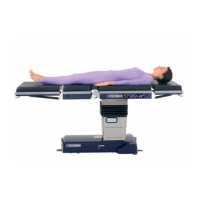
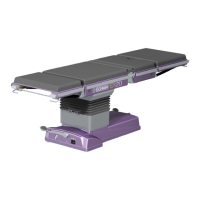
MR & MRS OPERATION TABLES
Page 18 of 29 T-SM5f
Part 4
travelling through its full stroke, the fault is
probably due to the presence of dirt in the ball
valve, (1, Fig. 13) of the hydraulic cylinder. It is
often possible to clear this obstruction by
vigorously operating the height control pedal. If
this fails, remove hydraulic cylinder from base
(see section 4.35); the ball valve should then be
disassembled and cleaned (see section 4.37). If
the pedal is suddenly inoperable either when
raising or lowering the table, refer to section 4.28.
Table top not maintaining height
4.27 If table top fails to maintain height, raise it
to its maximum height, fully depress the height
control pedal and, by pressing on the table top,
force the table top downwards as quickly as
possible. Repeat this operation several times. If
this does not rectify the fault remove hydraulic
cylinder from base (see section 4.35) then examine
the hydraulic mechanism for:
i Condition of ball valve jointing washer (2,
Fig. 13). If faulty, replace it (see section 4.37).
ii Secureness of ram cover plate (3, Fig. 13). If
it is loose, retighten it.
iii Efficiency of ball valve (1, Fig. 13). If
blocked or jammed, disassemble and clean
it, (see section 4.37). If the seating of the
larger (spring-loaded) ball has been
damaged, replace the complete valve.
iv Condition of ram cup washer (4, Fig. 13). If
worn or chipped, replace it (see section 4.36).
Operation table will not lower
4.28 First examine the steel ram for rust (see note
below); a type of black rust not easily noticed can
form on the circumference of the ram. This can
be identified by rubbing a piece of emery paper
on any discoloured portion of the ram surface. If
rust is detected, it must be removed completely,
as follows:
NOTE: Later tables have a black coating which
prevents this rust occurring.
i Protect the top of the cylinder by tying a
piece of rag around the ram.
ii Clean the ram surface thoroughly by rubbing
hard with emery paper.
4. MAINTENANCE
iii Carefully clean off all particles of grit and
completely cover the exposed ram surface
with oil.
iv Test the raising and lowering movement of
the table top.
4.29 If on testing the table pump mechanism for
normal function it is found to be still inoperable
this may be due to the fact that efforts made to
lower the table while seized have strained the
pump lever driving pin or the ram release
mechanism. If the table top descends at all in
response to pump lever operation, the descent will
be sluggish. To remedy this the following
procedure should be carried out:
i Refer to section 4.35 and remove hydraulic
cylinder from table base.
ii Examination of the ram release movement
must now be carried out. Refer to Fig. 14.
When the pump lever is depressed fully, this
operates the ram release lever (1). The ram
release lever pivots and the release screw (2)
enters the ball valve and should lift both
balls (3 and 6) at the end of lever travel.
Before testing this movement, the pressure
in the ball valve should be overcome by
forcing the release lever into the ball valve
after covering the cylinder with a cloth to
avoid leakage of oil under pressure.
iii Now depress the pump lever fully and hold
in this position. Test the ram release lever by
trying the movement using thumb pressure.
If the movement is other than very slight,
adjustment is required.
4.30 To adjust ram release mechanism, proceed
as follows:
i Position the compression tool clamp
(included in the tool kit available for the MR
series tables, Part No. 751030) across the
base of the cylinder (see Fig. 12c) and lightly
tighten it onto the ram release. Use an Allen
key to remove the four screws holding the
ram release in position.
ii Loosen the clamp until oil starts to run from
the hole. Allow the oil to drain.
iii Continue to unscrew the clamp until



 To Next Page