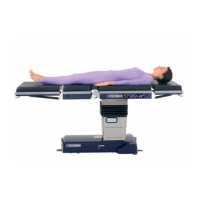
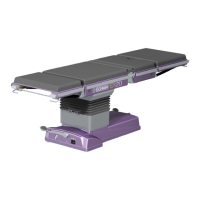
MR & MRS OPERATION TABLES
Page 6 of 29 T-SM5f
3. SAFETY NOTES
DO:
♦ Keep the instruction manual close-to-hand.
♦ Read the instructions carefully before using
the table.
♦ Check that the leg section is secure, and put
the table base in the brake position before
use.
♦ Raise the table top fully before washing the
table, to expose all the ram covers surface.
♦ Read and follow the instructions for cleaning,
and for the care of the mattresses and pads.
♦ Use the correct mattress and accessories.
♦ Service the table and accessories regularly.
♦ Remove table accessories and their clamps,
in particular rotary clamps from side bars,
when they are not in use.
Attention to the following points will prolong the life and efficiency of your operating table and
will help to avoid the risk of accidents, or damage:
DO NOT:
♦ Lift the table by its top.
♦ Push the table over rough surfaces, use a
trolley.
♦ Drop the table (or individual sections) when
transporting it.
♦ Put heavy weights on the table sections.
♦ Put sharp objects on, or against mattresses,
pads, or the radiographic table top.
♦ Drop heavy objects onto the radiographic
top.
♦ Spill oil, ether, or other chemical fluids onto
the mattress or the pads.
♦ Pull the table by the head or leg section,
always push it.
♦ Exceed maximum table loading
WARNINGS
The MR and MRS Operation Tables have been designed to minimise the possibility of accidental
electrosurgery burns. Contact with any metal surfaces (e.g. table side bars, or other equipment
etc.) can cause burns during electrosurgery and must be avoided.
The MR and MRS Operation Tables have been designed for patients weighing up to 135kg with
their centre of gravity (normally the perineum) over the base. However patient positioning and
additional loads can compromise table stability. Ensure that loading does not compromise table
stability.
With the table in (or during transition into) the castor position, the centre of gravity of the
patient (normally the perineum) should lie over the centre of the column . Whenever this is not
practical the overhanging weight of the patient and table should be adequately supported (e.g.
by at least two able people). Take extreme care when moving a table with a patient on and
ensure that the table is at minimum height
The patient’s weight should be supported whenever the sections are adjusted or removed from
the table during repositioning.
The head and leg sections are designed to support and position the appropriate part of the
patient’s weight only. Damage leading to failure of the section may be caused if excessive weight
is applied. Also do not sit or lean on the control arm of the MRS table.
The maximum loading weight of 10kg must not be exceeded for the Detachable ophthalmic head
flap and the Non-Detachable head flap accessories, as this may cause damage to the accessory
and could result in injury to the patient.
It is necessary to check at regular intervals for wear, corrosion, material fatigue and ageing on
all accessories which support all or part of the body of the patient using a single gas spring. Such
accessories are the detachable ophthalmic head-flap and head-flap.
Part 3



 To Next Page