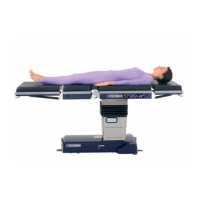
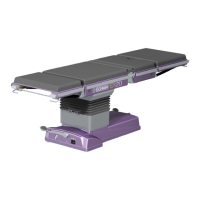
MR & MRS OPERATION TABLES
Page 22 of 29 T-SM5f
Part 4
by little and the table raised and lowered
via the pump pedal after each addition until
full table movement can be achieved. This
method ensures that excess oil is not
introduced.
Removing and replacing control arm cable
assembly - MRS table only pre Serial No. 1024
4.40 Proceed as follows:
i Remove table head section in the normal
manner as described in the table Instruction
for Use.
ii Adjust position of control arm to a
convenient working position and remove
the socket head screws from the top cover.
Lift away top cover.
iii If the ferrule at one end of the inner cable has
sheared-off, the inner cable will be loose
and the opposite end may be disconnected
from its control arm pivot (5, Fig. 11) or
cable pivot (12, Fig. 15).
iv Withdraw outer cable from cable holder
(6, Fig. 11) and from the adjusting screw
(1, Fig. 15. Remove cable assembly from
control arm.
v If a new cable is not to be fitted, soft-solder
the loose ferrule to the end of the inner cable.
Carefully restore the contour of the ferrule
(4, Fig. 11)
vi Feed the cable assembly through the control
arm.
vii Pass the ferrule (4, Fig. 11) through the
cable holder and locate the end of the outer
cable in the holder.
viii Pass the ferrule at the opposite end through
the adjusting screw (1, Fig. 15) and locate the
end of the outer cable in the adjusting screw.
ix Connect the ferrule to the cable pivot
(12, Fig. 15).
x Check that the standby gear lever is located
in the Trendelenburg position.
xi Move the extended control gear lever to the
lateral tilt position.
xii Press the selector lever (13, Fig. 15) to the
left.
xiii Connect the ferrule (4, Fig. 11) to the control
arm pivot (5, Fig. 11).
xiv Assemble the control arm top cover and tighten
the securing screws.
xv Refit the head section.
xvi Adjust the cable assembly (see section 4.32).
Replacing antistatic wheel in table base
4.41 Refer to section 4.3 and tilt table with pump
pedal uppermost and wheel to be removed
uppermost, then proceed as follows:
i Refer to Fig 5 and withdraw grub screw (7a)
just sufficiently to be able to tap out the
domed wheel spindle (8) from the inside,
while still retaining the bush in position.
ii Slacken grub screw (7b) then fit
replacement antistatic wheel with original
domed spindle. Adjust position of bush
under grub screw (7b) to accommodate
width of new wheel, then retighten grub
screw (7a) into the dimple of the spindle.
iii Finally, tap the inside bush under grub screw
(7b) to make a close fit against the wheel
and then tighten grub screw (7b).
Replacing castor
4.42 The castor assembly is available with aluminium
or antistatic rubber wheels and comes complete with
yoke, wheels, washers, spindle and spindle securing
nut. Individual wheels are also available. To replace
a damaged castor, refer to section 4.3 and tilt the
table with the pump pedal uppermost and the castor
to be removed uppermost, then refer to Fig. 5 and
remove the four set screws (5) and release the castor
mounting plate from the table base. Note: When
replacing a castor assembly (or just the wheels) ensure
that the wheels are identical to the original ones (i.e.
polyurethane, antistatic rubber, or aluminium). The
wider ‘single’ aluminium wheels have been
discontinued, only the ‘narrow double wheels’ are
available. It may be necessary to fit new castor
assemblies and then change the wheels to polyuethane.
Replacing worn brake pad
4.43 Tilt the table to expose the base underside
(see section 4.3) then proceed as follows:
4. MAINTENANCE



 To Next Page