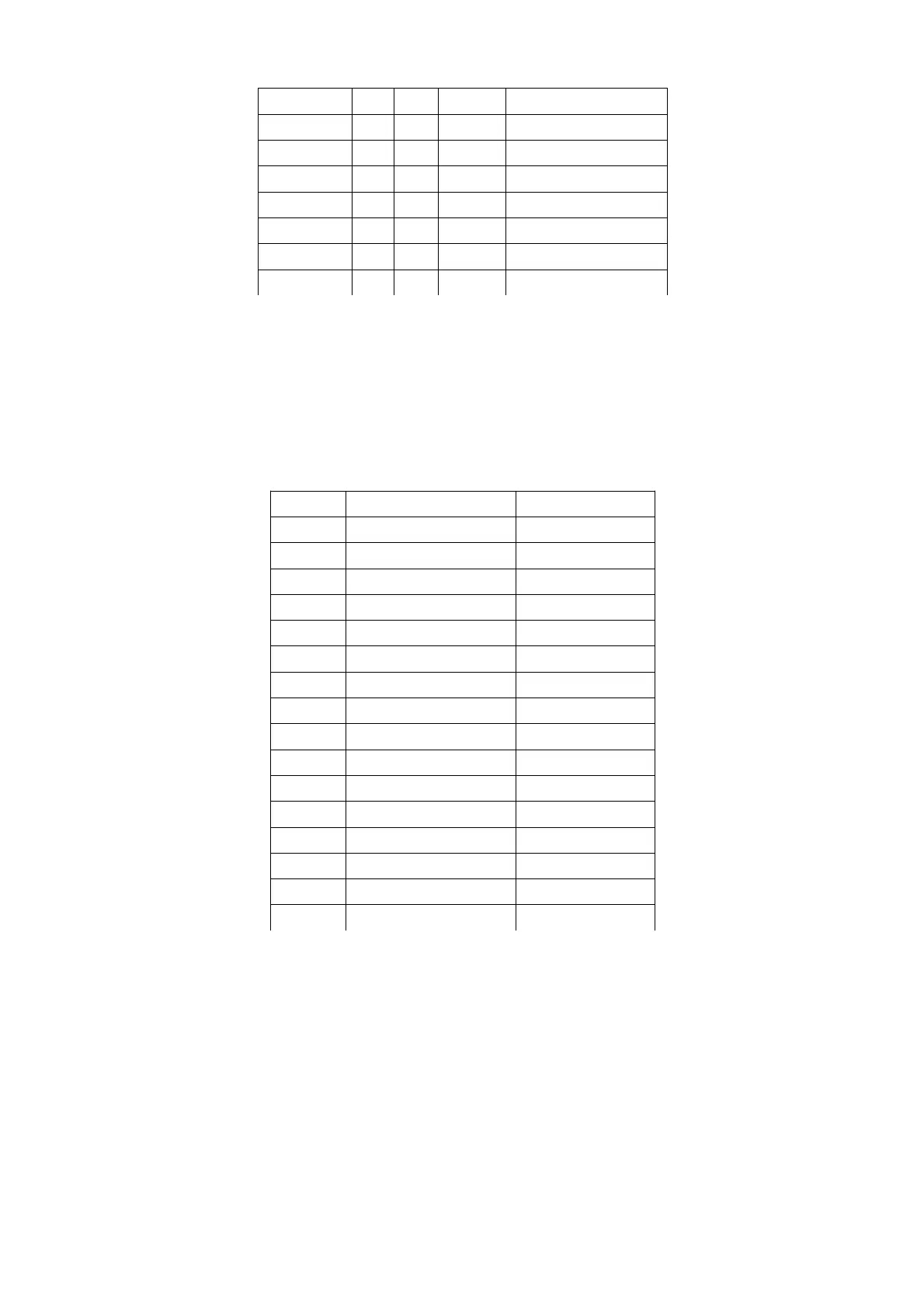
Parameter Min Max Default Description
0 0 32 32 Input X attenuation.
1 0 1 0 Transpose mode.
2 -31 31 0 Key.
3 0 31 0 Offset.
4 0 1 0 MIDI Gate.
5 -48 48 0 Transpose.
6 0 2 0 MIDI Mode.
Output A is a quantized version of input X; the closest whole-semitone value to the unquantized
V/octave pitch CV X. Output B is a trigger signal which fires whenever output A changes - a 5V
pulse approximately 10ms long.
As well as providing a chromatic scale, this algorithm can also constrain the quantized values to a
musical scale or chord. This is controlled by the Z knob/CV.
When Z changes, the scale is displayed on the LEDs. The scale's number in the following table is
shown, and after a short pause, the scale's name.
Number Scale Displayed name
0 chromatic Chromatic
1 major scale Major
2 minor scale Minor
3 major triad Triad
4 minor triad 3b+5
5 root+5th Fifth
6 major triad+6th Triad+6
7 minor triad+6th 3b+5+6
8 major triad+7th Triad+7
9 minor triad+7th 3b+5+7
10 root+5th+6th 5+6
11 root+5th+7th 5+7
12 pentatonic major Pent
13 pentatonic minor Minor Pent
14 natural minor scale Nat Minor
15 harmonic minor scale Harm Minor
A further option is controlled by Z being positive or negative. When Z is negative, the scale number
is shown as a negative value.
When Z is positive input Y is a transpose control. The CV on input Y is quantized (to a chromatic
scale) and added to the quantized result in one of two ways, controlled by parameter 1. If parameter
1 is zero, the transposition is applied to output A, after input X has been quantized to the chosen
scale. If parameter 1 is one, the transposition is applied to input X before it is forced into the chosen
scale. So, in mode zero the overall key of the quantization is transposed, whereas in mode one the
transposition moves the notes around within the same key.
When Z is negative input Y is a trigger. In this mode, input X is only sampled and converted to a
new quantized value when input Y rises over approximately 1V. (In non-triggered mode, X is
Page 23


 To Next Page