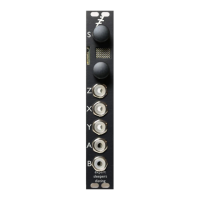
Z sets the amplitude of the outputs.
When the pitch is changed, the note name is scrolled across the display, first as a normal name (e.g.
'C#4') and then as a MIDI note number (e.g. 61).
G-4 Frequency Reference
Video
X & Y are not used
A is sine output
B is square output
Z sets the amplitude of A & B
Generates sine and square waves at a fixed frequency, specified in Hz.
Z sets the amplitude of the outputs.
When the pitch is changed, the frequency is scrolled across the display (e.g. '440Hz').
This algorithm uses an interface unlike any other, in order to be able to set the digits of the
frequency individually. It is somewhat like the usual parameters interface, in that pressing Z
advances through the digits, and turning S changes the values.
When S is turned, a pair of digits is displayed. The first is the decimal place that is being edited in
the frequency value e.g. '0' is ones, '1' is tens, '2' is hundreds and so on. The second digit is the value
of that digit within the frequency value.
Pressing Z advances the decimal place, and displays a pair of digits as above representing that new
part of the frequency value, which can then be edited with S.
G-5 Tuner
Video
X is input
Y is not used
A is a copy of X
B is a sine wave at the tracked pitch
Z sets the amplitude of B
Parameter Min Max Default Description
0 -99 99 0 Reference frequency.
This algorithm provides a chromatic tuner. The pitch of the input signal is tracked and displayed as
a note name, with indication of whether the note is sharp or flat.
Natural notes are shown in capitals i.e. 'C', 'D', 'E' etc. Lower case letters indicate sharps e.g. 'c'
indicates C sharp, 'd', indicates D sharp.
The fifth column of LEDs in the display shows the octave.
The sixth and seventh columns show how far away from the correct pitch the note is. When the note
is tuned, the sixth column will be blank and the seventh will have the centre LED lit.
Output A is a copy of X, so the tuner can be left inline without needing a mult.
Output B is a sine wave at the pitch of the detected note. The amplitude of the sine wave is set by
the Z knob/CV.
Page 60


 To Next Page