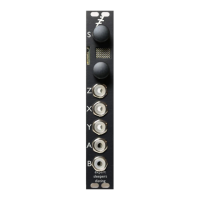
C-8 Bit Crusher
Video
X is signal input
Y is sample rate or signal (stereo) input
Z sets bit reduction
A is signal output
B is comparator or signal (stereo) output
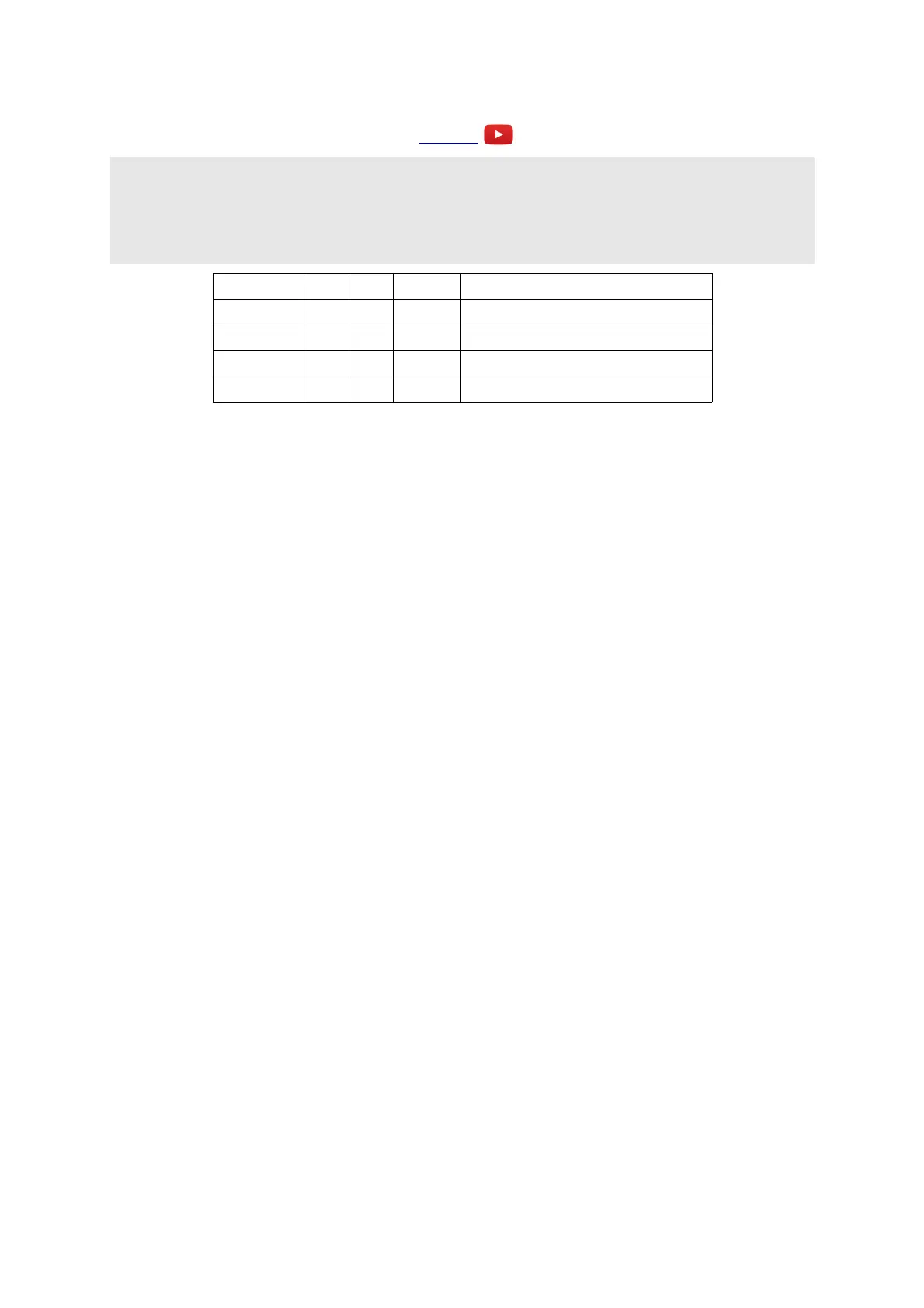
Parameter Min Max Default Description
0 -31 31 0 Applies an offset to the Y input.
1 0 7 0 Selects the bit reduction mode.
2 0 7 0 Selects the bit mangling mode.
3 0 1 0 Stereo mode.
This algorithm is a 'bit crusher' - it applies sample rate and sample depth reduction to deliberately
introduce quantisation and aliasing artefacts. It also optionally applies bitwise modification of the
samples for non-linear distortion effects.
X is the signal input.
Y is the sample rate reduction CV input. It has a 1V/octave response i.e. the sample rate is reduced
by a factor of 2 for every 1V rise in CV. This CV is offset by parameter 0, so you can set a rate
reduction without a CV input.
A is the signal output.
B is the output of a comparator. Output A is compared against zero; output B is +5V if A is above
zero, or 0V if A is below zero.
If parameter 3 is set to 1, the algorithm becomes stereo. Input Y is then the second signal input, and
output B is the second signal output.
The Z control sets the bit depth reduction. There are two types of bit reduction available:
• Type I - the signal is quantised to a 16 bit word, and the low bits thrown away. The
resulting signal uses a power of 2 bits. Changing between bit depths is therefore
discontinous.
• Type II - quantisation is achieved via the limited precision of integer maths when dividing
the signal by a factor. Since the factor can be continuously varied, this offers a smooth
variation between 'bit depths'.
Furthermore, positive and negative values of Z have different effects.
• Positive Z treats the whole signal range as one number to be quantised.
• Negative Z treats positive and negative sections of the input signal differently. Negative
sections are flipped positive, quantized, and flipped back.
Page 38


 To Next Page