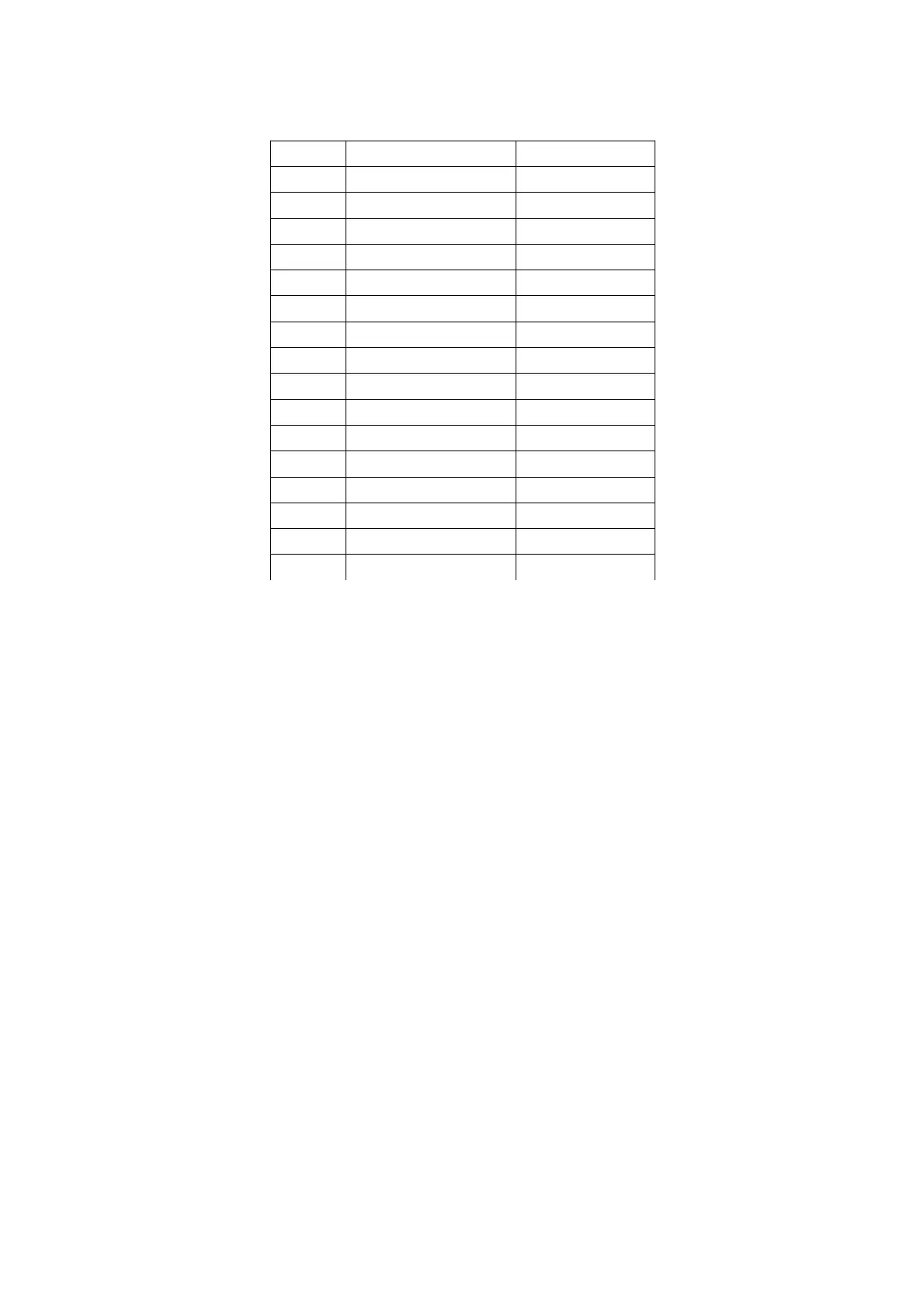
When Z changes, the scale is displayed on the LEDs. The scale's number in the following table is
shown, and after a short pause, the scale's name.
Number Scale Displayed name
0 chromatic Chromatic
1 major scale Major
2 minor scale Minor
3 major triad Triad
4 minor triad 3b+5
5 root+5th Fifth
6 major triad+6th Triad+6
7 minor triad+6th 3b+5+6
8 major triad+7th Triad+7
9 minor triad+7th 3b+5+7
10 root+5th+6th 5+6
11 root+5th+7th 5+7
12 pentatonic major Pent
13 pentatonic minor Minor Pent
14 natural minor scale Nat Minor
15 harmonic minor scale Harm Minor
For each quantizer, a parameter provides a transpose control. The transposition is applied to the
input before it is forced into the chosen scale i.e. the transposition moves the notes around within
the same key.
Parameter 4 sets the root key of the chosen scale. At zero, the first note of the scale (e.g. C in the
key of C) corresponds to 0V. If the parameter is set for example to 2, the first note of the scale is at
2/12 = 0.1667V - or to look at it another way, if your VCO is tuned so that 0V gives you a C, the
quantizer is now working in the key of D (D major, minor, triad etc. depending on the scale setting).
The quantized notes names are shown on the display (A left, B right). Natural notes are shown in
capitals i.e. 'C', 'D', 'E' etc. Lower case letters indicate sharps e.g. 'c' indicates C sharp, 'd', indicates
D sharp.
MIDI Output: each new note is output as a MIDI note message on the MIDI channel selected in
the settings (input X/output A) or on the next highest channel (input Y/output B). E.g. if the settings
specify MIDI channel 4, the notes are output on channels 4 (X/A) and 5 (Y/B).
H-4 Dual Quantizer
Page 68


 To Next Page