D-3 Waveform Animator
Video
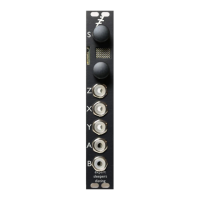
X is audio input
Y is threshold
Z is separation
A = animated output
B = square waves output
Parameter Min Max Default Description
0 -1 31 11 LFO depth.
1 -31 31 0 Y offset.
2 0 31 23 LFO rate.
3 -1 31 -1 Scale.
This algorithm recreates a popular analogue circuit variously known as a waveform animator or
wave multiplier. Such a circuit, when given (typically) a sawtooth waveform as input, uses a
comparator to generate a square wave of suitable phase and pulsewidth such that when the square
and saw waves are added together the result is a phase shifted saw waveform. This is usually done a
number of times and the results added with the overall effect of turning the original, rather plain,
waveform into a much richer one which to all intents and purposes is the same as if you'd started
with a number of VCOs rather than just one, and so sounds "fatter". In combination with LFOs
varying the comparator thresholds, very rich textures can be generated.
Here, four comparators and four LFOs are used.
X is the audio input.
The thresholds of the comparators are set by a combination of Y and Z. Y sets the 'centre' threshold;
Z sets a 'spread' of the individual thresholds around the centre. Parameter 1 also sets the centre.
Parameter 0 sets the LFO depth. Parameter 2 scales the LFO rates; the four LFOs have preset
individual speeds, which the parameter multiplies.
Parameter 3 sets the 'scale'. The recreation of phase shifted sawtooths works best when the square
wave amplitude is matched to that of the saw. The default setting of -1 uses an envelope tracker to
automatically set the square amplitude from the incoming audio. Other values directly set the
amplitude (31 corresponds to ±8V). Fixing the amplitude of the square waves and varying the input
signal's amplitude is a useful effect in its own right.
Output A is the animated output (sum of the orignal signal and the comparator outputs). Output B is
just the square waves.
Page 41


 To Next Page