H-8 Quantizer 2
Video
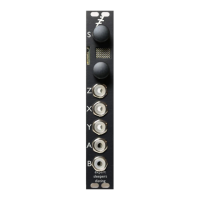
X is pitch CV input
Y is trigger input or pitch CV input
Z sets the interval between A & B
A is quantized CV out
B is quantized CV out
Receives MIDI
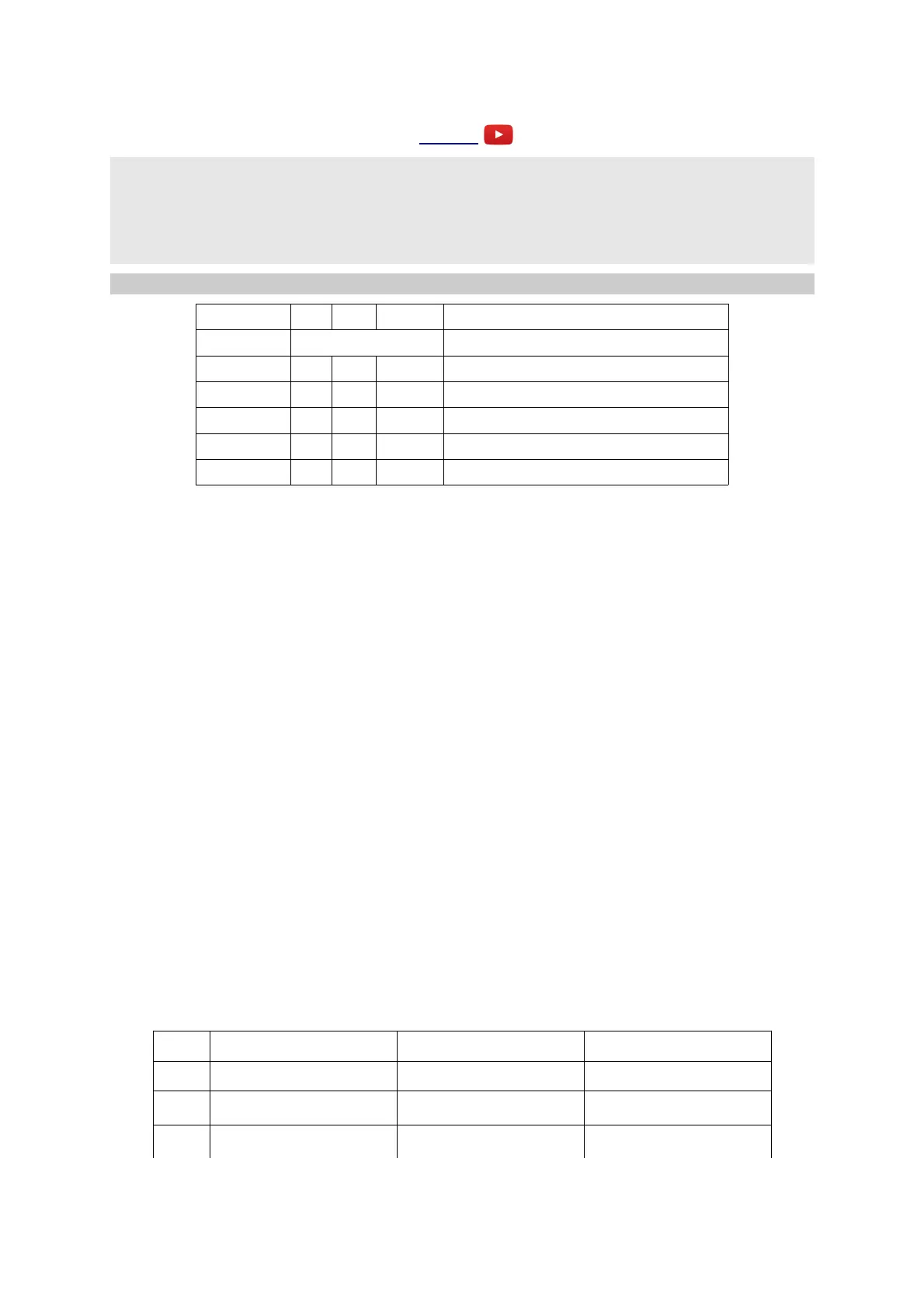
Parameter Min Max Default Description
0 N/A Pattern.
1 0 2 0 Scale.
2 -12 12 0 Key.
3 0 32 32 Input X attenuation.
4 -32 32 -32 Trigger mode / offset / Y attenuation.
5 0 32 0 Slew rate.
The imaginatively-named Quantizer 2 algorithm offers pitch quantization to musical scales, with
real-time user control over the notes in the scale to quantize to, and with two CV outputs that can be
offset by a musical interval (e.g. a third, a fifth, an octave etc.).
X is the pitch CV input. Parameter 3 allows you to attenuate the signal before it is quantized.
Y is either a second pitch CV input, simply added to X, or a trigger input. When it is a pitch input, it
is added to X after X has been attenuated – the attenuation parameter does not affect Y.
Parameter 4 controls the function of Y. When the parameter is in the range -32 to 0, Y is a CV
input, attenuated by the parameter (so -32 means no attenuation, -16 means 50%, and 0 means
complete attenuation). When the parameter is 1-32 Y is a trigger input, and the parameter defines an
offset (in sample frames) between the timing of the X & Y inputs. It is often a good idea to delay
the trigger slightly relative to the pitch, to ensure that the pitch has changed and settled before the
trigger samples a new note.
A & B are the quantized pitch CV outputs. The Z knob/CV controls an interval between the two
CVs, applied to output B. The interval is specified in scale degrees, so for example '3' is a third, and
'8' is an octave. 'U' is displayed for unison. Note that this is not simply a constant voltage offset
between the outputs – the voltage difference changes according to the position in the scale. For
example, if the interval is a third, in C major, and output A is C (0V), then output B will be E
(0.333V, a difference of 0.333V); if output A is D (0.167V), output B will be F (0.417V, a
difference of 0.25V).
Parameter 5 sets a slew rate for both outputs. At a value of 0 there is no slew; larger values apply
increasingly more slew.
Parameter 1 chooses the scale. The available options are:
Value Name Notes Example (on C)
0 Major 1, 3, 5, 6, 8, 10, 12 C D E F G A B
1 Natural Minor 1, 3, 4, 6, 8, 9, 11
C D E♭ F G A♭ B♭
2 Harmonic Minor 1, 3, 4, 6, 8, 9, 12
C D E♭ F G A♭ B
Page 73


 To Next Page