Video
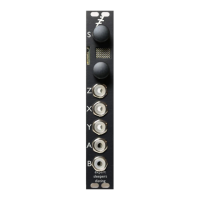
A = quantized( X+Y )
B = trigger on note change
Z is slew
Y = pitch or trigger
Outputs MIDI
Parameter Min Max Default Description
0 0 99 0 Scale.
1 0 32 32 Input X attenuation.
2 -1 32 32 Input Y attenuation.
3 -31 31 0 Transpose.
4 0 31 0 Offset.
5 0 1 0 Mode.
Output A is a quantized version of the sum of inputs X & Y, according to the scale chosen with
parameter 0.
The scales are defined by files on the MicroSD card – see “Scala Support”, above. The keyboard
mapping file is used to define the subset of notes that the quantizer may use. For example, in the
provided example files, the file 'root+fifth.kbm' can be used with a 12 note scale to make the
quantizer only output the root or fifth in each octave.
Parameter 5 chooses between two fundamentally different modes of operation. When parameter 5 is
0 (the default), an incoming CV is quantised to the closest pitch value defined by the chosen scale.
When the parameter is 1, the incoming CV is assumed linear 1V/octave and is used to look up a
note in the scale according to the keyboard map, based on the nearest semitone value of the input.
To understand the difference between these two modes, consider a scale with 19 degrees per octave,
and an input CV coming from a ramp LFO. In mode 0, the LFO will step through all 19 tones,
arriving at an octave when the CV is 1V higher than it started. In mode 1, when the LFO rises by
1V, the output will have only risen by 12 degrees of the scale; it will need to rise by another half
Volt or so to reach the octave. Or consider the same situation but with the input from a keyboard,
starting at 0V and rising 1/12
th
of a Volt per semitone. In mode 0, each semitone will be quantized
to the closest degree of the 19 tone scale, but you'll still only get 12 tones per octave. In mode 1,
playing the keyboard up from, say, C to C will give you 12 tones of the 19 tone scale; you would
need to continue up to the next G to reach the octave.
Output B is a trigger signal which fires whenever output A changes - a 5V pulse approximately
10ms long.
Parameters 1 & 2 are attenuators for inputs X & Y respectively. At 0 the input is completely
attenuated; at 32 the input is unattenuated.
If parameter 2 is set to -1, input Y becomes a trigger. In this mode, input X is only sampled and
converted to a new quantized value when input Y rises over approximately 1V. (In non-triggered
mode, X is constantly sampled and a new note is output as soon as X moves to the next scale
degree.)
Parameter 3 is a transpose control. The transposition occurs after the quantization, and is in terms of
the mapped notes of the scale. For example, if you're using a seven tone scale, with all tones
mapped, then a transposition of 7 raises or lowers the pitch by an octave.
Page 95


 To Next Page