Quantum Series Videowall Processing Systems • Reference Information 8484
IP addresses and octets
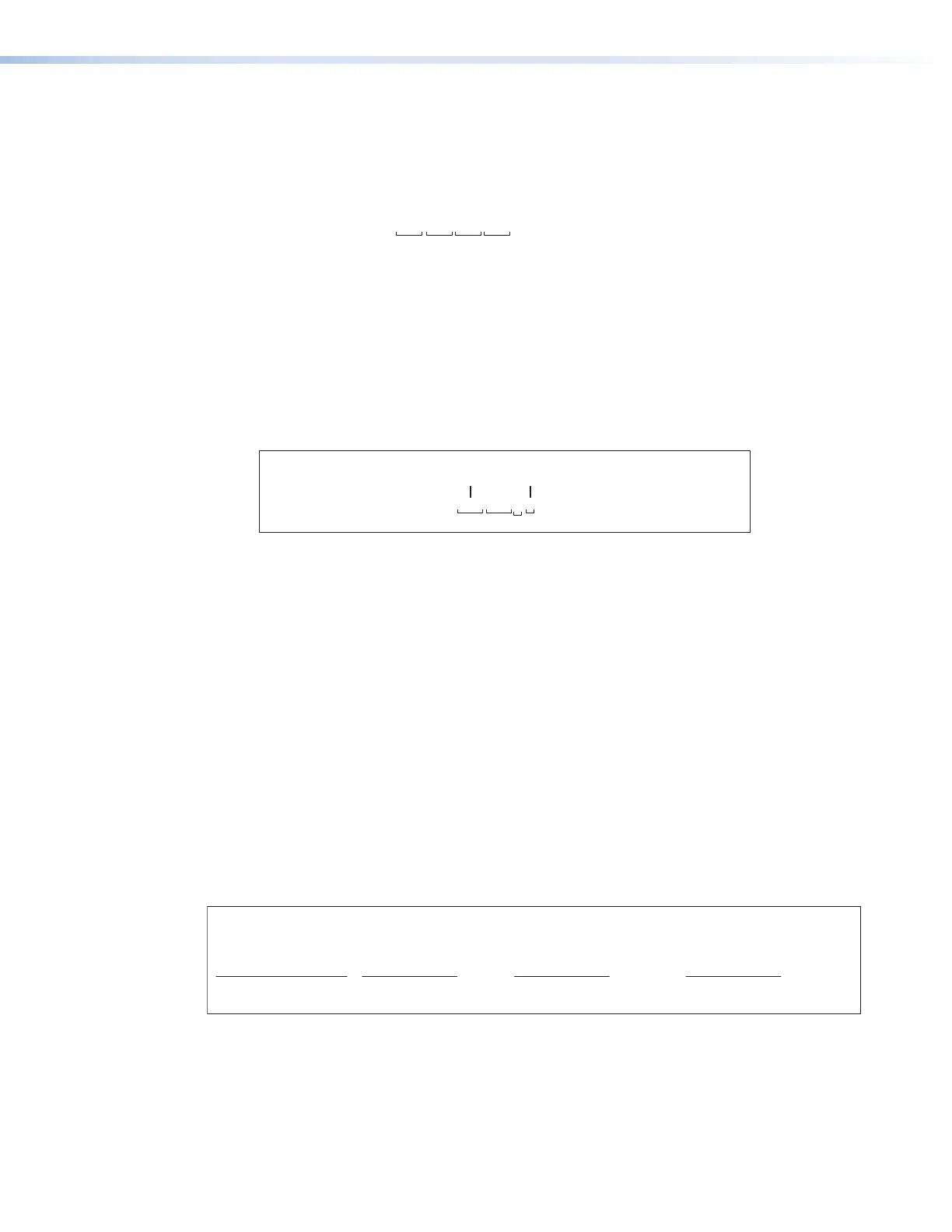
Valid IP addresses consist of four 1-, 2-, or 3-digit numeric sub-fields, called “octets,”
which are separated by dots (periods) (figure 71). Each octet can be numbered from 000
through 255. Leading zeros, up to 3 digits total per octet, are optional. Values of 256 and
above are invalid.
192.168.254.254Typical IP Address:
Octets
Figure 71. IP Address and Octets
Subnet masks and octets
The subnet mask (see figure 72) is used to determine whether the local and remote
devices are on the same subnet or different subnets. The subnet mask consists of four
numeric octets separated by dots. Each octet can be numbered 000 through 255.
Leading zeros, up to 3 digits total per octet, are optional. Each octet typically is either 255
or 0. The octets determine whether or not the same octets of two IP addresses will be
compared when determining if two devices are on the same subnet.
255.255.0.0Typical Subnet Mask:
Octets
0 indicates that this octet will not be
compared between two IP addresses.
255 indicates that this octet will be
compared between two IP addresses.
Figure 72. Subnet Mask and Octets
Determining whether devices are on the same subnet
To determine the subnet, the local device IP address is compared to the remote device IP
address (see figure 73). The octets of each address are compared or not, depending on
the value in the related subnet mask octet.
• If a subnet mask octet has the value 255, the related octets of the local device
address and the remote device IP address are unmasked.
Unmasked octets are compared (indicated by ? in figure 73).
• If the subnet mask octet has the value 0, the related octets of the local device and
remote device IP addresses are masked.
Masked octets are not compared (indicated by X in figure 73).
If the unmasked octets of the two IP addresses match (indicated by = in example 1 of
figure 73), the two addresses are on the same subnet.
If the two unmasked fields do not match (indicated by an unequal sign in figure 73,
examples 2 and 3), the addresses are not on the same subnet.
192.168.254.254
255.255.0.0 (?.?.X.X)
192.168.2.25
= . = .X.X — Match
(Same subnet) (Different subnet) (Different subnet)
Local IP Address:
Subnet Mask:
Remote IP Address:
Match?:
Example 1 Example 2
192.168.254.254
255.255.0.0 (?.?.X.X)
190.190.2.25
≠ . ≠ .X.X — No match
Example 3
192.168.254.254
255.255.0.0 (?.?.X.X)
192.190.2.25
= . ≠ .X.X — No match
Figure 73. Comparing the IP Addresses


 To Next Page