6
GENERAL FEATURES
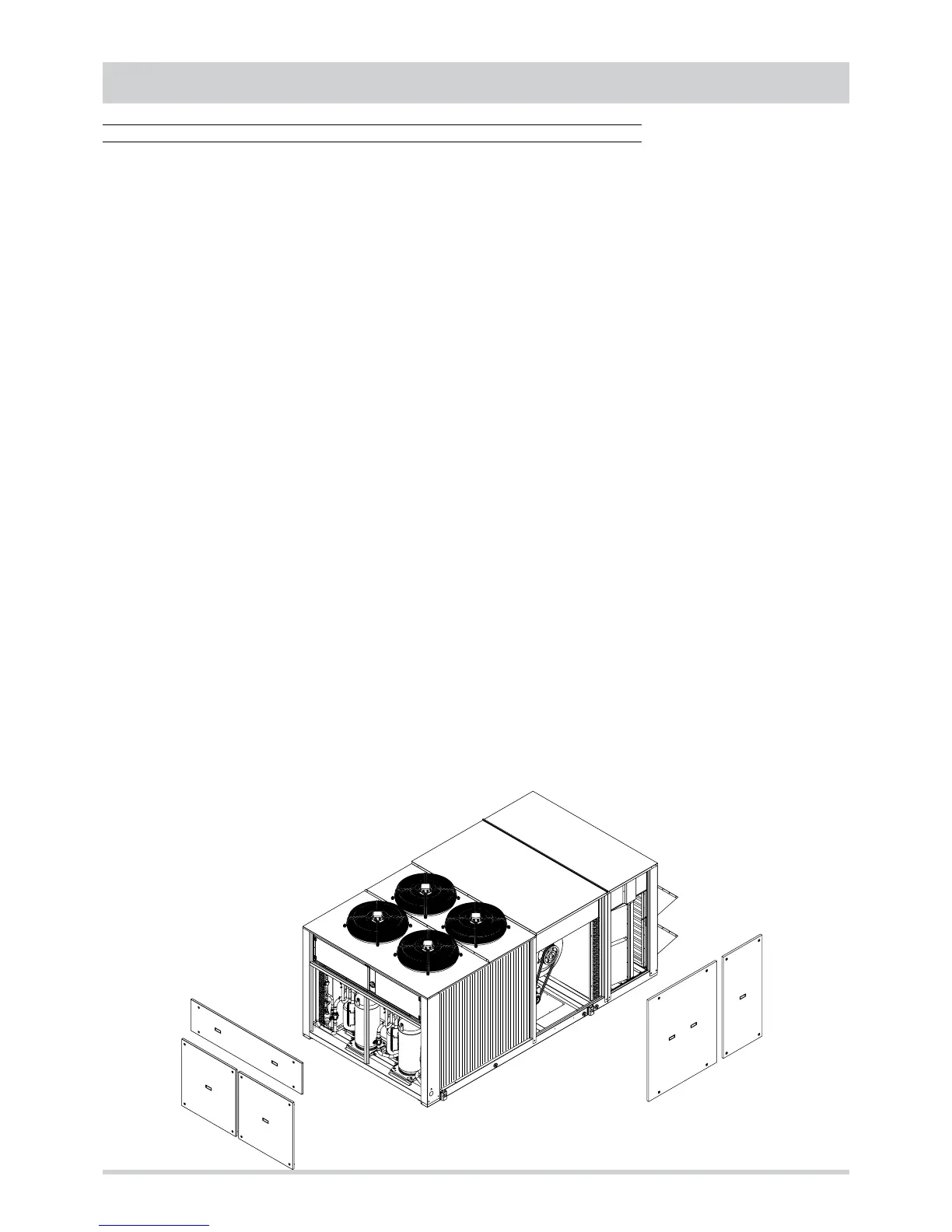
Description of components
External structure. Basement, supporting structure and
lateral panels are made of galvanized and painted sheet-
steel (colour RAL 7035) to guarantee good resistance to
atmospheric agents.
The inspection panels are all easily removable by means of
¼ turn locks in order to allow total accessibility to the internal
components. The area in contact with the treated air is realized
with galvanized sheet-steel to guarantee proper cleaning and
is externally insulated by means of foam panels and double
panels with interposed an appropriate thermo acoustic
absorber layer in class 1.
External fan section. It is realized by axial fans with alluminium
sickle profiled blades, placed in a galvanized and painted
sheet-steel nozzle, equipped with a safety protection grille and
directly coupled to external rotor motors with intenal thermal
protection. The fans rotational speed is modulated continuosly
by a phase cut device (option) that allow to control the
condensing pressure (in cooling) and the evaporation pressure
(in heating) according to the value read by the temperature
probe placed on the liquid line.
Internal fan section. It is realized by a couple of centrifugal
fans with double aspiration with forward curved blades
balanced both statically and dynamically according to ISO
1940 standards, grade 6.3. The screw, the impeller, and the
frame are realized with galvanized sheet-steel, while the shaft
is made of C40 steel. The fan is coupled by means of belt and
pulleys to a three phase asynchronous 4-poles electrical motor
connected to an appropriate belt tightening slide, with IP55
protection rating, F insulation class, and suitable for continuous
service (S1) with enough heating margins in case of overloads
of limited extent. For powers equal to or greater than 4 kW the
units are equipped as standard with star-delta starter in order
to reduce the starting current and to ensure longer life of the
transmission. The pulley installed on the motor is a variable
diameter type pulley, and allows, within certain limits, to adjust
the rotational speed of the fan to obtain the desired air flow and
available head values.
Return air fan section. It is realized by a couple of centrifugal
fans with double aspiration with forward curved blades
balanced both statically and dynamically according to ISO
1940 standards, grade 6.3. The screw, the impeller, and the
frame are realized with galvanized sheet-steel, while the shaft
is made of C40 steel. For the models of frame 1 and 2 the
fan is directly coupled to a 2 speed electrical motor (star or
delta connection). For the models of frame 3 the fan is coupled
by means of belt and pulleys to an electrical motor connected
to an appropriate belt tightening slide. The pulley installed on
the motor is a variable diameter type pulley, and allows, within
certain limits, to adjust the rotational speed of the fan to obtain
the desired air flow and available head values.
Filtering section. All the units are equipped with waved type
filter cells realized with a galvanized sheet metal frame, an
electrically welded galvanized steel wire protective screen
and a reusable filter element made of polyester fiber stiffened
with synthetic resins. The filter cells have G4 efficiency
class according to standard CEN-EN 779 (Eurovent EU4
classification - 90% average weighted efficiency) and class 1
flame resistance. The filter cells are easily accessible for the
periodic cleaning and inspection operations. Once the advised
final pressure drop has been reached, the synthetic fiber can be
partially reused after treating with warm water and detergents.
Refrigerant circuit. It is contained inside a compartment
separated from the air flow to simplify maintenance and control
operations.
The ermetic scroll compressors (1) are mounted on damper
supports and are protected against overtemperatures and
overcurrents. They are equipped with an electrical heater,
that is activated when the compressor turns off, to keep the
compressor crankcase oil temperature high enough to prevent
migration of refrigerant during winter stops and to evaporate
any liquid present in the crankcase, in order to prevent possible
liquid rushes on starting (only heat pump models).



 To Next Page