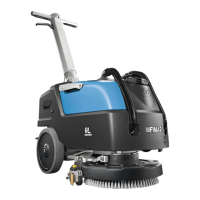
INSERTING WATER SYSTEM FILTER
Before using the machine for the rst time the water system lter needs to be reset, for shipping reasons the lter cartridge and the cap have
been removed. To insert the lter cartridge in the water system lter body proceed as follows:
1. Take the machine to the maintenance area.
2. Make sure the machine has been secured (see the section titled “SECURING THE MACHINE”).
CAUTION: it is recommended to wear the appropriate PPE (Personal Protective Equipment), suitable for the work to be carried out.
3. Close the tap's output ow, and shift the knob (10) on the left hand side of the steering column (Fig. 10) downward.
4. Open the machine's left lateral hatch (11) (Fig. 11).
5. Insert the lter cartridge (12) in the housing on the cap (13) (Fig. 12).
N.B.: the O-ring gasket in the lter cartridge should be inserted into its seat in the cap.
6. Screw the cap (13) onto the body of the detergent solution lter (14) (Fig. 13).
N.B.: for the sweeping versions, the water system lter is located on the right of the machine.
FILLING THE SOLUTION TANK
Before lling the solution tank, carry out the following steps:
1. Take the machine to the usual place for lling the solution tank.
2. Perform the procedure for securing the machine (see the section titled “SECURING THE MACHINE”).
3. Check to make sure that the solution tank drainage cap (15) is closed. If this is not the case, close it (Fig. 14).
4. Move to the left side of the machine and open the left side casing (11) (Fig. 11).
5. Check to make sure that the water system lter cap (13), located on the rear left-hand side of the machine, is closed, and close it if
necessary (Fig. 15).
The solution tank can be lled with water in two dierent ways:
• Removing the cap (16) and lling the solution tank by means of a rubber hose or a bucket (Fig. 16).
N.B.: check that the lter (17) under the ller cap (16) is positioned correctly; this is to prevent impurities and dirt causing the appliance's
water system to malfunction (Fig. 16).
• Using the ller hose (18) (Fig. 16). This supports the water hose on its own, but be sure to remove the cap (16) to allow adequate air venting.
6. Fill with clean water, at a temperature not higher than 50°C and not lower than 10°C. The amount inside the tank can be seen by means of
the level tube (19) on the front left of the seat (Fig. 16).
DETERGENT SOLUTION
For the versions without automatic detergent dosing system, after lling the solution tank with clean water, add the liquid detergent to the tank
in the concentration and manner indicated on the detergent manufacturer's label. To prevent the formation of an excessive amount of foam that
could damage the vacuum motor, use the minimum percentage of detergent required.
CAUTION: protective gloves should always be worn before handling detergents or acidic or alkaline solutions, to avoid serious injury
to the hands.
ATTENTION: always use detergents whose manufacturer's label indicates their suitability for scrubbing machines. Do not use acid
or alkaline products or solvents without this indication.
ATTENTION: always use low-foam detergent. To avoid the production of foam, put a minimum quantity of antifoam liquid in the recovery
tank before starting to clean. Do not use pure acids.
For versions with automatic detergent dosing system, ll the solution tank with clean water and then proceed as follows:
1. Make sure the machine is in a safe condition (read “MACHINE SAFETY”).
CAUTION: protective gloves should always be worn when handling detergents or acidic or alkaline solutions, to avoid serious injury
to the hands.
2. Remove the cap (20) of the detergent canister (Fig. 17).
3. Fill the canister with the desired detergent; it is possible to see the quantity in the detergent canister using the level tube (21) on the front left
of the canister (Fig. 17).
16


 To Next Page