
 Need help?
Do you have a question about the Flashforge Guider II and is the answer not in the manual?
Users will find the Quick Start Guide together with the printer accessories.
The official FlashForge website contains up-to-date information concerning software, firmware, and device maintenance.
Guidelines for maintaining a safe work environment, including tidiness and avoiding flammable substances.
Safety precautions related to electrical connections, grounding, and avoiding wet conditions.
Safety measures for users, such as avoiding contact with hot parts and proper attire.
Important warnings and precautions for operating the 3D printer safely and correctly.
Recommended environmental conditions for operating the 3D printer, including temperature and humidity.
Guidelines for positioning the printer in a suitable location with adequate space.
Recommendations for using compatible filament brands and proper filament handling.
Best practices for storing filament to maintain its quality and prevent degradation.
Information regarding document amendments, warranties, and liability.
Compliance statement regarding FCC rules for the device's operation.
Overview of the 3D printing workflow including model creation, slicing, and building.
Methods for creating 3D models: designing from scratch, 3D scanning, and downloading from cloud.
Using slicing software like FlashPrint to prepare 3D models for printing and export.
The process of the printer creating a physical object by laying down filament layers.
Step-by-step guide covering first print and daily print procedures.
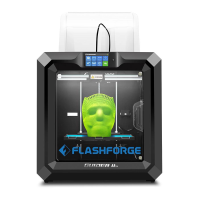
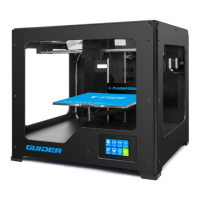
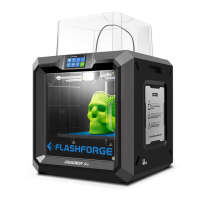
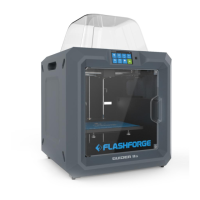
General information and overview of the Guider II 3D printer.
Identification of the different parts and views of the Guider II printer.
Definitions of key terms and components related to the Guider II 3D printer.
Technical specifications and reference data for the Guider II 3D printer.
Explanation of the various menus and options available on the Guider II's touch screen interface.
List and images of all included accessories with the Guider II 3D printer.
Step-by-step guide on how to install the filament cartridge and thread the filament.
Instructions for connecting the power supply and turning on the Guider II printer.
Detailed steps for properly loading filament using the filament guide tube.
Procedures for safely removing filament from the extruder.
Methods for acquiring and installing the FlashPrint software.
Details on how to obtain the FlashPrint installation package.
Steps to decompress, install, and launch the FlashPrint software.
Guide to navigating and understanding the features within the FlashPrint software.
How to select the correct printer model (Guider II) within FlashPrint.
Overview of the FlashPrint user interface and its main icons.
Various methods for loading model files or Gcode into FlashPrint.
How to change and manage viewing angles of the 3D model within FlashPrint.
Instructions on how to move and adjust the position of a 3D model in FlashPrint.
Steps for rotating a 3D model on different axes within FlashPrint.
How to resize a 3D model in FlashPrint using various methods.
Methods for cutting a 3D model into multiple parts using FlashPrint.
How to add, manage, and configure support structures for 3D models in FlashPrint.
Configuring print settings, previewing, and initiating the slicing process in FlashPrint.
Explanation of the File menu options for project management and saving in FlashPrint.
Overview of Edit menu functions like Undo, Redo, Copy, Paste, and Delete in FlashPrint.
How to connect the printer to a PC via USB or WiFi and start printing.
Using the Control Panel and other tools within FlashPrint for printer management.
Accessing help content, checking for updates, and viewing software information.
Step-by-step guide to loading a model, positioning it, and generating Gcode for printing.
Different methods for transferring and starting print jobs.
How to print a Gcode file from a computer using a USB cable connection.
How to print a Gcode file from a computer using a WiFi connection.
Instructions for printing a Gcode file directly from a USB stick.
How to print a Gcode file from a computer using an Ethernet cable connection.
Guide to setting up and printing using the Polar Cloud service.
Troubleshooting steps for extruder shaking due to loose cables or driver board issues.
Troubleshooting for incorrect extruder temperature display, likely thermocouple issues.
Solutions for extruder not heating up, involving checking pipe joints and exchange boards.
Troubleshooting steps for extruder moving uncontrollably due to sensor wire or limit switch problems.
Addressing print shape inaccuracies by checking X-Axis verticality.
Solutions for filament not extruding on the first layer, often related to build plate leveling.
Steps to clear extruder clogs and jammed filament from throat or teflon tubes.
Troubleshooting intermittent filament extrusion, checking filament quality and storage.
Diagnosing issues where filament won't extrude or load, including filament quality and diameter.
Solutions for wave-like artifacts on prints, involving Z-Axis lubrication and alignment.
Troubleshooting steps for axis motors not functioning correctly, checking for blockages or loose connections.
Resolving issues where an axis motor only moves in one direction, checking limit switches.
Fixing touch screen issues by adjusting fastening screws or replacing the screen.
Troubleshooting USB file recognition problems, checking printer type, file size, and USB stick integrity.
Addressing print shifts along the X-axis by checking the timing belt, motor wire, or driver board.
Resolving build plate leveling errors by recalibrating the extruder.
 General
| Display diagonal | 5 \ |
|---|---|
| Bundled software | FlashPrint |
| Accuracy | 0.2 mm |
| Print technology | - |
| Printing material | ABS, Polylactic acid (PLA) |
| Layer thickness (min) | - mm |
| Maximum build size (WxDxH) | 250 x 280 x 300 mm |
| AC input voltage | 100/240 V |
| Power consumption (typical) | 500 W |
 Weight and Dimensions
| Depth | 549 mm |
|---|---|
| Width | 490 mm |
| Height | 561 mm |

 To Next Page


