brake chambers will receive full (normal) appli-
cation air pressure.
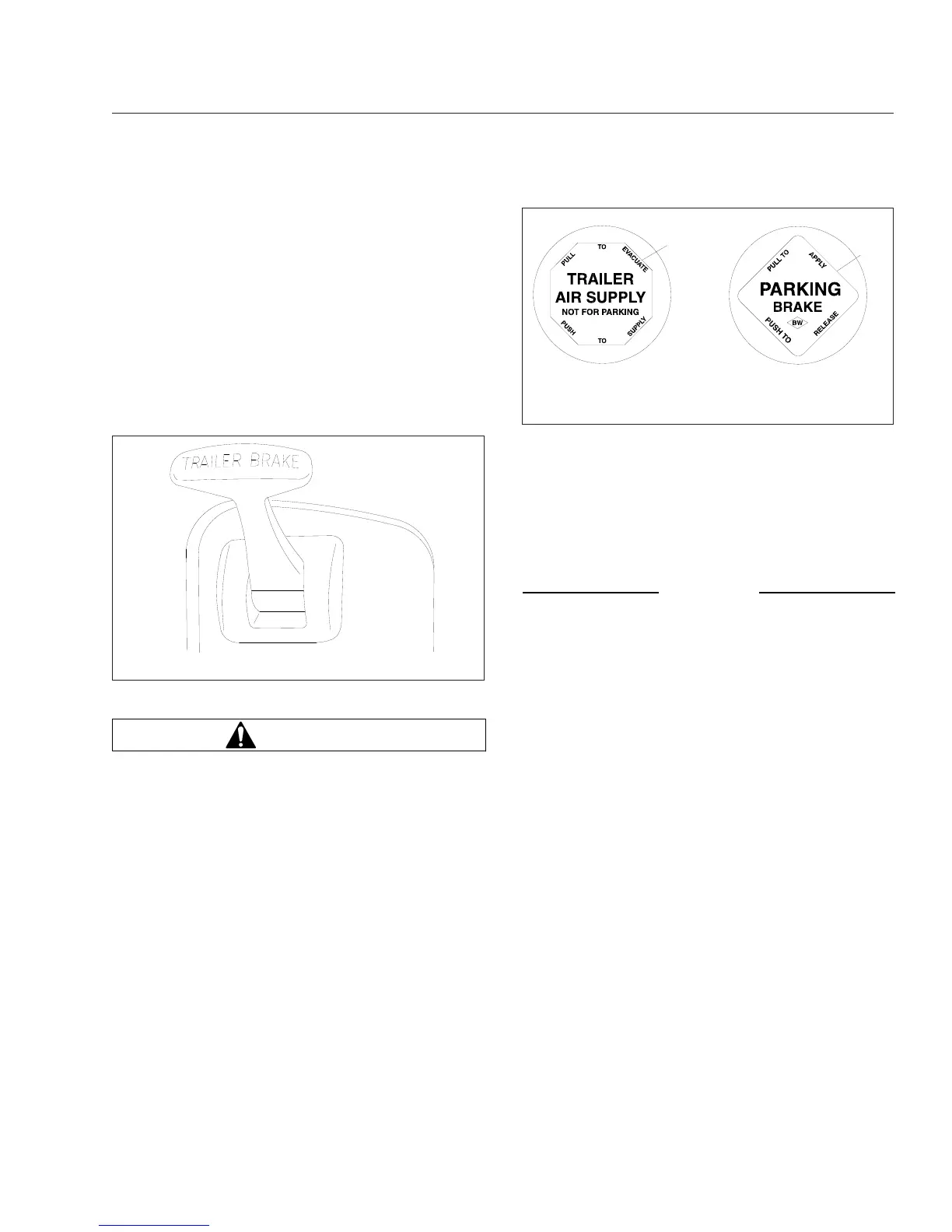
The trailer brake lever (hand control valve) is used
for applying the trailer brakes without applying the
truck or tractor service brakes. It is usually mounted
on the right-hand control panel. See
Fig. 12.1. The
valve can be partially or fully applied, but in any par-
tially on position it will be overridden by a full applica-
tion of the service brake pedal. Moving the lever
down applies the trailer brakes, while moving it up
releases the trailer brakes. The lever will automati-
cally return to the up position when it is released.
WARNING
Do not use the trailer service brakes for parking;
they are not designed for this purpose. If air
bleeds out of the trailer air tank during parking,
the vehicle could roll, causing serious personal
injury or property damage.
The red octagonal-shaped knob in the control panel
actuates the trailer air supply valve. See
Fig. 12.2.
After the vehicle’s air hoses are connected to a
trailer, and the pressure in both air systems is at
least 65 psi (448 kPa), the red knob must be pushed
in. It should stay in, to charge the trailer air supply
system and to release the trailer spring parking
brakes. It must be pulled out before disconnecting a
trailer. It must also be pulled out when operating a
vehicle without a trailer. If pressure in both air sys-
tems drops to 35 to 45 psi (242 to 310 kPa), the red
knob automatically pops out, exhausting the trailer air
supply, and applying the trailer service or spring
parking brakes.
The yellow diamond-shaped knob in the control
panel actuates the parking brake valve. See
Fig. 12.2. Pulling out the knob applies both the trac-
tor and trailer spring parking brakes and automati-
cally causes the trailer air-supply-valve knob to pop
out.
NOTICE
Do not use the spring parking brakes if the ser-
vice brakes are hot, such as after descending a
steep grade. To do so could damage the brakes.
Allow hot brakes to cool before using the spring
parking brakes.
Do not use the spring parking brakes during
freezing temperatures if the service brakes are
wet. To do so could cause them to freeze. If the
brakes are wet, drive the vehicle in low gear and
lightly apply the brakes to heat and dry them.
If the trailer is not equipped with spring parking
brakes, pulling out the yellow knob applies the tractor
spring parking brakes and the trailer service brakes.
When the tractor and trailer parking brakes (or trailer
service brakes) are both applied, the trailer brakes
are released by pushing in the red knob, leaving the
tractor parking brakes applied. Air pressure in the
primary or secondary reservoir must be at least 65
psi (447 kPa) before the tractor spring parking
brakes, or the trailer service or spring parking
brakes, can be released.
On trailers not equipped with spring parking brakes,
chock the trailer tires before disconnecting the truck
or tractor when parking just the trailer.
When parking a truck or tractor with a trailer (combi-
nation vehicle), and the trailer is not equipped with
10/17/2001
f610591
Fig. 12.1, Trailer Brake Lever
f610291
1
2
03/10/99
1. Trailer Air-Supply-Valve Knob
2. Parking-Brake-Valve Knob
Fig. 12.2, Brake Valve Knobs
Brake Systems
12.2



 To Next Page