Speedometer
Two speedometer face options are available. The
U.S. version of the speedometer registers speed in
both miles per hour (mph) and kilometers per hour
(km/h), with mph in larger numbers.
The metric version of the speedometer face reverses
this arrangement, with km/h in larger numbers.
Tachometer
The tachometer indicates engine speed in revolutions
per minute (rpm) and serves as a guide for shifting
the transmission and keeping the engine in the ap-
propriate rpm range. For low idle and rated rpm, see
the engine identification plate.
Voltmeter
The voltmeter indicates the vehicle charging system
voltage when the engine is running and the battery
voltage when the engine is stopped. By monitoring
the voltmeter, the driver can stay aware of potential
battery charging problems and have them fixed be-
fore the batteries discharge enough to create starting
difficulties.
The voltmeter will normally show approximately 13.7
to 14.1 volts when the engine is running. The voltage
of a fully charged battery is 12.7 to 12.8 volts when
the engine is stopped. A completely discharged bat-
tery will produce only about 12.0 volts. The voltmeter
will indicate lower voltage as the vehicle is being
started or when electrical devices in the vehicle are
being used.
If the voltmeter shows an undercharged or over-
charged condition for an extended period, have the
charging system and batteries checked at a repair
facility.
On a vehicle equipped with a battery isolator system,
the voltmeter measures the average voltage of all the
batteries when the engine is running. When the en-
gine is stopped, the voltmeter shows only the gel cell
battery voltage and does not indicate the voltage of
the engine-starting batteries.
NOTICE
Gel cell batteries can be damaged if the battery
voltage is allowed to drop below 12.0 volts or if
the charging voltage is more than 14.1 volts.
Start the engine to recharge the gel cell before
the battery becomes fully discharged. If an exter-
nal charger is needed, disconnect the gel cell
battery and use only an external battery charger
that has been approved for gel cell batteries.
Optional Instruments
Optional instruments are not found on every vehicle.
They are listed here in alphabetical order, to make
the information easier to find.
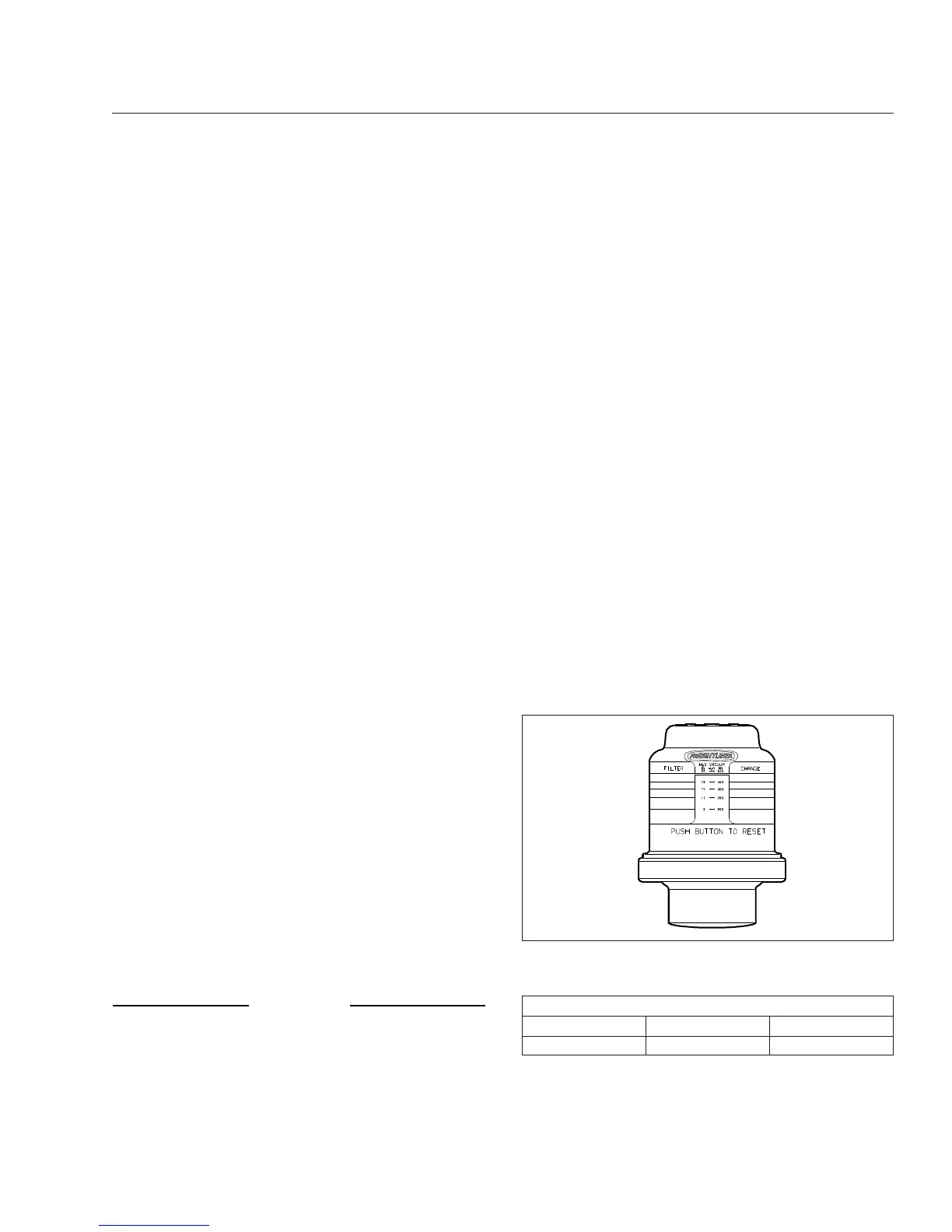
Air Restriction Gauge
The air intake restriction gauge measures the
vacuum on the engine side of the air cleaner. On
standard installations, it is mounted on the air intake
duct in the engine compartment. As an option for
easier viewing, an air intake restriction gauge may be
located in the ICU.
NOTE: Rain or snow can wet the air filter, caus-
ing a temporarily higher than normal reading.
Air intake restriction vacuum is measured in inches
of water (inH
2
O). For vehicles equipped with a
graduated indicator (see
Fig. 4.6) or a restriction
gauge on the dash, check the gauge with the engine
off. If the air restriction value equals or exceeds the
value shown in
Table 4.4, the air cleaner element
needs to be replaced.
Maximum Air Intake Restriction Values
Engine Make Initial inH
2
O
Service inH
2
O
Cummins 10 25
08/07/2007 f090452
Fig. 4.6, Manual-Reset Air Restriction Indicator with
Graduations
Instruments
4.10






 To Next Page