•
Never attempt to move the range preselection
lever with the gear shift lever in neutral while
the vehicle is moving. Preselection with the
range preselection lever must be made prior to
moving the shift lever out of gear into neutral.
•
After your shifting ability improves, you may
want to skip some of the ratios. This may be
done only when operating conditions permit,
depending on the load, grade, and road speed.
Upshifting
1.
Position the gear shift lever in neutral. Start the
engine, and bring the air system pressure up to
100 to 120 psi (689 to 827 kPa).
2.
Position the range preselection lever down, into
low range.
3.
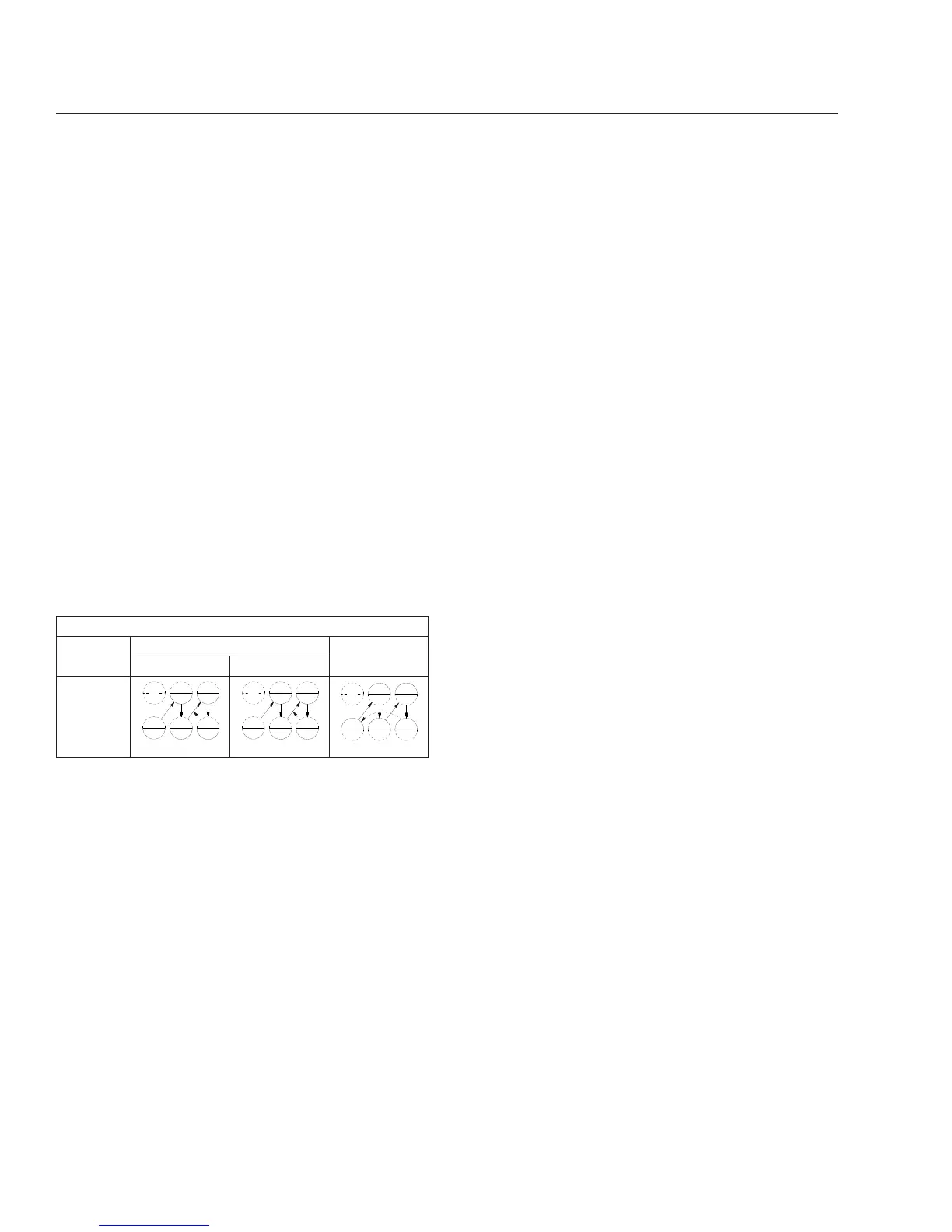
Press the clutch pedal to the floor; shift into low
or 1st gear (
Table 13.1), then engage the clutch,
with the engine at or near idle speed, to start the
vehicle moving. Accelerate to 80 percent of en-
gine governed speed.
Eaton Fuller Shift Progressions
TRANS.
MODEL
LOW RANGE
HIGH
RANGE
Off-Highway On-Highway
10-Speed
Direct or
Overdrive
(RT or
RTX)
2
3
4
1
f260329
R
5
2
3
4
1
f260329
R
5
9
8
10
7
f260330
R
6
Table 13.1, Eaton Fuller Range-Shift Shift
Progressions
4.
Shift progressively upward from low or 1st gear,
to the top gear in low range (
Table 13.1),
double-clutching between shifts, and accelerating
to 80 percent of engine governed speed.
5.
While in the top gear of the low range shift pat-
tern, and ready for the next upshift, flip the range
preselection lever up into high range. Double-
clutch through neutral, and shift into the bottom
gear in high range (
Table 13.1). As the shift lever
passes through neutral, the transmission will au-
tomatically shift from low range to high range.
6.
With the transmission in high range, shift pro-
gressively upward through each of the high
range gears (
Table 13.1), double-clutching be-
tween shifts.
Downshifting
1.
With the transmission in high range, shift pro-
gressively downward to the bottom gear in high
range, double-clutching between shifts.
2.
When in the bottom gear of the high range shift
pattern, and ready for the next downshift, push
the range preselection lever down into low range.
Double-clutch through neutral, and shift into the
top gear of the low range shift pattern. As the
shift lever passes through neutral, the transmis-
sion will automatically shift from high range to
low range.
3.
With the transmission in low range, downshift
through the low range gears as conditions re-
quire.
IMPORTANT: Never use the clutch brake when
downshifting, or as a brake to slow the vehicle.
Clutch
General Information
To ensure long service life of the clutch; start in the
right gear, be alert to clutch malfunctions, and know
when to adjust the clutch.
Typical operation will not break down the clutch fric-
tion surfaces. However, if a clutch is slipped exces-
sively, high temperatures develop quickly and destroy
the clutch. Temperatures generated between the fly-
wheel, driven discs, and pressure plates can be high
enough to cause the friction facing material to char
and burn.
Heat and wear are practically nonexistent when a
clutch is fully engaged. But during the moment of
engagement, when the clutch is picking up the load,
it generates considerable heat. An improperly ad-
justed or slipping clutch will rapidly generate suffi-
cient heat to destroy itself.
Clutch Operation
Clutch Break-In
With a new or newly installed clutch, the clutch may
slip for a short time while the friction surfaces break-
in. However, allowing the clutch to slip for more than
two seconds can severely damage the clutch disc,
pressure plate, and the flywheel.
Manual Transmissions and Clutch
13.5



 To Next Page