Need help?
Do you have a question about the Froggit HP2000 and is the answer not in the manual?
Provides critical safety warnings regarding lightning strikes and installation.
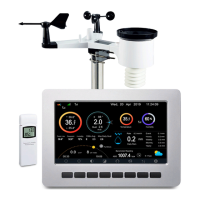
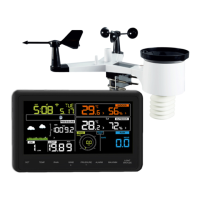
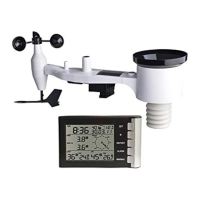
Lists items included in the weather station package.
Provides notes on battery types and power adapter placement for optimal reception.
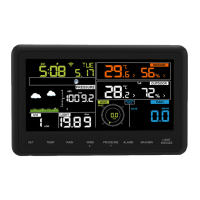
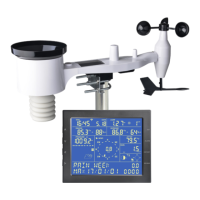
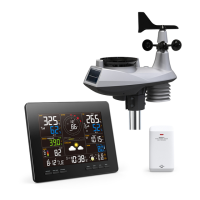
Identifies the components of the display console with a diagram.
Details the components of the outdoor wireless sensor array with a diagram.
Lists optional sensors compatible with the HP2000 console and their maximum numbers.
Outlines necessary tools and pre-installation checks before setup.
Details how to install batteries in the outdoor sensor package.
Provides guidance on mounting the ultrasonic anemometer and piezoelectric assembly.
Illustrates the process of mounting the sensor array on a pole.
Explains how to orient the sensor and use the heating plate in winter.
Describes how to reset the sensor package using the reset button and LED indicator.
Explains the factory calibration of the ultrasonic sensor and when user calibration might be needed.
Offers tips to ensure reliable wireless communication between sensors and the console.
Refers to a figure to identify elements on the console's display screen.
Explains the layout and details of the console's display screen with numbered elements.
Guides through the initial power-up and sensor data reception process.
Illustrates and explains the dark and light background display modes.
Explains the function of each key on the display console.
Details the color rings used to indicate temperature ranges on the interface.
Explains the color rings for humidity and the indications for wind direction.
Shows icons representing different hourly rainfall amounts.
Explains how to select and scroll through multi-channel sensor data.
Guides on how to view and clear maximum and minimum data records.
Explains how to enter and navigate the history record mode.
Details the process for clearing all saved history records from the console.
Explains how to navigate and view specific pages of historical data.
Guides on how to view historical data in graphical format.
Explains how to access and view data from optional sensors in channel mode.
Describes how to access the main setting mode menu.
Details the various sub-modes available within the setup menu.
Guides on setting the date, time, timezone, and synchronization.
Explains how to change the time format (e.g., 12-hour vs. 24-hour).
Covers changing date format, temperature, barometric, and wind speed units.
Explains how to rename or re-register multi-channel sensors.
Details settings for automatic backlight control and brightness adjustment.
Guides on setting the geographic coordinates for accurate sunrise/sunset times.
Covers resetting weekly rain, setting rainfall season, and storage interval.
Covers resetting daily rain data and accessing more options like calibration.
Details calibration for optional sensors and setting up sensor IDs.
Provides calibration screens for multi-channel temp/humidity and PM2.5 sensors.
Covers calibration for CO2, PM2.5, PM10 sensors and sensor ID setup.
Displays sensor signal status, ID, and registration information.
Explains how to disconnect or reconnect sensors and correct hexadecimal IDs.
Lists and describes supported internet-based weather services like Ecowitt, Wunderground.
Provides step-by-step instructions to register a station on Wunderground.com.
Details selecting the device type and finding the local position for Wunderground.
Explains filling in device details and privacy preferences for Wunderground.
Guides on obtaining and entering station ID and key for Wunderground.
Details the process of setting the station ID and key using the console keyboard.
Explains how to view weather station data on the Wunderground website.
Lists and links to mobile apps for viewing weather data (WunderStation, WU Storm).
Provides URLs for iOS and Android forecast applications from Weather Underground.
Describes the PWS Weather Station Monitor app for viewing neighborhood data.
Guides on registering a weather station with Weathercloud.
Details how to enter Weathercloud ID and Key into the console.
Provides steps to sign up and register on the Met Office WOW website.
Explains how to create a new WOW site and obtain Site ID and Authentication Key.
Guides on finding the Site ID and setting the Authentication Key (PIN).
Shows the screen for configuring WOW server settings on the console.
Details the steps to register and upload data to Ecowitt.net.
Explains how to view sensor data on the ecowitt.net website and set data sharing.
Illustrates the Ecowitt dashboard and graph display for sensor data.
Shows the list view of sensor data and the weather map feature on Ecowitt.
Provides guidance for advanced users to set up a custom server.
Details configuration for custom servers using Wunderground or Ecowitt protocols.
Explains how to scan for available Wi-Fi networks and connect.
Guides on connecting to Wi-Fi networks with hidden SSIDs.
Guides on setting high and low alarm values for various weather parameters.
Provides an overview of calibration settings for different sensors.
Details how to adjust calibration values for temperature, humidity, pressure, etc.
Discusses calibration sources and provides notes for temperature and humidity.
Explains pressure readings and notes on sensor array installation for calibration.
Covers calibration for solar radiation, wind speed, and rain gauge.
Lists options for factory reset, re-registering transmitters, and clearing data.
Details re-registering indoor/outdoor transmitters and automatic Max/Min clearing.
Explains how to clear history records and back up data to an SD card.
Displays device model, storage, firmware, MAC, and IP address.
Guides on selecting and switching the display language.
Explains the Beaufort scale for wind speed classification.
Details the UV-index scale and its corresponding descriptions.
Explains the meaning of weather forecast icons based on barometric pressure changes.
Describes the lightning alert icon and limitations of weather forecasting.
Explains how the moon phase is displayed on the console.
Provides a chart showing moon phases from Day 1 to Day 26.
Details the steps for replacing the Temp & Humidity sensor kit.
Provides solutions for outdoor sensor array communication problems with the console.
Addresses issues like high temperature readings, pressure discrepancies, and rain gauge errors.
Solves problems with reporting data to Wunderground and Wi-Fi connectivity.
Lists the technical specifications for the outdoor sensor array.
Details specifications for the indoor sensor, power source, and transmission.
Provides crucial safety information, including dangers of asphyxiation, burns, shock, fire, and explosion.
States policies on manual reproduction, errors, and trademarks.
Provides contact information and company registration details for HS Group.
States product compliance with essential requirements of Directive 2014/53/EU.
 General
| Temperature Range (Indoor) | 0°C to 50°C (32°F to 122°F) |
|---|---|
| Humidity Range | 1% to 99% |
| Indoor Humidity Range | 1% to 99% |
| Wireless Range | 100m |
| Rainfall Range | 0 to 9999mm |
| Wind Direction | 16 directions |
| Forecast Icons | Sunny, Cloudy, Rainy |
| Alarms | Temperature, humidity, wind speed, rainfall alarms |

 To Next Page