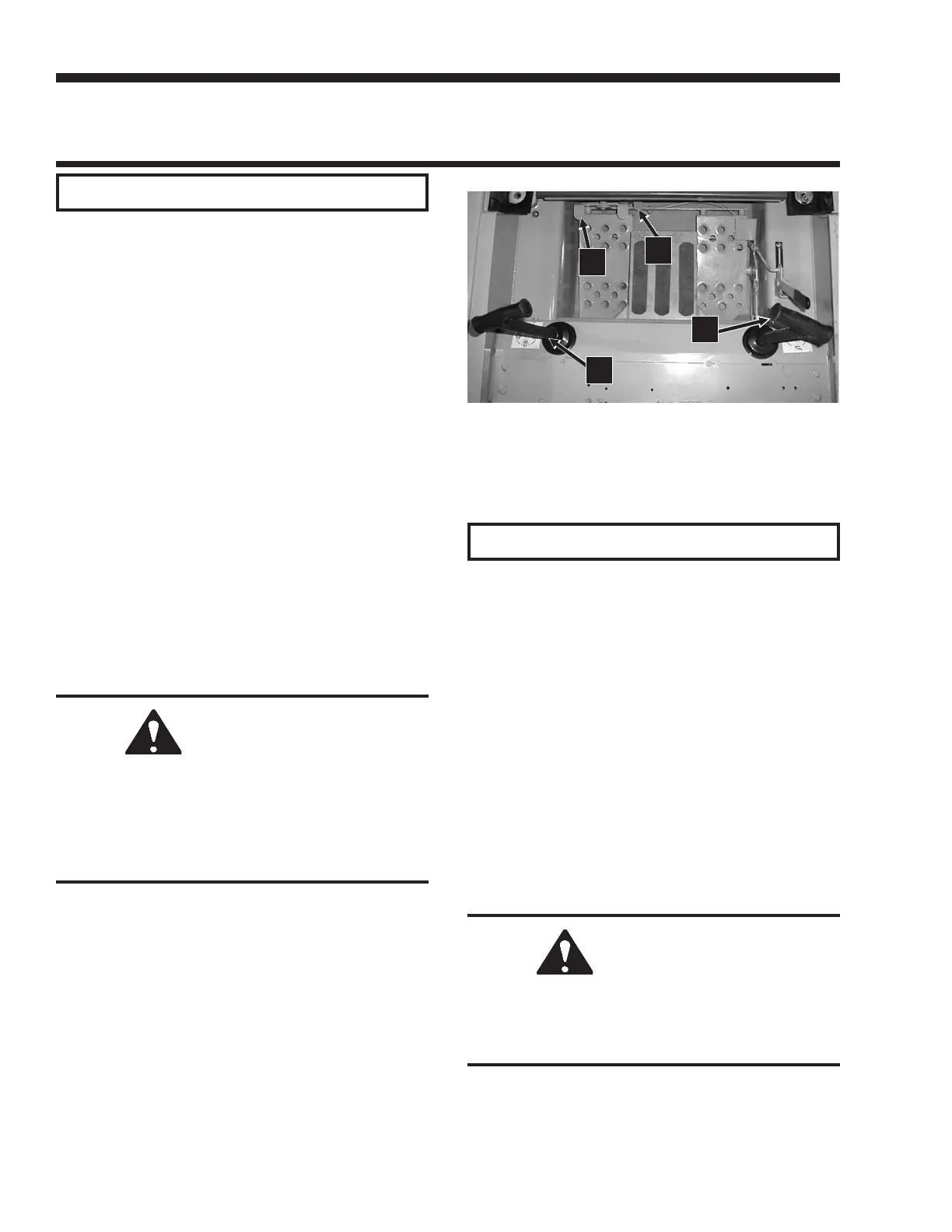
T-BAR CONTROLLED LOADERS (Fig. 5-2)
T-Bars on the skid loader control the hydraulic and hydrostatic functions. The left T-Bar controls the drive
(hydrostatics) and the right T-Bar controls the lift/tilt (hydraulics).
Drive Control T-Bar
The left T-Bar is the drive control which is linked to the
hydrostatic drives.
Forward Travel: Push the left T-Bar straight forward
(without twisting).
Reverse Travel: Pull the left T-Bar straight backwards
(without twisting).
Turning during Travel: Twist the left T-Bar
clockwise (to turn right) or counterclockwise (to turn
left) and move it slightly forward or rearward to cause a
slow gradual turn. The farther the T-Bar is moved in any
direction, the faster the turn will be made. Engine RPM
has a directly proportional affect on movement.
Fast Turning (Pivoting): Twist the left T-Bar
clockwise to cause a spin turn to the right; twist the
T-Bar counterclockwise to cause a spin turn to the left.
On a spin turn, the wheels opposite the direction of the
turn will rotate forward and the wheels on the same side
as the direction of the turn will rotate rearward.
Auxiliary Hydraulics: Depress the foot pedal to
control the direction of flow. A stop locks the foot pedal
in the “on” (detent) position for continuous use.
WARNING
BE SURE the T-Bar controls are in “neutral”
BEFORE starting the engine. Operate the
T-Bars gradually and smoothly. Excessive
speed and quick T-Bar movements without
regard for conditions and circumstances is
hazardous and could cause an accident.
Lift/Tilt Control T-Bar
The right T-Bar controls the lift (arm) and tilt
(attachment) through linkage to the main hydraulic
control valve.
Attachment Travel: Twist the right T-Bar clockwise to
tilt the attachment downward; twist it counterclockwise
to tilt the attachment up or back.
Lift Arm Travel: To raise the lift arm: Pull the right
T-Bar straight back (without twisting).
To lower the lift arm: Push the right T-Bar straight
forward (without twisting).
The system control valve lift spool has a detent circuit
allowing the lowered lift arm to “float” while traveling
over changing ground conditions. To place the lift arm
in the detent (float) position: Push the right T-Bar all the
way forward, past the detent.
WARNING
NEVER push the lift/tilt T-Bar control into the
“float” position with the bucket or attachment
loaded or raised, because this will cause the lift
arm to lower rapidly.
NOTE: The speed of lift/tilt motion is directly
proportional to the amount of T-Bar movement and
engine RPM.
907808/CP0300 22 PRINTED IN USA
Fig. 5-2: T-Bar Controls
1. Drive Control T-Bar
2. Lift/Tilt T-Bar
3. Auxiliary Hydraulics Foot Pedal
4. Auxiliary Hydraulics Foot Pedal Stop
3
4
1
2



 To Next Page