44 / 66
1436 cPos
16 General information regarding control
engineering
16.1 The control circuit
16.2 Control engineering terminology
Referencevariable(setvalue)w:
The input variable (set value) for the control circuit. The
controlled variable x should follow it with a pre-determined
dependency.
Controlledvariable(actualvalue)x:
The volumetric ow currently measured.
Controldierencexd:
The dierence between reference variable w and controlled
variable x, xd = w - x
Manipulated variable y:
Input variable for the controlled system. The process controller
guidance to the positioner regarding the position in which the
triggered control valve must be driven in order to achieve the
desired volumetric ow.
Disturbancevariablez:
An external variable that inuences the controlled system that
normally cannot be inuenced (e.g. volume ow uctuations).
16.3 Control parameters
Explanation of parameters of GEMÜ 1436 cPos:
Proc P: KP
Proc I: Tn
Proc D: KD
Proc T: Tv
Proportional band Xp:
The proportional band tells us the extent to which the
controlled variable x changes when the manipulated variable y
is adjusted.
Xp can be used to adapt the controller amplication to the
controlled system.
If a small proportional band is selected, it has a large
manipulated variable y (e.g. 20mA) as a result, i.e. the
controller reacts more swiftly and harder with a small
proportional band. If a too small proportional band is chosen,
this leads to oscillation of the control circuit.
Proportional action factor Kp:
Instead of the description proportional band, the expression
proportional-action factor K
p is used frequently.
Conversion of Xp to Kp is:
Xp=100[%]/Kp
or
Kp=100[%]/Xp
The Kp value tells us to what degree the controlled variable x
changes if the manipulated variable y is adjusted.
Kp=∆x/∆y=x2–x1/y2–y
In order to obtain a unit-independent relationship in the
equation above, x and y must be divided by their respective
maximum values (100 %).
In this case, a high K
p value results in smaller deviation.
However, if the K
p value is set too high, it leads to an increased
tendency for the control circuit to oscillate.
Derivative action time T
v:
It is used to set the intensity of the D component.
Dierentialcomponent(Dcomponent):
For an inverse controller (heating) the D component has the
following eects:
● If the controlled variable is reduced due to a disturbance
in the controlled system, the D component counteracts the
change by creating a positive regulation ratio.
● If the controlled variable increases due to a disturbance in
the controlled system, the D component counteracts this
change by creating a negative regulation ratio.
The higher the derivative action time T
v is set, the stronger the
dampening reaction.
Positioner
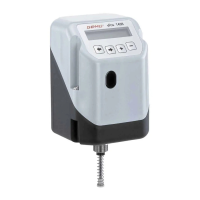
GEMÜ 1436 cPos
Flowmeter
GEMÜ 3021
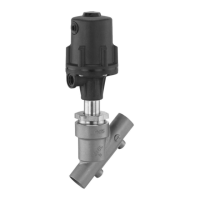
Control valve GEMÜ
Disturbancevariablez
Volumetricowuctuations
Reference variable w
Desired volumetric ow
Controlled variable x
Current volumetric ow


 To Next Page