11
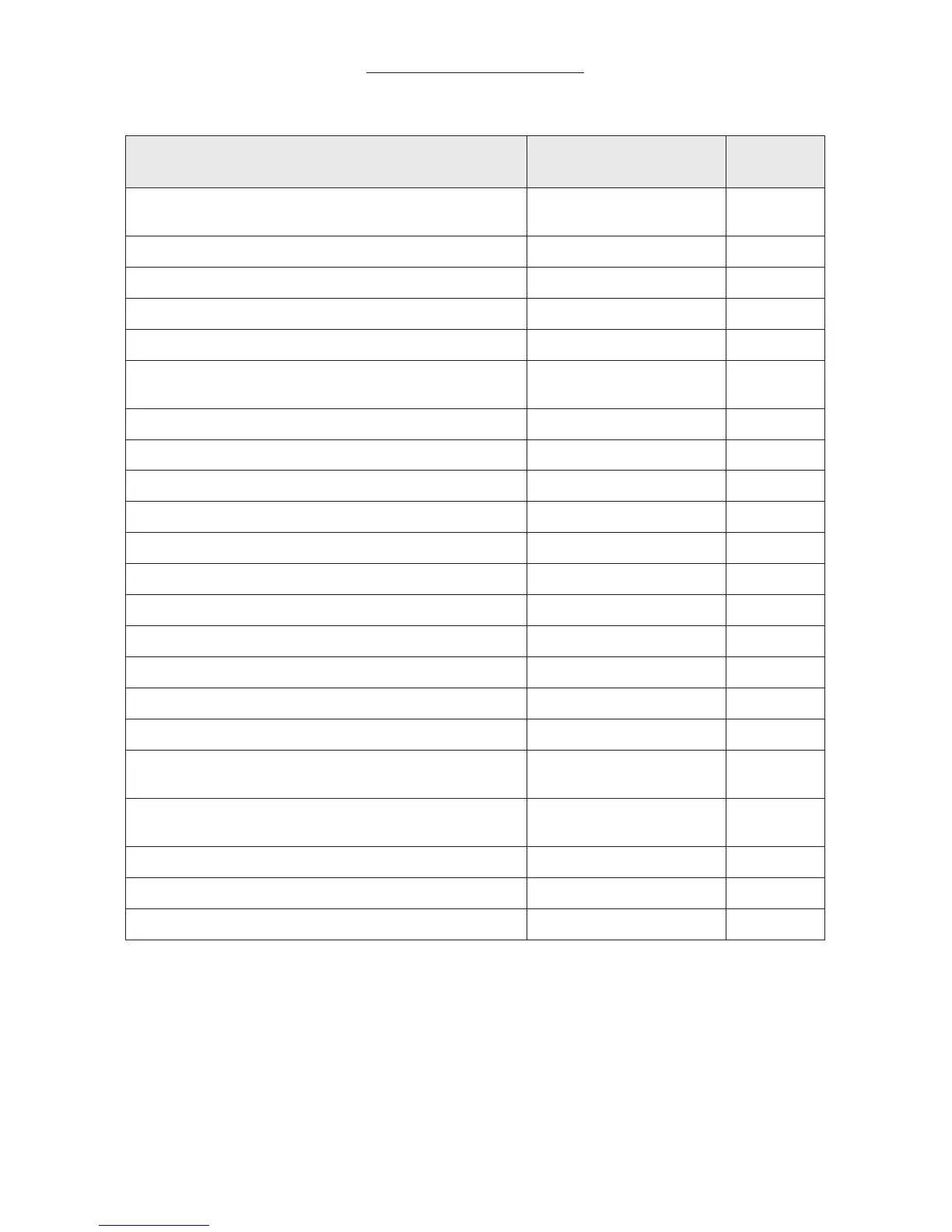
Description Parameter / Range
Factory
Setting
AC Line Input Voltage (VAC)
115 & 208/230 (±15%),
380 - 460 (±10%)
—
Input Line Frequency Range (Hz) 48 - 62 —
Output Waveform Sine Coded PWM —
Frequency Range (Hz) 0.1 - 200 60
Switching Frequency Range (kHz) 4 - 16 8
Frequency Resolution (Hz Increments)
0.1 up to 100 Hz and
1.0 from 100 Hz thru 200 Hz
—
Acceleration/Deceleration Range (Seconds) 0.1 - 999 5.0
Overvoltage Trip Point @ 230 VAC, @ 460 VAC (VAC) 290, 580 —
Undervoltage Trip Point @ 230 VAC, @ 460 VAC (VAC) 140, 280 —
Overload Rating (% for 1 Minute) 150 —
Minimum Frequency Range (Hz) 0.0 - 200 0.0
Maximum Frequency Range (Hz) 1.0 - 200 60.0
Braking Torque without Braking Resistor (%)
1
20 20
Braking Torque with Braking Resistor (%)
2
20 - 130
4
20
Operating Temperature Range (ºC) -10 to 50 —
Humidity (Relative, Non-Condensing) (%) 0 - 95 —
Maximum Vibration (G) 1 —
Output Relay Contact Rating
1 Amp @ 30 Volts DC,
250 Volts AC
—
External Analog Signal Input
0 - 10 VDC,4 - 20 mADC,
0 - 20 mADC
0 - 10 VDC
Remote Speed Potentiometer (Ω) 5k or 10k —
Analog Output Voltage (Volts DC)
3
0 - 10 —
Built-In EMC Filter Specification (“F” Suffix Models) Class A Industrial —
TABLE 2 – GENERAL PERFORMANCE SPECIFICATIONS
Notes: 1. Models KBE2-1125-P, 1150-P, 2150-P, 2101-P do not contain a braking transistor. 2. Models KBE2-
2202, 2203, 4301, 4302, and 4303 require optional brake resistor to achieve maximum braking. Maximum brak-
ing torque varies with model. 3. Proportional to the Output Frequency Upper Limit set with F06.
Sec. I – Introduction (Cont.)


 To Next Page