Description components16
Date of issue: October 2011
Automatic Greasing System OnePlus
EG1605R01
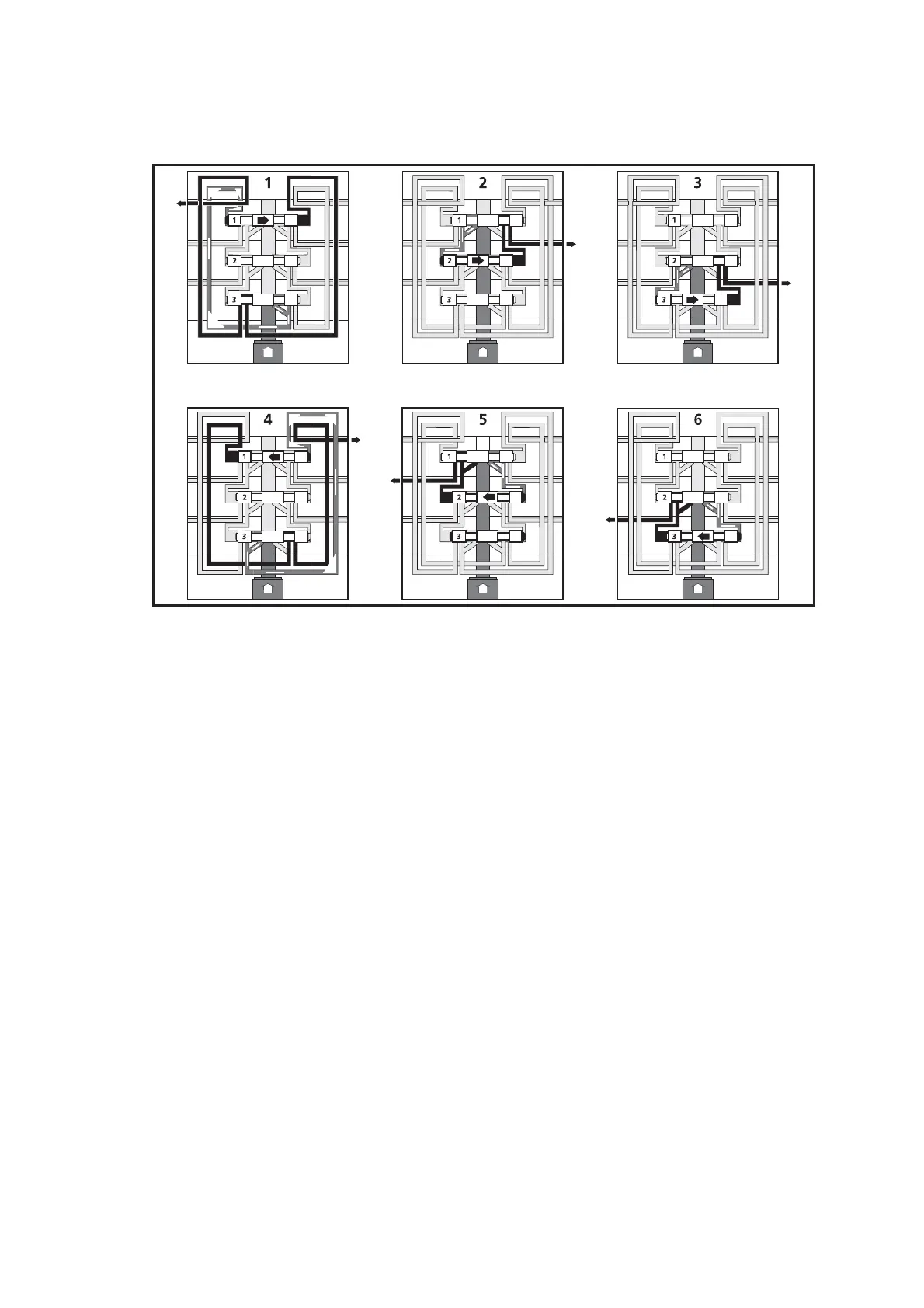
2.9.3 Principle of operation
Figure 2.7 Principle of operation.
To operate, progressive distribution blocks need no other energy source than the
grease pressure supplied by the pump of the greasing system:
1. The lubricant flows from the input port, via piston 3, through all segments to
the left-hand side of piston 1.
2. Piston 1 is pushed to the right by the grease pressure. The grease at the right-
hand side of piston 1 is pressed to output port 1.
Because piston 1 has now been pushed to the right, the lubricant now flows,
via piston 1, from the central input channel to the left-hand side of piston 2.
3. Piston 2 is then moves and supplies grease to output 2.
Because piston 2 has been pushed to the right, the lubricant now flows, via
piston 2, to the left-hand side of piston 3. Piston 3 is pushed to the right and
supplies lubricant to output port 3.
4. After piston 3 has been pushed to the right, the lubricant is pressed to the
right-hand side of piston 1. Piston 1 will move to the left and supply lubricant
to output port 4.
5. Afterwards piston 2 will also be pressed to the right and will supply lubricant
to output port 5.
6. Afterwards piston 3 will also be pressed to the right and will supply lubricant
to output port 6.
1. The distribution block then arrives back at its starting-off point, and the cycle
will repeat as long as there is pressure in the primary grease line.
Remark:
The description and illustration above assume there is a fixed starting-off
point for the doser segments in the distribution block. This is not so. The dis-
tribution block always continues from where it left-off during the previous
pump phase of the grease cycle.


 To Next Page