40
Identifying physical IRF ports on the member switches
Identify the physical IRF ports on the member switches according to your topology and connection
scheme.
Table 7 sh
ows the physical ports that can be used for IRF connection and the port use restrictions.
Table 7 Physical IRF port requirements
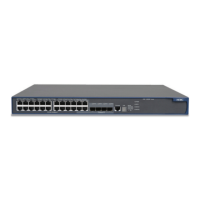
Chassis Candidate physical IRF ports Requirements
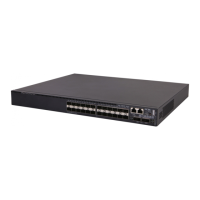
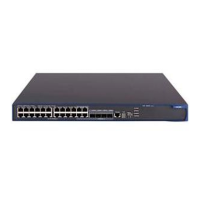
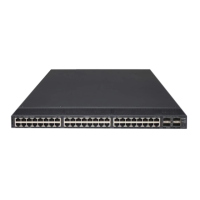
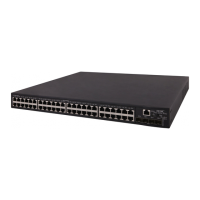
S5560X-34S-EI
S5560X-54S-EI
• Four SFP+ ports on the front panel
• Two QSFP+ ports on the rear panel
• All physical ports to be bound to an
IRF port must have the same data
rate.
• Physical ports on interface cards
and the front panel can be bound to
the same IRF port.
• If a QSFP+ port is split into four
virtual SFP+ ports, the QSFP+ port
cannot be used as a physical IRF
port.
• When a
10G/5G/2.5G/1000BASE-T
autosensing Ethernet port and a
5G/2.5G/1000BASE-T
autosensing Ethernet port
connects to establish an IRF link,
both the ports operate in 5G mode.
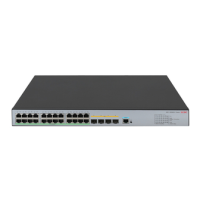
S5560X-30C-EI
S5560X-30C-PWR-EI
S5560X-54C-EI
S5560X-54C-PWR-EI
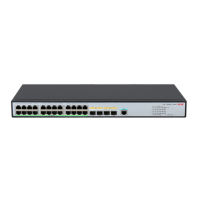
S5560X-30F-EI
S5560X-54F-EI
• Four fixed SFP+ ports on the front
panel
• Ports on the interface cards on the
rear panel:
{ 1/10GBASE-T autosensing
Ethernet ports
{ 5G/2.5G/1000BASE-T
autosensing Ethernet ports
{ 10G/5G/2.5G/1000BASE-T
autosensing Ethernet ports
{ SFP+ ports
{ SFP28 ports
{ QSFP+ ports
Planning the cabling scheme
The cables available for connecting two peer IRF physical ports vary by port type:
• 1/10GBASE-T autosensing Ethernet ports, 5G/2.5G/1000BASE-T autosensing Ethernet
ports, or 10G/5G/2.5G/1000BASE-T autosensing Ethernet ports—For the available cables,
see the relevant ports in "Appendix C Ports and LEDs."
• SFP+
ports—SFP+ transceiver modules and optical fiber or SFP+ cable. For the available
transceiver modules and cables, see SFP+ port in "Appendix C Ports and LEDs."
• SFP28
ports—SFP28 transceiver modules and optical fiber or SFP28 cable. For the available
transceiver modules and cables, see SFP28 port in "Appendix C Ports and LEDs."
• QSFP+
ports—QSFP+ transceiver modules and optical fiber or QSFP+ cable. For the
available transceiver modules and cables, see QSFP+ port in "Appendix C Ports and LEDs."
For a sh
ort-distance IRF connection in an equipment room, use a twisted-pair cable, SFP+ cable,
SFP28 cable, or QSFP+ cable.
For a long-distance IRF connection, use SFP+/SFP28/QSFP+ transceiver modules and optical
fibers.
The following subsections describe several H3C recommended IRF connection schemes. All these
schemes use a ring topology.
IMPORTANT:
In these schemes, all physical IRF ports are located on the same side. If physical IRF ports are on
different sides, you must measure the distance between them to select an appropriate cable.



 To Next Page
 Loading...