8
• The unit is not suitable for applications where the rod is subjected to permanent
and high mechanical stress (e�g� fast moving viscous media or fast flowing
media)�
• In case of operation with single probe: use preferably in metal tanks� When
used in plastic tanks, deterioration caused by electromagnetic interference may
occur (noise immunity to EN61000-6-2)�Corrective measures: (→ 7.6.4)
• When operating with a single probe and small tanks (probe lengths shorter than
200 mm and less than 300 mm distance to the tank wall), interference from the
tank (resonances) may occur in rare cases� Corrective measures: (→ 7.1)
• In case of operation with coaxial probe: not suitable for soiled or viscous media,
media containing solid particles and media prone to formation of deposit�
Maximum viscosity: 500 mPa · s
6 Function
6.1 Measuring principle
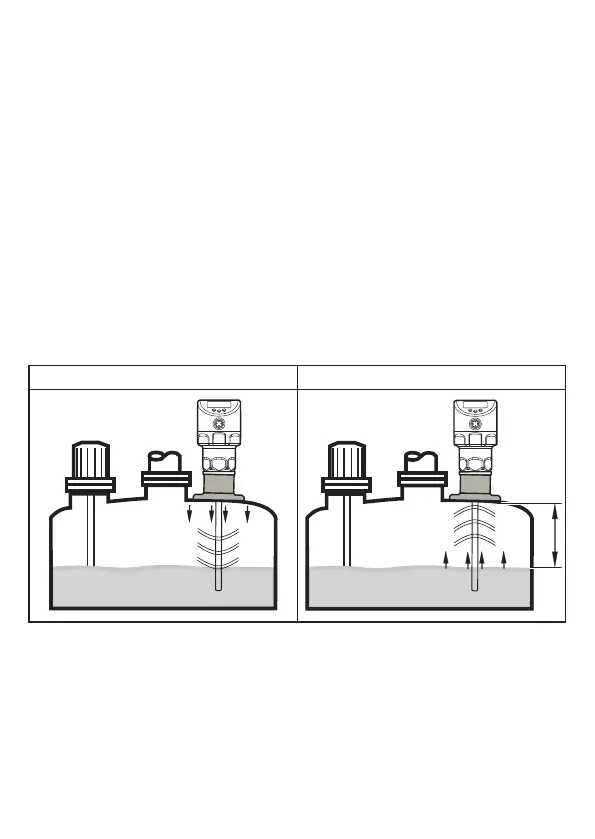
Fig. 6-1 Fig. 6-2
D
The unit operates on the principle of guided wave radar� It measures the level
using electromagnetic pulses in the nanosecond range�
The pulses are transmitted by the sensor head and guided along the rod (fig�
6-1)� When they hit the medium to be detected they are reflected and guided back
to the sensor (fig� 6-2)� The time between transmitting and receiving the pulse
directly relates to the travelled distance (D) and the current level� The reference for
distance measurement is the lower edge of the process connection�



 To Next Page