D-0116684-B – 2020/03
OtoRead™ - Instructions for Use - US Page 49
3.18.10.3 TE stimulus level
The OtoRead
TM
TEOAE protocols all use a fixed stimulus level of 80 dBSPL. This cannot be changed by the
user.
3.18.10.4
Setting the averaging time
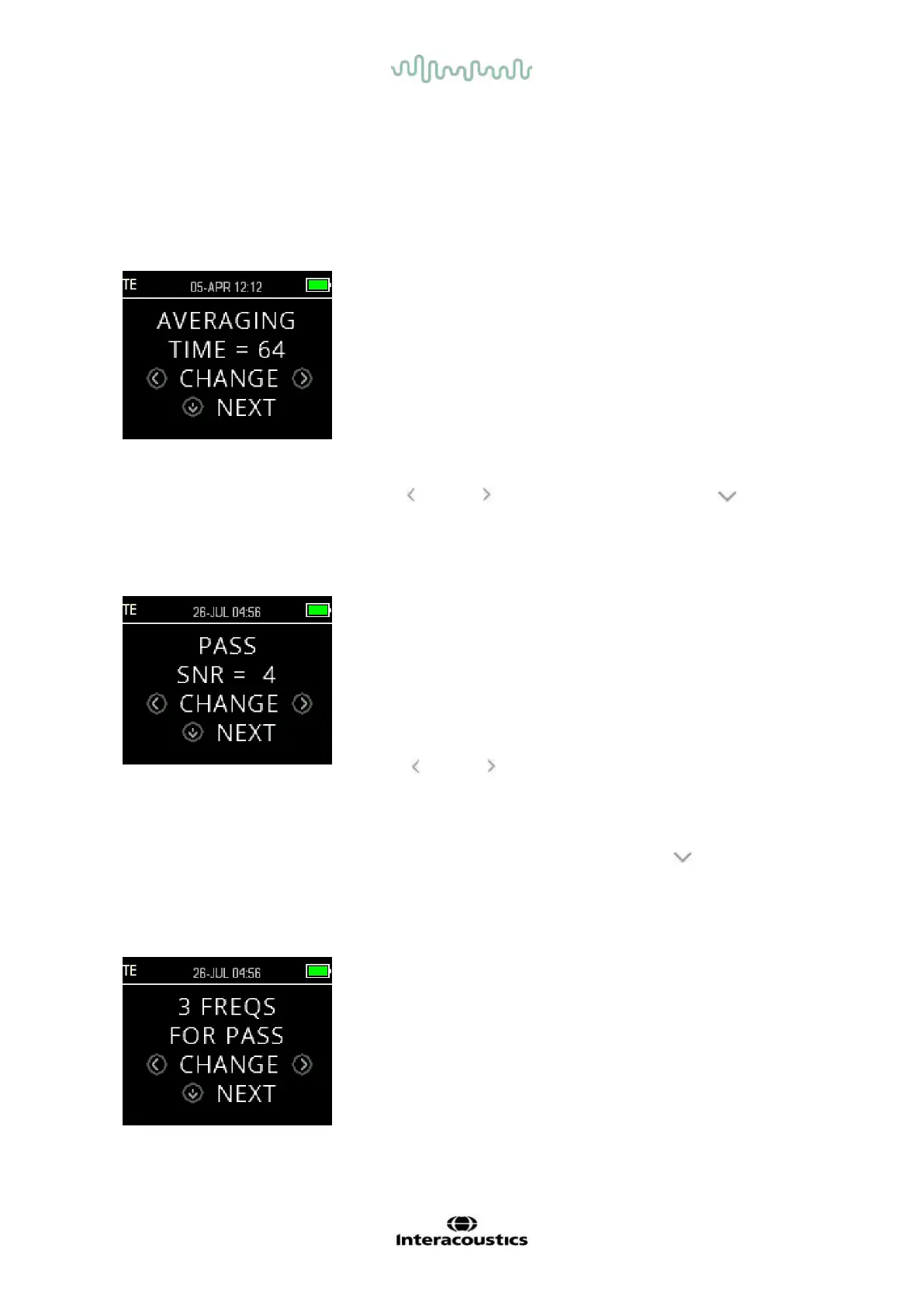
The Averaging Time for TE protocols refers to the maximum test
time. The Averaging Time can have a significant impact on the
signal-to-noise ratio (SNR) achieved and the final test outcome (e.g.,
PASS/REFER). The averaging time is independent of the probe
check process.
The possible settings for the Averaging Time are:
4, 8, 16, 32 or 64 seconds.
The test will automatically stop before the maximum test time is
reached in cases when the PASS criteria are met.
Use the CHANGE keys to select an option and the NEXT key to
go to the next test parameter.
3.18.10.5
Setting the PASS SNR level
In order to provide a PASS/REFER determination for each test, the
PASS SNR for all TE test bands must be set. This number refers to
the number of decibels that the TEOAE signal must be above the
noise to be considered as present (detected) at each frequency band.
The PASS SNR can be set between 3 – 10 dB.
A checkmark will appear above the frequency bands in cases where
the SNR and minimum value criteria are met.
Use the CHANGE keys to increase or decrease the value. This
criterion is used in combination with the number of frequencies
(discussed below) to determine an overall PASS/REFER for each
test.
After setting the desired PASS SNR, press the NEXT key to go to
3.18.10.6
Setting the number of frequencies for PASS
The number of frequencies (TE bands) for determining a PASS can
be set from 0 to 6. If the setting is on 0, then no assessment of
PASS/REFER will be made. This setting is used in conjunction with
the PASS SNR and the MIN LEVEL criteria to determine the overall
test outcome (PASS or REFER).
For example, if the MIN LEVEL is set to -10 dB, the PASS SNR is set
to 4 dB and the number of frequencies for PASS is set to 3 then the
test must contain at least 3 frequencies where the emission is at least
4 dB above the noise at a minimum level of -10 dB to indicate a
PASS.






 To Next Page