CHAPTER 2
Ethernet Ports and Connectors
•
Ethernet Connections for WLA532 Access Points on page 9
•
PoE Information for WLA532 Access Points on page 9
Ethernet Connections for WLA532 Access Points
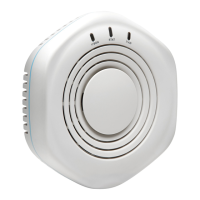
You use the RJ-45 network port on the WLA532 access point to connect the access point
to a wireless LAN controller (WLC) or to a switch in the network. The access point receives
power and data through the RJ-45 port.
The port provides a 10/100/1000 autosensing (MDI/MDX) Gigabit Ethernet connection.
You configure the connection either as a direct connection or as an indirect connection
through an intermediate Layer 2 or Layer 3 network. You use a Category 5 cable with
straight-through signaling and standard RJ-45 connectors to connect the access point
to a controller or to a Juniper Networks switch in the network.
The access point uses only Power over Ethernet (PoE) IEEE 802.3af. It can also receive
PoE power from PoE-capables witches or other Juniper Networks switches that support
PoE.
NOTE: The access points do not support daisy-chain configurations. Do not
connect one access point to another access point.
Related
Documentation
Connecting the Access Point to Wireless LAN Controllers on page 48•
• PoE Information for WLA532 Access Points on page 9
PoE Information for WLA532 Access Points
The WLA532 access point operates as a powered device within standard IEEE 802.3af
Power over Ethernet (PoE) from either mid-span or end-span power source equipment.
It also operates on IEEE 802.3af+ (54 V from power source equipment) or IEEE 802.3at
(PoE+). It responds to IEEE 802.3at discovery as an IEEE 802.3af class 3 device. The
access point operates below IEEE 802.3af standard PoE power.
9Copyright © 2012, Juniper Networks, Inc.


 To Next Page