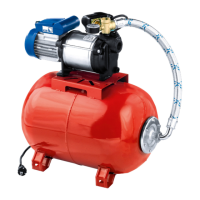
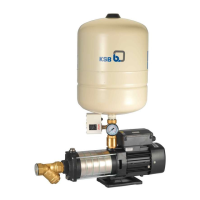
Multitec
Motor rating (kW) Max. start-ups/h
up to 3 kW 20
from 4 to 11 kW 15
from 11 to 45 kW 10
45 kW and above 5
6.2.3 Minimum Flows
If the plant configuration is such that the pump might be operated
against a closed discharge-side shut-off valve, the following
minimum flows are required during the time.
t -10 to + 100
0
C 15% of Qopt
t > 100 to 140
0
C 20% of Qopt
t > 140 to + 200
0
C 25% of Qopt
Contact KSB if exact minimum flows have to be calculated.
The minimum flows indicated above are for single pump operation
and prevent a thermal or mechanical overload of the pump. In
case of parallel operation with pumps of identical or different
design higher minimum flows may be required in some cases, to
guarantee a stable operating behavior.
6.2.4 Density of the Medium Handled
The power input of the pump will increase in proportion to the
density of the medium handled. To avoid overloading of the motor
and the pump, the density of the medium must comply with the
data specified on the purchase order.
6.3 Shutdown / Storage / Preservation
6.3.1 The pump/unit remains installed; periodic
check of operation :
In order to make sure that the pump is always ready for instant
start-up and to prevent the formation of deposits within the pump
and the pump intake area, start up the pump set regularly once a
month or once every 3 months for a short time (approx. 5 minutes)
during prolonged shutdown periods. Follow the instructions for
commissioning (see 6.1).
For pumps of materials variants 10, 20 and 21 (cast iron), longer
shutdown periods have to be avoided especially when pumping
aggressive water qualities (high oxygen content). In this case,
the pumps should be left filled and the functional run should be
made at least every two days instead of in intervals of 1 to 3
months (see also 6.1.5).
In the event of frost and/or prolonged shutdowns, the pump must
be drained and protected against freezing and corrosion. To drain
the pump, open drain plug 6B.
6.2.2 Switching Frequency
The permissible number of start-ups in a given period of time
depends on the circumstances prevailing in the plant and the
operating conditions. Overloading of the motor may generally
result in :
- an bonormal increase in motor temperature exceeding the
temperature limit of the winding or the bearing grease.
- premature coupling wear
- a reduced service life of the pump components
- irregularities or malfunctions in the plant
To prevent abnormal temperature increases in the motor and
excessive loads on the motor, coupling, pump, seals and
bearings, the switching frequency must not exceed the following
number of start-ups per hour (h).
In the case of horizontal pumps, virtually complete
drainage of the stage casings of pumps in installed
condition can only ensured by opening the plugs on the stage
casings (option). If this is not possible, it is recommended to
remove the pump and to proceed according to chap. 6.3.2.
6.3.2 The pump is removed from the pipe and stored
Before putting the pump into storage carry out all checks and
maintenance work specified in sections 7.1. Then preserve as
follows :
Drain pump as completely as possible. For vertical pumps, this
can be done by opening the dry plugs on the suction casing. For
horizontal pumps, an almost complete draining can be achieved
through the draining holes on the stage casings (option) by
opening the respective closing plug. The drainage can also
achieved by having the pump brought into vertical position with
the aid of a crane, with the suction nozzle pointing down, while
turning the rotor by hand. However, in addition, the seal chamber
still has to be drained by opening the respective drain plug.
When utilising lifting equipment, care must be taken
that the pump does not slip out of the suspension as
otherwise there is a risk of personal and material
damage! If a complete draining is not possible, it is recommended
to dismantle the pump and to dry the individual parts. Afterwards,
will the pump with a water-repellent preservative, e.g. RUSTELO
DEWATERING 924 (manufacturer CASTROL), OSYRIS DW
(manufacturer TOTAL) or equivalent. The pump shall be turned
by hand several times in order to ensure even distribution of the
preservative. Then drain the pump and close the suction and
discharge nozzle. Exposed blank metal parts are to be treated
with a suitable anti-corrosive agent.
If the pump must be preserved for a longer storage
period with KLUBERTOP K 01-601 or with another
preservative on the basis of glycol, the preservative must not be
drained. In this case, the pump must be filled completely with the
preservative for storage. The preservative has to be drained
before the pump is returned to operation. It can be re-used. Before
re-use, it should be made sure that the water content in the
preservative does not exceed 20%.
6.4 Returning to Service after Storage
Before returning the pump to service, carry out all instructions
laid down in the sections on “Commissioning” (6.1) and “Operating
Limits” (6.2).
Upon completion of the work, all safety-related and protective
equipment must be properly refitted and/or reactivated before
starting the pump set.
10



 To Next Page