Operation
3.5.3 Display Units Selection
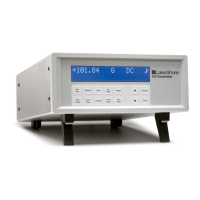
The Model 211 has a 6-character LED display. During normal operation it
can display the senor reading in temperature (kelvin, Celsius, or Fahrenheit)
or sensor units (V or ). The LEDs to the right of the keys indicate what
units are being displayed.
To select display units, continue from input curve selection (Paragraph
3.5.2) or press the Select key, use the s or t key to select ―InPUt,‖ then
press the Enter key three times. The display shows ―UnitS‖ and a LED
shows the selected display units. Use the s or t key to cycle through the
display units. When the desired unit is highlighted, press the Enter key.
3.6 ALARM SETUP AND OPERATION
The input of the Model 211 has high and low alarm capability. Temperature
reading data in kelvin can be compared to the alarm setpoint values. A
reading higher than the high setpoint or off the high end of the temperature
curve triggers the high alarm and a reading lower than the low alarm
setpoint or off the low end of the temperature curve triggers the low alarm.
NOTE: Alarm setpoints are always set in K, but the alarm feature will still
operate if the instrument displays °C or °F. If no temperature
response curve is chosen, the alarm function will not operate. Refer
to Paragraph 3.5.2 for curve selection.
If an alarm activates for the input, the display flashes between the current
reading and ―ALA K‖ or ―ALA L‖ for high and low alarms respectively.
The two relays can also be tied to alarm functions (refer to Paragraph 3.7).
Latching Alarms. Often used to detect faults in a system or experiment that
require operator intervention. The alarm state remains visible to the operator
for diagnostics even if the alarm condition is removed. Relays often signal
remote monitors or for added safety take critical equipment off line.
Pressing the Select key clears latched alarms.
Non-Latching Alarms. Often tied to relay operation to control part of a
system or experiment. The dead band parameter can prevent relays from
turning on and off repeatedly when the sensor input reading is near an alarm
setpoint. Example: If the high alarm setpoint = 100 K and the dead band =
1 K, the high alarm triggers when sensor input temperature increases to
100 K, and it will not deactivate until temperature drops to 99 K.
To begin alarm setup press the Select key and use the s or t key to select
―ALA‖ and press the Enter key. Use the s or t key to turn the alarm
function on or off. If the alarm function is powered on, the alarm will
continue with alarm setup otherwise no other settings need to be made and
the display will return to normal operation.



 To Next Page