3 Introduction
13
3.2 Theoretical principles of measurement
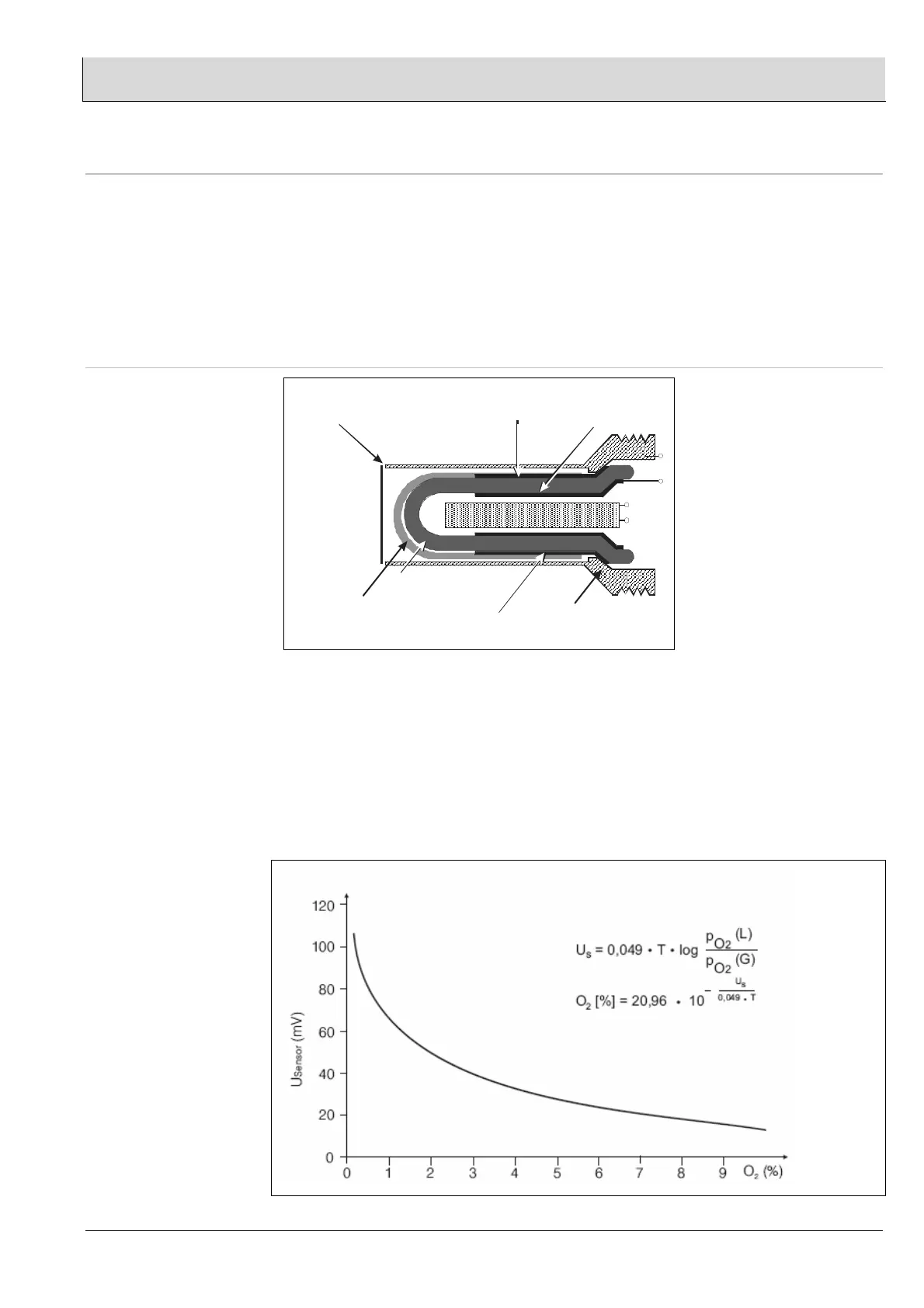
The KS1-DK combination probe basically consists of an electrochemical cell of
zirconium dioxide ceramic.
It has three electrodes:
• O
2
-sensitive platinum electrode
• CO/H
2
-sensitive electrode of a platinum/precious metal alloy
• Platinum reference electrode
3.3 Probe method of functioning - O
2
-sensitive electrode
CO/H electrode
(Pt / noble metal alloy)
2
Gas in let
Reference
electrode (Pt)
Protective coating
Zi rco niu m ox ide cer ami c
Ho usin g
O-selective
reference electrode (Pt)
2
U
S
U
H
Schematic diagram of the structure of the KS1-DK combination probe
The O
2
measuring cell functions as an electrochemical concentration cell and
generates a direct voltage, which depends upon the absolute temperature T and the
logarithm of the O
2
concentration ratio or O
2
partial pressure ratio on the reference
electrode and O
2
outer electrode.
If specimen gas is fed to the outer electrode and a reference gas with a known O
2
concentration, such as air (20.96 %), to the inner electrode, at a constant temperature
the logarithmic relationship illustrated below occurs between the probe voltage U and
the oxygen concentration of the specimen gas.
Sensor characteristic U = f (O
2
)



 To Next Page