300781172_002_C0 - 012/2019 - © Leybold 78
Appendix
13 Appendix
13.1 Theory of operation
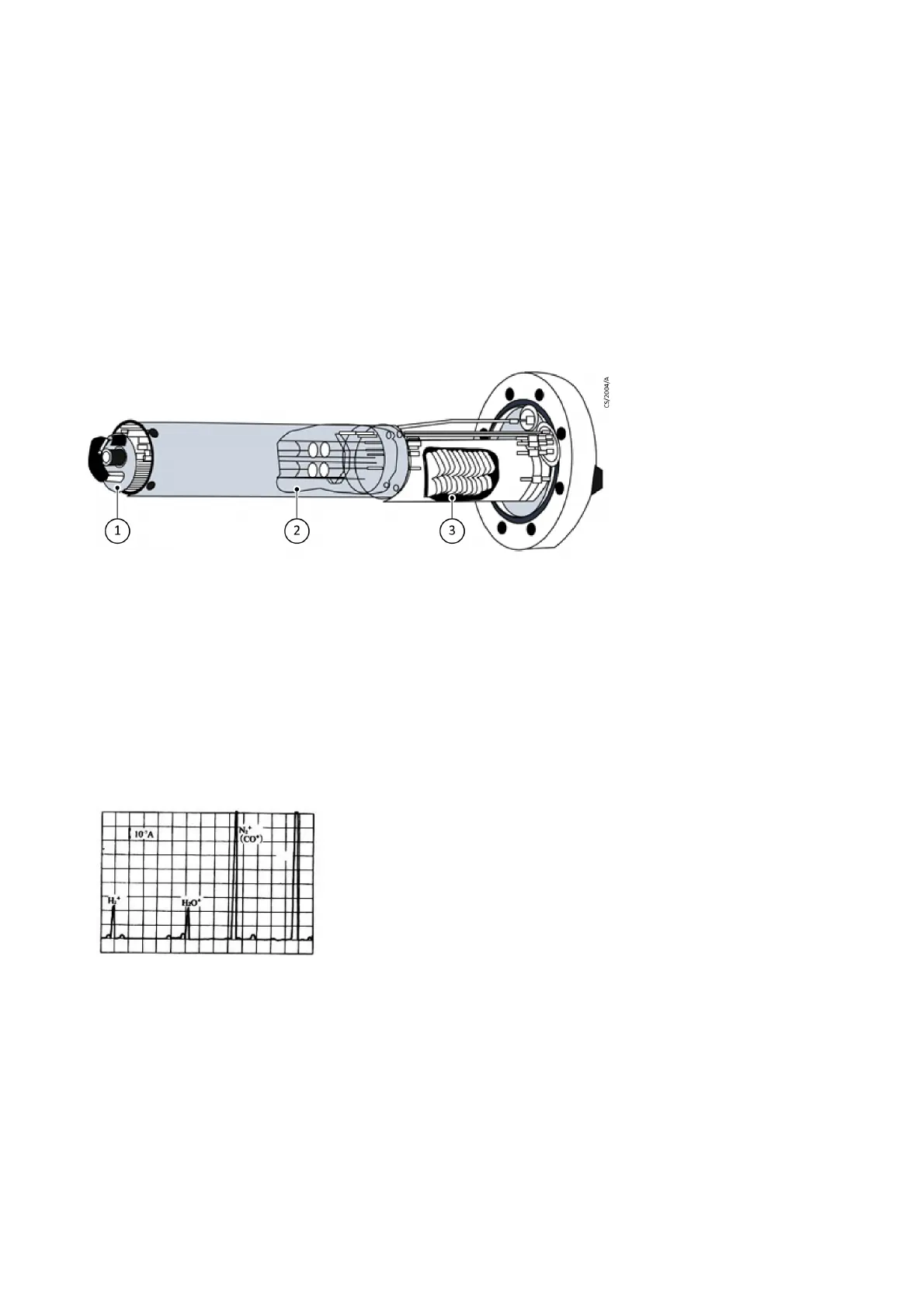
The analyzer tube of the quadrupole spectrometer consists of the ion source
section, filter section, and detector section. The mass of ions generated by the ion
source is analysed in the filter section and the ion current is measured by the
detector section.
Fig. 13.1 Structure of quadrupole spectrometer analyzer tube
1. On source
2. Filter
3. Detector
The example spectrum below shows mass/electric charge ratios. A waveform with
equal intervals is obtained for one mass. Gas composition is shown by the position
of the peaks and gas amount is related to the peak height, for example, H2 in the
position of mass number 2, H
2
O in the position of 18, N
2
in the position of mass
number 28 and Ar in the position of mass number 40.
Fig. 13.2 Example spectrum from a quadrupole spectrometer
13.2 Principles of operation
13.2.1 Ion source section
The structure of the ion source is identical to that of the hot cathode type ionization
vacuum gauge, in which thermions emitted from the filament are accelerated, and
gas molecules are ionized. In the ionization vacuum gauge, ions are collected into


 To Next Page